Bank Guarantee vs LC: How to Pick the Right Instrument

Use a letter of credit when you need a bank to actually pay on your behalf once documents match the deal. Use a bank guarantee when you need a bank to stand behind someone else's promise, paying out only if that person fails to perform. That's the whole distinction in one sentence, and almost every confused email between a trader and their relationship manager traces back to missing it.
A letter of credit (LC) puts the issuing bank in the primary seat. It commits to pay the exporter once the exporter presents documents that comply with the credit's terms, regardless of whether the buyer's business is thriving or collapsing. A bank guarantee (BG), by contrast, is a backstop. The bank only pays if the party it's backing defaults or fails to perform, and the beneficiary has to make a demand, sometimes with proof, to trigger that payment.
Two quick examples make it concrete:
- An electronics importer buying a container of components from a supplier in another country typically uses an LC. The bank checks the bill of lading, invoice, and packing list, and pays the exporter once they line up with the credit.
- A contractor bidding on a $12 million infrastructure project usually needs a bid bond or performance guarantee. The bank isn't paying for goods; it's promising the project owner compensation if the contractor walks away or performs badly.
Before signing anything, check which rulebook governs the instrument: UCP 600 for most commercial LCs, ISP98 for many standby letters of credit, and URDG 758 for demand guarantees. The rule-set changes how strictly documents get examined and how fast you get paid.
Key Takeaways
Letters of credit put the bank on the hook to pay against compliant documents, while bank guarantees only pay if the party they're backing actually defaults.
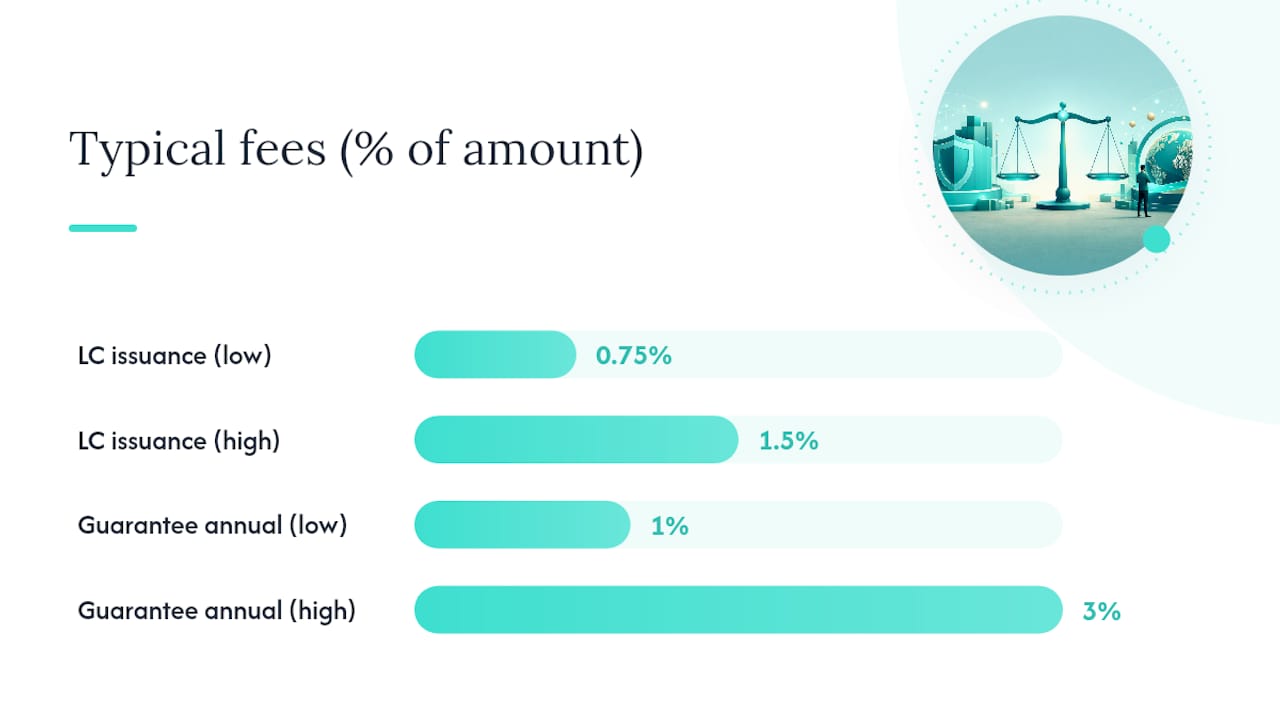
| Point | Details | | --- | --- | | Match instrument to transaction | Use an LC for goods crossing borders; use a BG for performance, bid, or advance payment protection. | | Confirm the governing rules | Ask whether UCP 600, ISP98, or URDG 758 applies before signing, since it changes examination and payout speed. | | Watch documentary discrepancies | Misaligned invoices and shipping documents are the top cause of delayed LC payments. | | Expect different fee shapes | LC issuance often runs 0.75% to 1.5% of value; guarantees often run 1% to 3% annually. | | Prepare your credit package early | Kapvoy's multi-lender submission across 30+ Singapore lenders speeds underwriting and can sharpen pricing before you approach a bank for an LC or BG. |
This article is general information, not a substitute for advice from a qualified financial advisor. Consult a qualified financial professional about your own circumstances before acting on anything here.
Table of Contents
- Bank Guarantee vs LC: The Core Definitions
- LC vs Bank Guarantee: A Side-by-Side Comparison
- Instrument Types and the Rules That Govern Them
- What Bank Guarantees and Letters of Credit Actually Cost
- How to Choose Between a Letter of Credit and a Bank Guarantee
- Preparing Your Credit Package Improves Both Speed and Price
- A Blunt Take on When Businesses Overthink This Choice
- How Kapvoy Helps You Prepare for LC and BG Financing
- Sources
Bank Guarantee vs LC: The Core Definitions
Getting the vocabulary right matters more than most people assume, because the same economic function often hides behind different names depending on which market you're in.
A commercial letter of credit is the classic trade finance tool. The issuing bank agrees to pay the beneficiary (usually an exporter) once it receives documents, like invoices, bills of lading, and certificates of origin, that comply exactly with the credit's terms. If a confirming bank adds its own guarantee to the issuing bank's promise, the exporter gets an extra layer of payment certainty, which matters when the issuing bank sits in a country with shaky banking infrastructure. Investopedia notes that this creates a primary payment obligation: the bank is expected to pay once documents comply, and not once the underlying goods actually show up in good condition.
A standby letter of credit (SBLC) looks like an LC on paper but behaves more like a guarantee in practice. It sits dormant unless the applicant fails to pay or perform, at which point the beneficiary draws on it by presenting a compliant demand. The ICC Academy's guide to standby letters of credit points out that SBLCs are economically close to demand guarantees, but the governing rules can differ, and regional habits differ even more: SBLCs dominate in the Americas, while demand guarantees are the default instrument across Europe, Asia, and the Middle East.
A demand guarantee, often called a first-demand guarantee, pays out when the beneficiary submits a compliant written demand, sometimes with a supporting statement of default, but without needing to prove the underlying breach in court. A conditional guarantee requires more, typically documentary evidence or even an arbitral award confirming the applicant actually failed to perform. Banks and corporates almost always prefer demand guarantees because conditional guarantees drag disputes into slow-moving legal proceedings before anyone gets paid.
Within the guarantee family, three subtypes come up constantly:
- Performance guarantees back a contractor's obligation to complete work to spec, common in construction and manufacturing contracts.
- Advance payment guarantees protect a buyer who pays a deposit upfront, ensuring the money comes back if the seller never delivers.
- Bid bonds protect a project owner running a tender, covering the cost of re-tendering if a winning bidder withdraws.
Both LCs and guarantees rely on what lawyers call the independence principle. The bank's payment obligation stands apart from the underlying sale or construction contract. If the goods arrive damaged or the building has cracks in the foundation, that's a dispute between buyer and seller, not a reason for the bank to withhold payment on a compliant LC or a valid demand under a guarantee. That independence is exactly why banks demand a counter-indemnity from the applicant before issuing either instrument. The bank is fronting risk, and it wants a contractual right to recover every dollar it pays out.
Pro Tip: If a supplier or buyer mentions an "SBLC" and you operate outside the Americas, ask explicitly which rule-set governs it. The label alone doesn't tell you whether it behaves like ISP98 standby paper or a URDG 758 demand guarantee, and that difference changes how fast you get paid.
LC vs Bank Guarantee: A Side-by-Side Comparison
The cleanest way to separate these instruments is to walk through the practical mechanics that actually decide who gets paid, how fast, and under what evidence.
What triggers payment is the sharpest dividing line. An LC pays when the beneficiary presents documents, invoices, transport documents, inspection certificates, that comply strictly with the credit's terms. Banks examine paper, not performance. A bank guarantee pays when the beneficiary makes a demand asserting the applicant defaulted, and depending on whether it's a demand guarantee or conditional guarantee, that demand may need supporting proof or may stand on its own.
Who's protected, and who pays first, also differs. Under an LC, the exporter (beneficiary) gets paid by the bank directly once documents check out; the importer (applicant) reimburses the bank afterward. Under a guarantee, the beneficiary, often a project owner or buyer, only collects if something goes wrong, and the applicant's bank then chases the applicant for reimbursement under the counter-indemnity.
Documentation and examination risk cut in opposite directions. LCs are notorious for discrepancies. A misspelled company name, a bill of lading dated one day outside the credit's window, or a missing signature can all trigger a rejection, forcing renegotiation between the parties even though the underlying shipment is perfectly fine. Guarantees flip that risk: the paperwork to make a demand is usually thin, but the beneficiary carries the burden of proving default exists if the guarantee is conditional rather than payable on first demand.
Cost structure tracks risk exposure and tenor. Trade Finance Global reports that LC issuance fees commonly run 0.75% to 1.5% of the credit value, with confirmation adding further cost when a second bank backs the credit. Bank guarantees tend to carry annual fees in the range of 1% to 3% of the guaranteed amount, scaling with the applicant's credit profile and how long the guarantee stays open. A guarantee left in place for three years on a long construction project accumulates fees very differently than a 90-day LC covering a single shipment.
Speed and dispute patterns follow from the trigger mechanism. A compliant LC presentation typically gets paid within days once the bank finishes document examination, since the independence principle removes most legal ambiguity. A bank guarantee claim can move just as fast if it's a straightforward first-demand instrument, but conditional guarantees or guarantees facing an injunction application (where the applicant argues fraud to block payment) can stretch into weeks or months of legal wrangling.
Here's how the two stack up across the axes that actually matter when you're deciding:
| Factor | Letter of Credit | Bank Guarantee | | --- | --- | --- | | Trigger/activation | Compliant documentary presentation | Demand (with or without proof of default) | | Primary purpose | Ensures seller gets paid for goods/services | Protects beneficiary if applicant defaults or underperforms | | Typical use case | Import/export, international trade | Construction, bids, performance, advance payments | | Documentation requirement | Strict document set defined in the credit | Demand statement, sometimes with default evidence | | Governing rules | UCP 600 (commercial), ISP98 (standby) | URDG 758 (most common), sometimes ISP98 | | Cost/fee structure | Roughly 0.75% to 1.5% of credit value | Roughly 1% to 3% annually of guaranteed amount | | Time to issue/resolve | Days once documents are compliant | Fast if first-demand; slower if conditional or contested |
The pattern that jumps out: LCs reward precision in paperwork, and guarantees reward precision in contract drafting up front, because that's what determines how easily a beneficiary can make a valid claim later.
Instrument Types and the Rules That Govern Them
Every LC and guarantee lives under a rulebook, and that rulebook decides how strictly your bank examines a claim, how fast it pays, and what recourse the applicant has if something looks wrong.
On the letter of credit side, four variants come up in day-to-day trading:
- Commercial LC: the standard trade instrument, paying against shipping and commercial documents.
- Confirmed LC: a second bank, usually in the exporter's own country, adds its payment guarantee on top of the issuing bank's, useful when the issuing bank's home market carries political or currency risk.
- Usance (deferred payment) LC: payment happens a set number of days after document presentation, effectively giving the buyer trade credit.
- Transferable LC: lets the original beneficiary transfer rights to a second beneficiary, common when a trading company sits between the manufacturer and the end buyer.
On the guarantee side, the working vocabulary splits into:
- Demand (first-demand) guarantees: pay on a compliant written demand alone, no proof required.
- Conditional guarantees: require documentary or judicial evidence that default actually occurred.
- Performance guarantees: cover contract execution quality and completion.
- Advance payment guarantees: protect deposits paid before work begins.
- Bid bonds: protect a tender process against a winning bidder backing out.
The rule-sets themselves aren't interchangeable. UCP 600 governs most commercial letters of credit and sets out how banks examine documents, generally on a strict compliance standard where even minor mismatches can justify rejection. ISP98 was written specifically for standby letters of credit and takes a somewhat more flexible view of what counts as a compliant presentation, reflecting the fact that standbys are meant to sit dormant rather than get triggered on routine trade flows. URDG 758 governs demand guarantees and, according to the ICC Academy's guide, was built to normalize demand guarantee practice globally, since guarantee law historically varied enormously from one jurisdiction to the next.
Insist a guarantee reference a recognized rule-set wherever possible. Without one, you're relying on whatever domestic guarantee law happens to apply in the issuing bank's jurisdiction, and that can vary wildly on questions as basic as how independence and fraud exceptions work.
That advice matters more than it sounds. A guarantee silent on governing rules leaves both sides guessing how a court will treat a fraud allegation, an injunction request, or an ambiguous demand. Naming URDG 758 or a specific national law up front removes that guesswork before a dispute ever starts.
One regional quirk worth flagging: the same economic instrument gets called different things depending on where you're trading. What one bank calls a "standby letter of credit" in Singapore might be functionally identical to what a European counterparty calls a "demand guarantee." Never assume the label tells you the governing rules. Ask directly, and get it confirmed in writing.
What Bank Guarantees and Letters of Credit Actually Cost
Fees for both instruments move with three variables: the applicant's creditworthiness, the tenor (how long the instrument stays open), and whether a second bank has to confirm or counter-guarantee the deal.
- Issuance fees. Trade Finance Global's figures put LC issuance costs around 0.75% to 1.5% of the credit value, while bank guarantees commonly run 1% to 3% annually of the guaranteed amount. A guarantee open for two years on a large project accumulates cost differently than a one-off shipment LC, so tenor matters as much as the headline percentage.
- Confirmation and country risk premiums. If your exporter insists on a confirmed LC because the buyer's bank sits in a higher-risk jurisdiction, expect an additional confirmation fee layered on top of the base issuance cost.
- Underwriting and collateral steps. Before issuing either instrument, banks run credit checks on the applicant, route the request through internal credit approval, and typically require some form of collateral or a signed counter-indemnity agreement. Investopedia confirms that this underwriting step, and the fee that comes with it, scales directly with applicant risk and the instrument's tenor.
- Issuance and payment timelines. A straightforward LC can be issued within a few business days once the applicant's credit line is confirmed, and payment on a compliant presentation typically follows within days of document examination. A demand guarantee claim, if it's a clean first-demand instrument, can resolve almost as quickly; a conditional guarantee facing a dispute can stretch into weeks.
- Operational risk points. Documentary discrepancies remain the single biggest source of delay on LCs, since even a trivial mismatch between the bill of lading and the credit terms can trigger a rejection cycle. On the guarantee side, fraud and forgery claims, along with cross-border enforcement questions when the applicant and beneficiary sit under different legal systems, cause the most friction.
Pro Tip: Align your invoice, packing list, and shipping documents word-for-word with the LC's stated terms before you ship anything. Discrepancy-driven rejections are the most common, and most avoidable, reason LC payments stall.
Because a bank guarantee typically requires a counter-indemnity, it functions as a contingent liability on the applicant's balance sheet even before any claim is made. Lenders and auditors treat an open guarantee as a real exposure, not a footnote, which is worth remembering if you're stacking several guarantees across active contracts at once.
How to Choose Between a Letter of Credit and a Bank Guarantee
Run through this checklist before you brief your bank or your counterparty, and you'll cut the back-and-forth down to a single conversation instead of three.
- Identify the transaction type first. Are you paying for goods that need to move across a border, or are you protecting against a counterparty failing to perform on a contract? Goods movement almost always points to an LC; performance risk points to a guarantee.
- Check what evidence you can realistically produce. If you can guarantee clean shipping documents and tight invoice matching, an LC works in your favor. If proving default would be messy or slow, push for a first-demand guarantee rather than a conditional one.
- Gauge the counterparty's risk appetite. A cautious buyer may insist on a confirmed LC from a bank in their own country. A project owner running a competitive tender will almost always demand a bid bond before shortlisting you.
- Weigh how fast you need certainty. LCs deliver payment quickly once documents comply. Guarantees deliver certainty upfront (the beneficiary knows the money is there) but claim resolution speed depends entirely on whether it's demand or conditional.
- Confirm enforceability across jurisdictions. If applicant and beneficiary sit in different countries, ask which country's courts would hear a dispute and whether the guarantee names URDG 758, ISP98, or a specific national law.
When you brief your bank, ask these questions directly: Which rule-set governs this instrument? Is confirmation available, and at what added cost? What collateral or counter-indemnity will you require from me? What's your realistic turnaround time for issuance? Exactly which documents will you need to see before you'll pay a claim?
Treat a few answers as red flags. A bank that can't tell you which rule-set applies, that won't put estimated fees in writing, or that quotes a turnaround time measured in weeks rather than days for a routine LC is worth pushing back on, or shopping elsewhere. If you're preparing paperwork for either instrument, a tight SME loan documents checklist helps you assemble the financials and supporting records banks want to see before they'll even quote a fee.
Pro Tip: Ask your bank for their standard turnaround benchmark on both instruments before you sign a sales contract with a payment deadline attached. A seller who promises 30-day LC payment terms is making a promise your bank, not you, actually has to keep.
As a fast scenario guide: importing physical goods, use an LC. Bidding on a construction tender, use a bid bond. Running a multi-year performance contract, use a demand guarantee under URDG 758. Paying a supplier a deposit before production starts, use an advance payment guarantee.
Preparing Your Credit Package Improves Both Speed and Price
Every bank issuing an LC or guarantee runs the same underwriting exercise: it checks the applicant's creditworthiness, confirms available collateral, and decides how much risk it's comfortable carrying before it commits its own balance sheet. How well-prepared that credit package is has a direct, measurable effect on both the fee you get quoted and how fast the instrument gets issued.
Kapvoy works across a panel of more than 30 banks and non-bank lenders in Singapore, and the pattern shows up consistently: businesses that walk in with clean financials, a clear use of funds, and matching commercial documentation get faster underwriting decisions and often sharper pricing than those submitting incomplete packages one lender at a time.
A few things consistently move the needle when preparing for an LC or BG application:
- Matching invoice and contract terms exactly to what the instrument will require, since discrepancies are the leading cause of delay on both sides.
- Having recent financial statements and cash flow projections ready before approaching a bank, rather than scrambling once a deal deadline is already ticking.
- Submitting to multiple lenders in parallel rather than sequentially, which shortens the overall time to a usable answer instead of waiting on one bank's internal committee before trying another.
- Understanding collateral expectations upfront so you're not renegotiating terms mid-process when a bank asks for security you hadn't planned to offer.
None of this changes the underlying mechanics of an LC or a guarantee. It changes how fast a bank says yes, and at what price.
A Blunt Take on When Businesses Overthink This Choice
Most of the confusion around bank guarantee vs LC decisions doesn't come from the instruments themselves. It comes from businesses treating the choice as more open-ended than it actually is. In practice, the underlying transaction almost always tells you which instrument fits. Buying goods that need to cross a border points to an LC nearly every time. Protecting against a counterparty's non-performance points to a guarantee nearly every time. The real decisions worth agonizing over are the details inside each instrument, not the choice between them.
Where businesses genuinely lose money is skipping the governing-rules conversation. A guarantee that never names URDG 758 or a clear governing law is a guarantee where nobody quite knows what happens if a fraud allegation shows up mid-claim. That's not a hypothetical; it's the single most common source of drawn-out guarantee disputes.
My default advice: for straightforward trade in goods, ask for an LC under UCP 600 and get documents matched before you ship. For anything involving performance risk, insist on a first-demand guarantee referencing URDG 758 rather than a conditional one, since conditional guarantees turn a payment instrument into a legal proceeding. Confirm which bank will actually confirm the instrument, and never assume a label like "SBLC" tells you the whole story without asking which rules sit behind it.
How Kapvoy Helps You Prepare for LC and BG Financing
Getting a letter of credit or bank guarantee approved quickly comes down to one thing: how ready your credit package looks the moment it lands on an underwriter's desk. Kapvoy is the alternative to walking into a single bank and hoping their appetite matches your timeline. Instead, Kapvoy compares your profile against more than 30 banks and non-bank lenders in Singapore at once, submitting your application in parallel rather than one rejection at a time.
That matters most when a deal has a deadline attached, a shipment waiting on an LC, a tender requiring a bid bond within days. Kapvoy charges nothing upfront, no consultation fee, no retainer, and only takes a fee once financing is actually disbursed. If you're assembling the documentation a bank will want before issuing a guarantee or standby credit, start with a free eligibility check to see which lenders on the panel fit your business profile, or browse Kapvoy's full range of financing options to see what fits your transaction before you approach a bank directly.
Sources
- ICC Academy — Comprehensive guide to standby letters of credit (PDF)
- Trade Finance Global — Difference between LCs and bank guarantees
- Investopedia — Difference between bank guarantee and letter of credit