5 Questions That Decide Bridge or Term Loan for SMEs & Investors

Choose a bridging loan when you have a short, time-sensitive gap with a defined exit, like a sale or a lined-up refinance, and choose a term loan when you need durable, lower-cost financing repaid over years from operating income. Most borrowers who get this wrong pick bridging finance without a locked exit or a term loan when speed matters more than rate. A broker can help you run either path, and often both in sequence.
TL;DR:
- A bridging loan is suitable for short-term needs with a clear exit plan, typically funding within one to four weeks, but it costs more on a monthly basis.
- A long-term, amortizing term loan takes longer to approve, relies on your income, and is best suited for stable, ongoing financing needs over several years.
- Borrowers should time their exit strategy carefully and secure it before drawing a bridging loan to avoid default or extension penalties.
- Comparing absolute costs over the actual holding period reveals that short-term bridging costs can be lower than long-term loans if the exit occurs quickly.
- Many successful borrowers use bridging as a first step and refinance into a cheaper, stable term loan once the initial urgent need is met.
Table of Contents
- Bridging vs Term Loan: What a Bridging Loan Actually Is
- Bridging vs Term Loan: What a Term Loan Actually Is
- Bridging Loan vs Term Loan: A Head-to-Head Comparison
- How to Decide Between Bridging Finance and a Term Loan
- Comparing the Real Dollar Cost of Bridging vs Term Loans
- Risks and How to Protect Yourself on Either Loan
- Case Studies: How Borrowers Fared With Each Loan Type
- Our Take: Why the Bridge-Or-Term Debate Misses the Point
- Getting Both Loans Right With Kapvoy
- Sources
Bridging vs Term Loan: What a Bridging Loan Actually Is
A bridging loan is short-term, asset-focused financing. The lender cares less about your monthly cash flow and more about what the asset is worth and how confident you are that you can repay it fast, usually through a sale, a refinance, or another planned receipt. Terms commonly run 1 to 12 months, occasionally stretching to 24 months, with interest-only, roll-up, or balloon repayment structures rather than the amortizing payments you'd see on a mortgage.
You'll typically see bridging finance used for:
- Property auctions where you need funds within days, not weeks
- A quick acquisition before a competing buyer closes first
- Refurbishment projects where the property isn't yet mortgageable
- Covering a gap between selling one asset and closing on another
Pro Tip: Never take a bridge without already knowing exactly how you'll repay it. "I'll figure out the exit later" is the single most common reason bridging deals go wrong.
Bridging vs Term Loan: What a Term Loan Actually Is
A term loan is long-term, amortizing financing built for stability, not speed. Underwriting here looks at your income, your affordability ratios, and your ability to service the debt for years, not just the value of one asset. Expect multi-year repayment schedules with monthly principal and interest, and a choice between fixed and variable rates depending on the lender.
Because underwriting digs into financial statements, tax filings, and cash-flow projections, term loans generally take longer to close than bridging finance. Term loans tend to fit:
- Buying equipment or machinery you'll use for years
- Funding a long-term property hold or business expansion
- Refinancing expensive short-term debt into something cheaper and stable
The trade-off is patience for a much lower cost of capital over the life of the loan.
Bridging Loan vs Term Loan: A Head-to-Head Comparison
The two products solve opposite problems, and the numbers make that obvious once you line them up.
| Dimension | Bridging Loan | Term Loan | |---|---|---| | Purpose / best use | Short, time-sensitive gap with a defined exit | Permanent financing for a stable, long-term need | | Typical term / duration | 1 to 12 months, occasionally up to 24 | Multiple years, amortized on a fixed schedule | | Speed to fund / approval | Often 1 to 4 weeks | Commonly 1 to 3 months | | Typical cost profile | Higher monthly rate plus origination points | Lower annualized rate, smaller arrangement fees | | Repayment structure | Interest-only, roll-up, or balloon at exit | Monthly principal and interest over the term | | Eligibility / underwriting focus | Asset value and exit certainty | Income, affordability, long-term cash flow |
Speed is the entire reason bridging finance exists. Bridging loans typically fund within one to four weeks, while term loans commonly need one to three months for full underwriting and closing. If your deal falls apart without funds in the next two weeks, a term loan simply isn't in the running, no matter how attractive its rate looks on paper.
Cost runs in the opposite direction. Bridge loans generally cost more on a monthly basis and include origination or arrangement fees, while term loans carry a lower annualized rate in exchange for a longer, more document-heavy approval process. That's not a flaw in bridging finance. It's the price of speed and flexible underwriting.
The underwriting logic explains why. Bridge lenders underwrite the asset and the exit plan; term lenders underwrite your income and your ability to carry the debt over years. That single distinction decides which documents a lender asks for, how fast they can say yes, and how much risk they price into the rate.
Three practical differences follow from that:
- Exit dependence. A bridge only works if the exit, sale, refinance, or receivable, actually lands on time. A term loan doesn't depend on any single future event; it's repaid from ongoing operations.
- Documentation load. Term loans ask for financial statements, tax returns, and projections. Bridges lean more heavily on valuation reports and proof of the exit.
- Renewal risk. A bridge that overruns its term usually triggers extension fees or default clauses. A term loan simply continues its amortization schedule.
None of this makes one product "better." It makes them suited to different moments in the same business or property strategy, which is why many borrowers use a bridge to move fast and then refinance into a term loan once the dust settles.
How to Decide Between Bridging Finance and a Term Loan
Run through this checklist before you apply for either product:
- How fast do you actually need funds? If the answer is under a month, bridging finance is likely your only realistic option.
- How certain is your exit? A signed sale contract or a pre-approved refinance is a real exit. A hopeful market forecast is not.
- What does the loan do to your monthly cash flow? Bridge repayments are often interest-only or deferred, but the balloon payment at the end needs a real source.
- What's your loan-to-value or equity position? Lower leverage gives you more room if the exit slips by a few weeks.
- Is your documentation ready now? Term loans move faster when your financials are already clean and current.
When you talk to a lender or a broker, ask directly:
- What's your realistic funding timeline for a file like mine, not your best-case number?
- What fees apply if my exit is delayed by 30 or 60 days?
- Will you give conditional pre-approval on the refinance before I draw the bridge?
- What assumptions are you making about my exit, and what happens if they don't hold?
Treat these as red flags: no concrete exit strategy, a plan that depends entirely on the market moving your way, or no contingency capital if the timeline slips. Finance professionals generally advise locking the refinance or buyer before the bridge funds even disburse, not after.
Pro Tip: If you already know a bridge will end in a refinance, start that refinance conversation on day one, not day 60. Lenders move faster when the exit is already half-arranged.
Comparing the Real Dollar Cost of Bridging vs Term Loans
Bridge lenders usually quote pricing monthly, sometimes as a monthly percentage plus upfront points, while term lenders quote an annual rate. Comparing those two numbers side by side without converting them is how borrowers talk themselves into the wrong product.
The fix is to calculate total expected dollar cost over your actual hold period, not the headline rate. A bridge that looks expensive at a glance may cost less in absolute dollars than a term loan if you only need the money for three months. Run the reverse case too: a bridge rolled over multiple times because the exit slipped can quietly cost more than a term loan would have from day one.
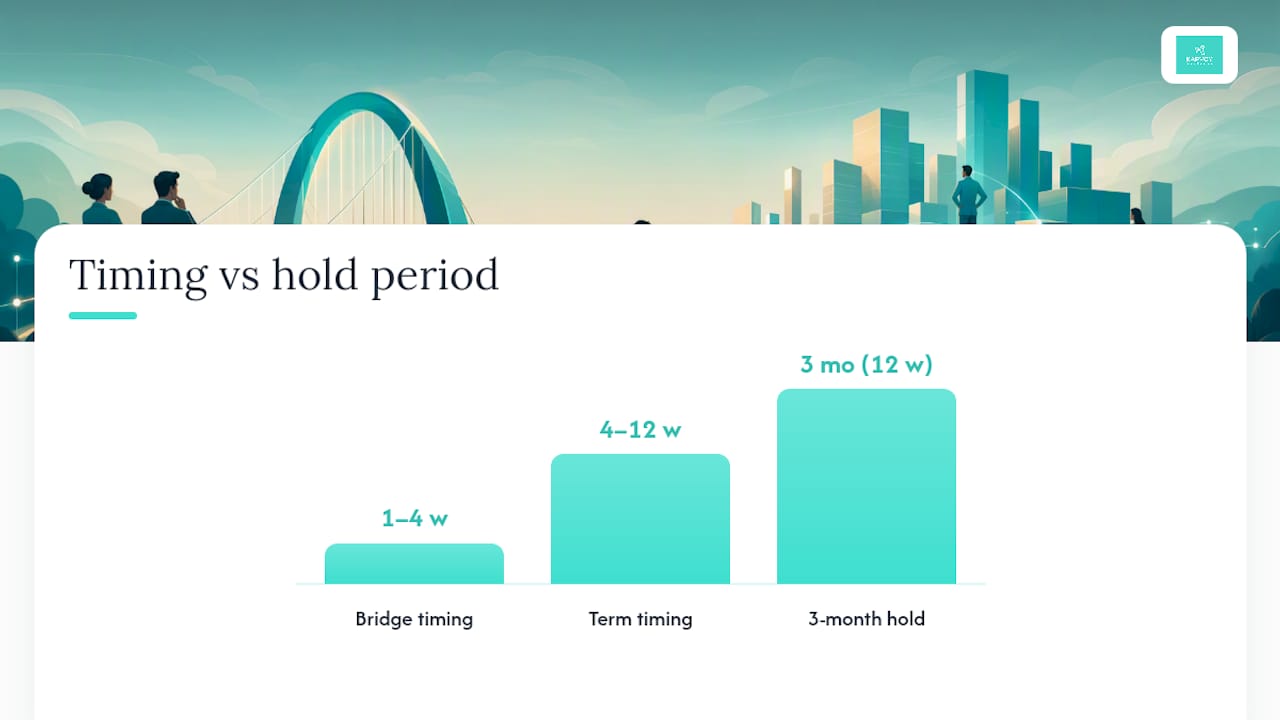
Bridge loans typically carry higher short-term costs while term loans carry lower annualized rates but a longer underwriting runway, and that timing gap, often 1 to 4 weeks for a bridge versus 1 to 3 months for a term loan, is exactly what you're paying the premium for.
A few tactics reduce that premium in practice:
- Lock your exit before applying; lenders price uncertainty, not just risk
- Negotiate arrangement fees and origination points, which move more than the headline rate suggests
- Ask about staged draws instead of drawing the full facility upfront, which cuts the interest clock on unused funds
Negotiation on fees and structure tends to move further in brokered deals, since lenders are competing for a file with a credible exit plan attached to it rather than negotiating with a single applicant one-on-one.
Risks and How to Protect Yourself on Either Loan
The biggest risk with bridging finance is a failed exit secured with collateral assignment life insurance. If the sale falls through or the refinance doesn't close on schedule, you're left holding a short-term facility with no way to repay it, often facing extension penalties or default exposure. Rising rates and valuation drops between application and exit compound that risk, especially on property deals where market timing isn't fully in your control.
Term loans carry a quieter risk: overcommitting to years of fixed monthly payments before your income is stable enough to support them.
Protect yourself with a few concrete steps:
- Arrange the refinance or buyer before you draw the bridge, not after
- Assume a more conservative loan-to-value than the lender's maximum, so a valuation dip doesn't wipe out your margin
- Negotiate extension terms upfront, so a short delay doesn't trigger default
- Keep contingency capital equal to at least one extra month of bridge interest
Pro Tip: If you can't answer "what happens if my exit is 60 days late" with a specific plan, that's your signal to decline the bridge and look at a term loan instead.
Case Studies: How Borrowers Fared With Each Loan Type
A property investor who won a unit at auction needed funds within two weeks or forfeited the deposit. A term loan's one to three month underwriting window made that impossible, so the investor used a bridge, renovated the unit over four months, then refinanced into a term loan once the property qualified for standard mortgage lending. The bridge cost more per month, but it was the only product fast enough to save the deal.
Contrast that with an SME owner buying a second delivery vehicle for a growing logistics business. There was no urgency, no auction clock, and a clear multi-year revenue stream to support repayment. A term loan made far more sense here: lower monthly cost, predictable payments, and no exit event to manage. Taking a bridge for this purchase would have meant paying a speed premium for a problem that didn't need speed.
A third case sits in between: a small manufacturer needed working capital fast to fulfill a large order, expecting the customer's payment within 45 days. A bridge fit the timeline, but the mitigation mattered more than the product choice: the exit, the customer's payment, was already contractually confirmed before the loan was drawn. That's the difference between a calculated bridge and a hopeful one.
Our Take: Why the Bridge-Or-Term Debate Misses the Point
Most articles frame bridging vs term loans as a single either/or decision. That framing is backwards. The better question isn't which product wins. It's what sequence of products gets you from where you are now to where you need to be, at the lowest realistic total cost.

The borrowers who get burned aren't the ones who choose bridging finance. They're the ones who treat a bridge as a standalone decision instead of the first half of a two-step plan. A bridge without a refinance already in motion isn't aggressive financing. It's a gamble dressed up as a strategy. Conversely, the borrowers who overpay are often the ones who force a term loan into a situation that needed speed, watching a deal die during a three-month underwriting process that a two-week bridge would have solved.
The honest advantage of working with a broker isn't just faster paperwork. It's that a broker who can place both products, and see how one lender's exit assumptions compare to another's, catches the mismatch between your timeline and your chosen product before you sign anything. This is a structural advantage a single-bank relationship rarely offers, since one lender only ever shows you their own products, not the full menu of what actually fits your deal.
— Viknesh
Getting Both Loans Right With Kapvoy
Kapvoy exists for exactly the moment this article describes: when you're not sure whether your deal needs speed or needs a lower long-term rate, and you don't want to guess wrong. Instead of applying to one bank and hoping, Kapvoy compares more than 30 banks and non-bank lenders at once, submitting your file to multiple lenders simultaneously to improve your approval odds on either a bridge or a term loan.

That matters most in the two scenarios this article keeps circling back to: a tight deadline where a single lender's slow underwriting could cost you the deal, and a planned bridge→refinance sequence where the exit needs to be lined up before the bridge even funds. Some brokers charge a fee only on successful funding, with no upfront cost for the comparison itself, and turnaround typically runs a few days once your file is ready. If you're weighing which path fits your situation, start by checking your eligibility for financing options or go straight to comparing SME loan solutions built around your actual timeline, not a single lender's product menu.
Sources
- Term loan vs bridge loan: permanent vs short-term (Axiant)
- Bridge loan vs term loan: key differences (Trentium Capital)