48 to 72 Hours to Funding: Singapore Business Loan Timeline Playbook

Approval speed in Singapore comes down to two things: which lender type you apply to and how complete your paperwork is on day one. Fintech lenders and merchant cash advance providers can approve and fund very quickly once your application is complete, often within a few days. Community banks and smaller government-backed requests usually take a few weeks. Large bank term loans, commercial property loans, and complex Enterprise Financing Scheme applications can take several weeks or longer.
TL;DR:
- Fintech and online lenders typically approve and fund small business applications within a few days, with some offering same-day approval for smaller amounts.
- Complete documentation and early initiation of third-party reports can significantly reduce approval delays, especially for secured or property-backed loans.
- Larger loans and government-backed schemes generally take several weeks or more due to additional scrutiny, appraisals, and legal reviews.
- Applying to multiple lenders simultaneously through a broker can cut approval time from weeks to just a few days, as it avoids serial rejection delays.
- Responding promptly to lender stipulations within 24 hours keeps your application active and can prevent additional delays in the approval process.
Table of Contents
- How Fast Is Business Loan Approval by Lender Type in Singapore?
- What Factors Actually Speed Up or Slow Down Approval?
- How Long Does Each Common Loan Type Take in Singapore?
- Practical Checklist: What to Prepare Before You Apply
- Which Lender Fits Your Timeline and Budget?
- What a Broker Actually Changes About Your Timeline
- How Kapvoy Helps You Skip the Waiting Game
- Sources
- FAQ
How Fast Is Business Loan Approval by Lender Type in Singapore?
If you want a quick answer to "how long for loan approval," the honest response is: it depends entirely on who you ask. Here's how the main lender categories in Singapore actually stack up.
- Fintech and online lenders: a few days from application to funding, with some products offering same-day approval for smaller amounts.
- Merchant cash advances: a few days once revenue and bank data are verified.
- Invoice financing: several days, depending on how fast your buyers confirm invoices.
- Community banks and relationship lenders: several weeks, often faster if you already bank with them.
- Large banks (unsecured term loans): several weeks, longer for larger facilities.
- Commercial property or secured loans: several weeks or more once appraisals and title work are factored in.
- Enterprise Financing Scheme (EFS) applications: variable, often several weeks depending on the participating financial institution and loan complexity.
Industry data from Axiant Partners confirms this pattern holds broadly across markets: fintech and online lenders consistently outpace banks by weeks, not days. Crestmont Capital's analysis reports similar findings, with online lenders funding in as little as one day for straightforward files, while traditional bank processing commonly stretches past a month.
Statistic callout: Online lenders and merchant cash advance providers fund complete applications in a few days on average, according to Crestmont Capital's processing time data, compared to 2 to 8 weeks or more for traditional bank facilities.
The tradeoff is cost. Faster capital from fintechs and MCAs almost always carries a higher rate than a bank term loan, so speed and price pull in opposite directions. MoneySmart's guide to SME loans in Singapore notes that several local lenders now advertise instant or same-day approval for smaller working capital requests, a sign that the fintech segment keeps compressing timelines further.
What Factors Actually Speed Up or Slow Down Approval?
Some delays are within your control. Others simply aren't, no matter how organized you are.
Document completeness is the single biggest lever you have. Missing bank statements, unreconciled ledgers, or a mismatched company resolution force underwriters to pause your file and request clarification, and each round of back-and-forth can add days. Axiant Partners found that submitting a complete package from the start typically significantly reduces the overall timeline compared to files that arrive incomplete.
Third-party reports are the other major bottleneck, especially for anything secured by property or equipment. Appraisals, environmental checks, and title searches run on their own schedules, and ordering them early keeps the file moving instead of sitting idle while a report queue clears.
On the lender's side, underwriting cadence and credit committee schedules matter more than most applicants realize. A bank that meets its credit committee weekly moves faster than one that convenes monthly, and existing customers with deposit history often clear faster than new relationships because the underwriter already has visibility into cash flow.
- Larger loan amounts trigger deeper scrutiny and more approval layers.
- New-to-bank applicants face longer verification than existing relationship clients.
- Complex ownership structures or multiple guarantors add legal review time.
- Slow responses to lender requests (called "stipulations" or "stips") are the most common self-inflicted delay.
Pro Tip: Respond to any lender stipulation within 24 hours, even if your answer is incomplete. A quick partial response keeps your file active in the underwriter's queue; a delayed one often pushes you to the bottom of the pile.
How Long Does Each Common Loan Type Take in Singapore?
Timelines shift meaningfully depending on what you're actually applying for. Here's the breakdown by product.
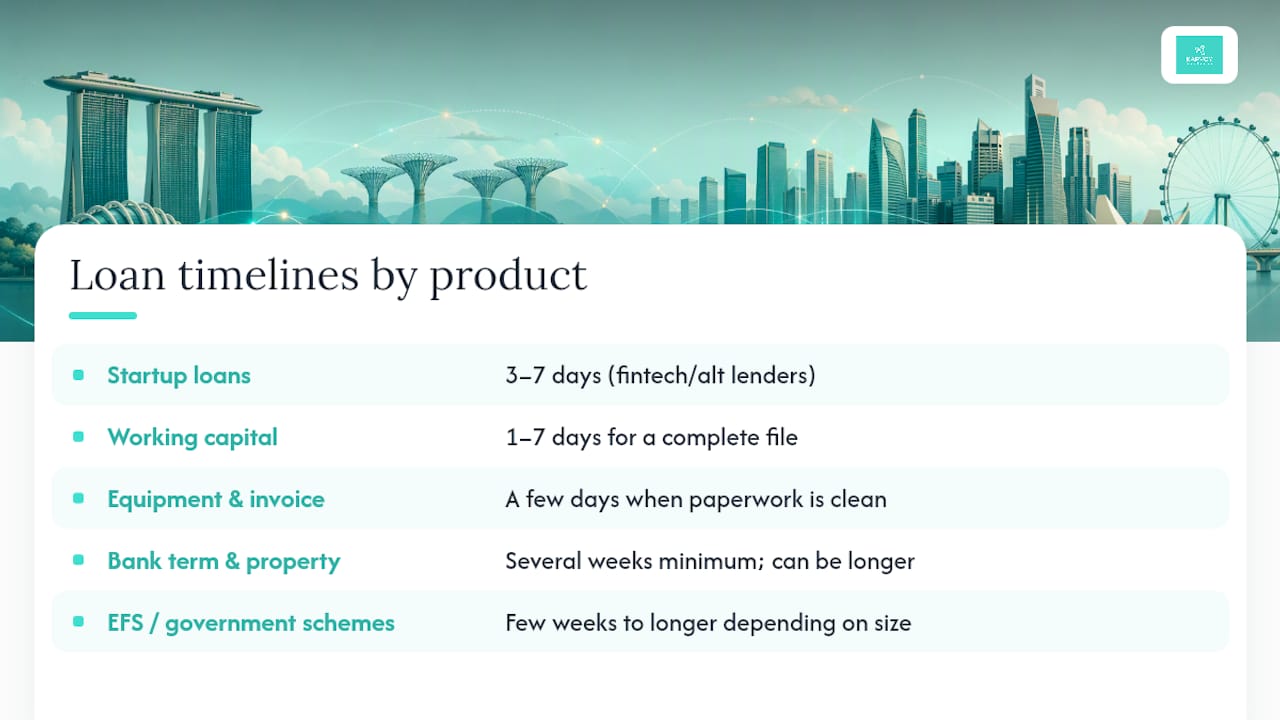
Startup loans and small unsecured term loans. Startups with under two years of operating history face tighter eligibility screens, but the approval process for startup loans at fintech and alternative lenders can still move in 3 to 7 days once revenue and founder documentation are in order. Airwallex's review of startup lending options in Singapore shows most early-stage products favor speed over low rates, which suits founders who need working capital fast rather than the cheapest capital available.
Working capital and online term loans. For businesses with a track record, working capital loans processed through fintech lenders typically fund in 1 to 7 days for a complete file. This is the segment where Singapore's alternative lending market has genuinely compressed timelines over the past few years.
Equipment financing and invoice financing. Both products benefit from having a built-in reference point: the vendor invoice or the accounts receivable ledger. That documentation structure means underwriters spend less time verifying the deal itself, and closings in a few days are common when the paperwork is clean.
Bank term loans and commercial property loans. This is where patience becomes necessary. A business term loan from a major bank routes through committee review, and secured facilities add appraisal and title work on top. Plan for several weeks minimum, longer if the property requires an environmental assessment or if your ownership structure needs legal sign-off.
Government-backed EFS and other schemes. The Enterprise Financing Scheme administered by Enterprise Singapore works through participating financial institutions rather than a single government office, so timing depends on which bank or lender processes your application. Smaller EFS-backed working capital requests can move in a few weeks; larger fixed asset or trade finance facilities under the scheme often take longer because they still go through full bank underwriting. Our EFS loan guide breaks down eligibility by scheme category if you're unsure which route fits your business.
Practical Checklist: What to Prepare Before You Apply
Most delays are avoidable. Here's the prep sequence that actually moves the needle.
- Pull your BizFile extract first. Every lender asks for this, and BizFile via ACRA is where you get it. Order it before you start filling out any application.
- Gather 6 to 12 months of bank statements and reconcile them. Unexplained deposits or gaps in your ledger are the number one reason underwriters send follow-up requests.
- Have your latest management accounts or audited financials ready. Lenders want to see revenue trends, not just a single snapshot.
- Confirm your GST or IRAS filings are current. A lapsed filing is an easy red flag that stalls a file.
- Collect director and shareholder identification plus a company resolution authorizing the loan. Missing signatory authority is a common last-minute holdup.
- For asset-backed loans, order the appraisal and bind insurance early. These run on independent timelines you don't control, so start them the same day you submit your application, not after.
- Ask your lender directly about committee cadence. Knowing whether they meet weekly or monthly tells you what to expect realistically.
Our SME loan documents checklist walks through the exact paperwork by product type if you want a more detailed reference before you apply.
Pro Tip: If speed matters more than shopping around for the lowest rate, submit your complete file to multiple lenders at once rather than applying sequentially. Serial applications mean starting the document-verification clock over each time you get rejected or want a second quote; parallel submissions let lenders compete for your file simultaneously.
Which Lender Fits Your Timeline and Budget?
The right lender depends on how urgently you need the money and how much you're willing to pay for that urgency.
- Need funds in 48 to 72 hours? Fintech lenders and merchant cash advances are your realistic options. Expect a higher rate in exchange for speed, and confirm the total cost of capital before signing, not just the headline rate.
- Have 1 to 4 weeks? Community banks and mid-sized online lenders sit in a reasonable middle ground: better pricing than fintech, faster turnaround than a large bank.
- Can wait 4 to 8 weeks for a lower rate? Large banks and full EFS applications typically offer the best pricing, but you're committing to committee review cycles and, if secured, appraisal timing you can't rush.
- Ask any lender these three questions up front: What's your typical service-level turnaround for a file like mine? How often does your credit committee meet? Will this loan require a third-party appraisal or title search?
- Consider a broker when speed genuinely matters. A broker who submits to multiple lenders in parallel and triages your documentation before submission can avoid the serial rejection cycle that eats weeks off your timeline, especially when supported by Stress-Free Marketing for Sydney Businesses.
What a Broker Actually Changes About Your Timeline
Most of the timeline math above assumes you're applying to one lender at a time, which is exactly where most Singapore SMEs lose weeks. Some brokers compare many banks and non-bank lenders and submit parallel applications rather than sequential ones, which avoids the trap of getting rejected by one lender, then starting the entire document cycle over with the next.
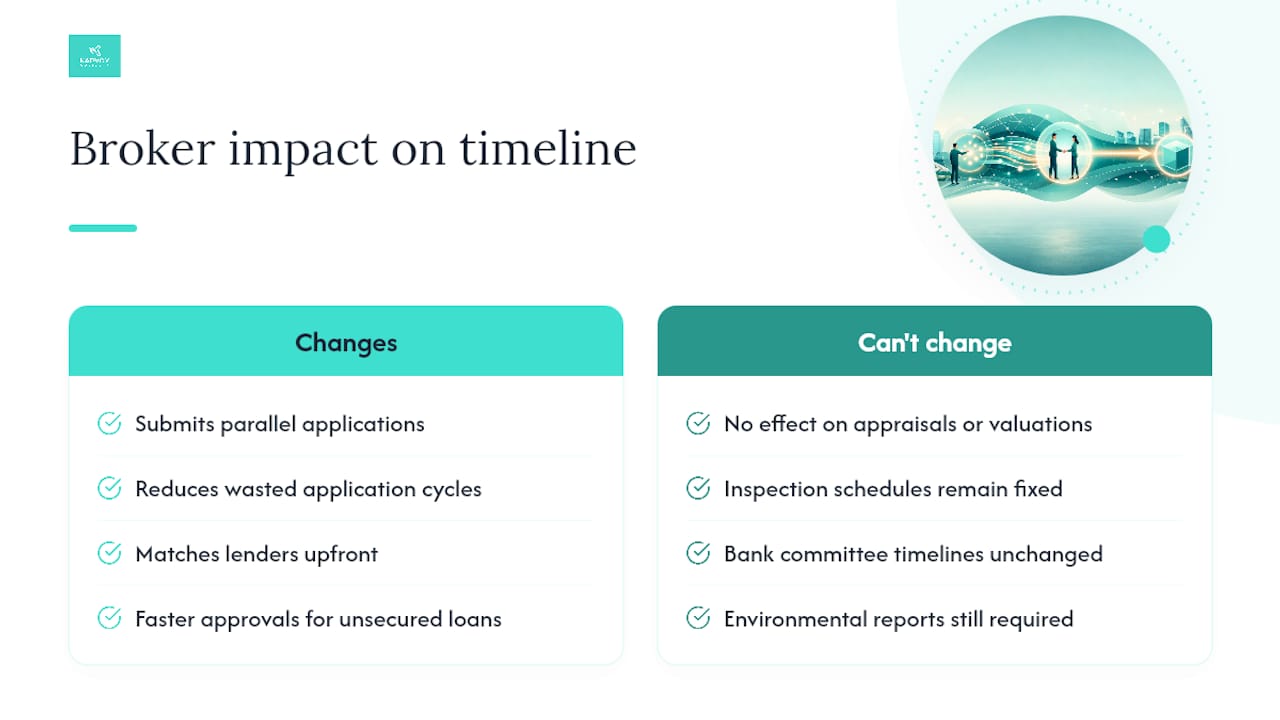
A broker's average approval time for clients typically runs a few days for working capital, term loans, and unsecured SME financing where documentation is the main variable. Property-backed and appraisal-heavy loans still move on third-party timelines that no broker can compress, since a title search or valuation runs on its own schedule regardless of who submits the file. What a broker changes is the document triage and lender matching upfront, not the physical time a bank appraiser needs to inspect a property.
The honest limitation worth stating plainly: brokering reduces wasted cycles, not physical inspection or committee timelines. If your loan requires an appraisal or environmental report, budget for that reality even when working with a broker.
— Viknesh
How Kapvoy Helps You Skip the Waiting Game
Some brokers offer an alternative to applying lender by lender and hoping the first one says yes. Instead of submitting to one bank, waiting two weeks, getting a rejection, and starting over, they run your file against many banks and lenders at once, which can help clients see faster approval decisions for standard SME financing.
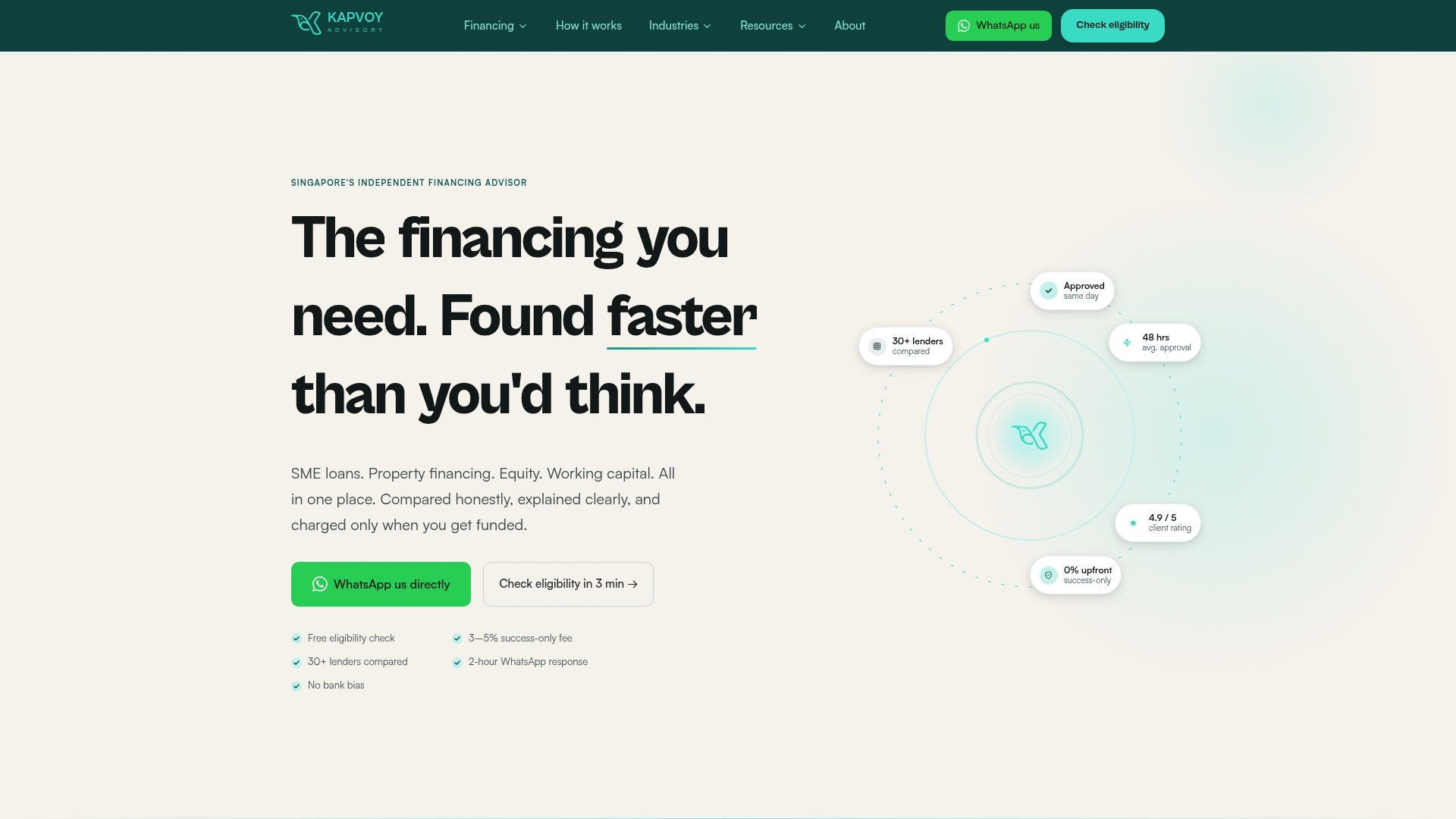
There's no upfront consultation fee and no charge unless your financing actually gets funded. That structure means the incentive is aligned with getting you approved quickly, not billing you for paperwork. Whether you need a working capital loan, a startup facility, or you're exploring the full range of SME loan options in Singapore, the fastest next step is a free eligibility check. It takes about three minutes and tells you which lenders in Kapvoy's panel are realistically a fit for your business before you commit any documentation. Check your eligibility now and find out where you actually stand.
Sources
These are the primary sources that back the timelines and figures cited throughout this guide.
- Enterprise Singapore — Enterprise Financing Scheme
- Axiant Partners — Business loan approval timeline
- Crestmont Capital — Business loan processing time statistics
- MoneySmart — Guide to Best Small Business / SME Loans in Singapore
This article is general information, not a substitute for advice from a qualified financial advisor. Consult a qualified financial professional about your own circumstances before acting on anything here.
FAQ
How Fast Can I Get Approved for a Business Loan?
Fintech lenders and merchant cash advance providers can approve complete applications within a few days, while community banks typically take a few weeks and large bank term loans usually run several weeks or longer.
What Is the Best Business Loan in Singapore?
There's no single best option. It depends on whether you prioritize speed (fintech or MCA), lower cost (bank term loan), or government-backed pricing with longer processing (Enterprise Financing Scheme), and Kapvoy compares a wide range of lenders to match your priority against the right fit.
Which Bank Is Best for Small Business Loans?
Community banks and lenders where you already hold a business relationship tend to process faster than large banks because underwriters have existing visibility into your deposit history and cash flow.
How Long Is a Usual Business Loan Approval Process?
For a complete, well-documented application, expect 1 to 7 days at a fintech lender, 1 to 4 weeks at a community bank, and 3 to 8 weeks or more for a large bank term loan or a property-secured facility.
What Happens Between Approval and Actually Getting Funded?
Approval means the lender has agreed to lend; funding is the wire transfer or disbursement, which can lag by days or weeks depending on whether insurance needs to be bound, title needs to clear, or an appraisal is still outstanding.
What If My Loan Application Gets Rejected?
A rejection doesn't have to reset your timeline from zero if you address the underlying issue quickly. Our guide on what to do after a loan rejection covers the most common causes and how to fix your file before reapplying.