30+ Lenders Compared for Singapore SMEs: Loan Interest & Amortization

The monthly payment on a fully amortizing business loan comes from one formula: Payment = P × r × (1+r)^n ÷ ((1+r)^n − 1), where P is the amount you borrow, r is your monthly interest rate, and n is your number of monthly payments. That formula returns your fixed monthly payment. It does not include fees, which is why your APR and your quoted rate are rarely the same number. Check the full amortization table before you sign anything.
TL;DR:
- Most errors in online loan calculations come from mismatched inputs, especially confusing the nominal rate with APR or entering rates as whole numbers.
- The effective cost of a loan can significantly differ from the nominal rate once fees like origination or processing charges are included in the APR.
- Using a fixed formula for amortization works well only for standard loans with equal payments; interest-only or variable-rate loans require separate modeling.
- Comparing lenders effectively requires modeling each loan's full amortization schedule with real fees and costs, not just relying on individual calculator outputs.
- Preparing detailed financial data and running scenario-based comparisons across multiple lenders can save money and clarify the true loan cost.
Table of Contents
- How the standard business loan interest formula works
- How to use an online business loan calculator correctly
- Worked amortization example with a full payment breakdown
- Fees, APR, and comparing the real cost of a loan
- Repayment frequency: monthly, fortnightly, or weekly
- Loan types where the standard formula doesn't apply
- Kapvoy's approach: modeling amortization across 30+ lenders
- Get a tailored loan comparison, not just a calculator result
- Where to double check your own numbers
- Kapvoy's take: the formula is easy, the comparison is what's hard
- Sources
How the standard business loan interest formula works
Every variable in the formula does one job. P is your principal, the amount disbursed. r is your monthly interest rate, expressed as a decimal, not a percentage. n is the total number of payments over the loan's life.
Lenders quote rates annually, so you convert first: divide the annual percentage by 100, then divide by 12. A quoted rate of 9% becomes r = 0.09 ÷ 12 = 0.0075. For n, multiply your loan term in years by 12. A 5 year loan gives you a term of several years. If your term includes a partial year, round to the nearest whole month rather than guessing, since the formula assumes discrete monthly periods.
Try it with small numbers. Borrow $10,000 at 9% for 12 months. r = 0.0075, n = 12. Plug those into the formula and you get a monthly payment close to $875. Run that same principal at 12 months but 15% and the payment climbs, because a higher r pushes both the numerator and the compounding term higher. This is the same formula underlying most amortization calculators, so if your own math and a calculator's output disagree, check your r and n first.
How to use an online business loan calculator correctly
Most calculator errors come from mismatched inputs, not bad math. Before you touch a business loan calculator, gather these figures:
- Principal amount you plan to borrow
- Annual rate, and whether it's APR or a nominal/stated rate
- Loan term in months or years
- Payment frequency (monthly, fortnightly, or weekly)
- Any origination, documentation, or processing fees
- Compounding method, if the lender specifies one
The most common mistake is entering a rate as a whole number when the field expects a decimal, which can throw the output off by a factor of 100. A close second is confusing APR with the stated rate on a term sheet, since APR already folds in fees while the stated rate doesn't. Once you get results, verify them against the amortization schedule: check that the monthly payment stays constant, that total interest matches the sum of every period's interest column, and that total payback equals principal plus total interest. Lenders also often model your payment against a debt service coverage ratio of 1.25 or higher before approving, so it's worth running that check yourself.
Pro Tip: Save a PDF or spreadsheet copy of every amortization schedule you generate. You'll want it later for bookkeeping, and for substantiating interest deductions at tax time.
Worked amortization example with a full payment breakdown
Take a $50,000 term loan at 8% annual interest over a multi-year term. Convert the rate: r = 0.08 ÷ 12 = 0.006667. With a multi-year term, the formula returns a monthly payment of roughly one thousand dollars. Over the full term, you'll pay a substantial amount in total interest, increasing your total payback significantly over the principal.
The period-by-period math follows three steps each month:
- Interest for the period = opening balance × r
- Principal paid = monthly payment − interest for the period
- New balance = opening balance − principal paid
In month one, interest is $50,000 × 0.006667, or about $333. Principal paid that month is roughly $681. By month 30, the balance has fallen enough that interest drops to around $170, while principal paid climbs to roughly $844. That's the core mechanic of amortization: the interest share of every payment shrinks as the balance shrinks, while the principal share grows. It matters for cash flow because your early payments do less to reduce what you owe, even though the dollar amount stays flat. Export the full schedule once you have it. It becomes the reference document for your books and for calculating deductible interest each fiscal year.
Fees, APR, and comparing the real cost of a loan
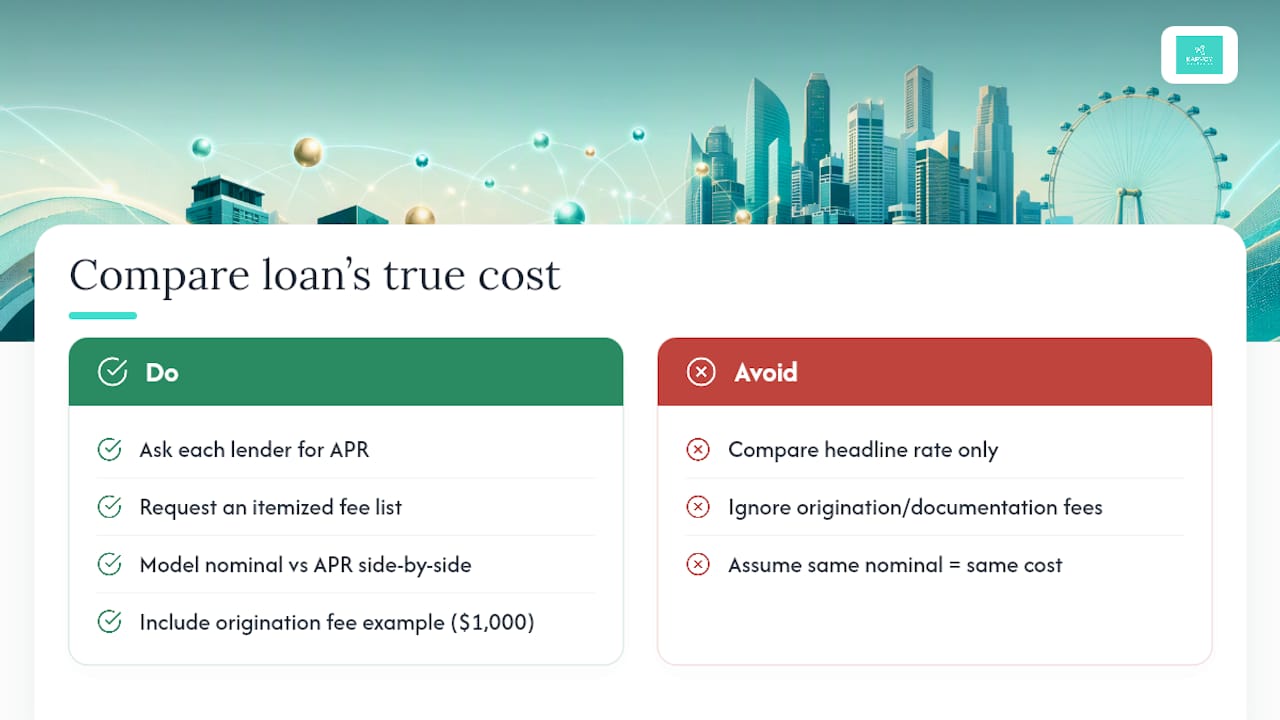
APR is the rate that folds fees into your interest cost, which is why two loans quoting the same nominal rate can have very different true costs. Common fees include origination charges, documentation fees, prepayment penalties, and late fees, and each one raises your effective cost above the sticker rate.
Say a $50,000 loan at 8% nominal carries a 2% origination fee, or $1,000, deducted at disbursement. Ask every lender for their APR and an itemized fee list, then model both the nominal rate and the APR scenario side by side. Rate ranges vary widely by loan type and borrower risk profile, so the comparison only holds up when you're looking at full cost, not headline rate.
Repayment frequency: monthly, fortnightly, or weekly
Frequency changes how often interest accrues and how it interacts with your cash cycle. Weekly or fortnightly schedules apply smaller interest charges more often, which can chip down your balance slightly faster than an equivalent monthly plan at the same nominal APR.
If your revenue arrives weekly, a weekly repayment schedule tends to smooth cash flow better than a single large monthly draw. Retail and food service businesses with steady daily receipts often prefer this.
Loan types where the standard formula doesn't apply
The amortizing formula assumes equal payments and steady compounding, and several common products break that assumption. Interest-only loans and revolving lines of credit charge interest on the outstanding balance each period without requiring principal reduction, so there's no fixed n to plug in.
Merchant cash advances use a factor rate instead of APR. A 1.10 factor rate on $10,000 means you repay $11,000, but that figure doesn't translate directly into an annualized rate without extra math, and it usually ignores added fees. Variable-rate loans need scenario modeling instead of a single calculation. Because the index component can move, model best case, base case, and worst case payment paths, and confirm your lender's reset frequency before you commit.
Kapvoy's approach: modeling amortization across 30+ lenders
We build a full amortization scenario for every borrower profile before recommending a lender, comparing effective APR, not just headline rates. That's how we've matched clients against a panel of 30+ banks and non-bank lenders with an average approval time of 1 to 3 days.
Before reaching out, prepare your last two years of financials and your target loan amount. It speeds up the comparison significantly.
Get a tailored loan comparison, not just a calculator result
A calculator tells you what one lender's numbers look like. It won't tell you whether a different lender offers a lower effective APR for your exact profile, or whether your fee structure could be improved elsewhere. That's the gap Kapvoy closes for Singapore SME owners: instead of running the same numbers through five different lender websites, we run your financials once and compare offers across our panel of 30+ banks and non-bank lenders side by side.
There's no upfront cost to find out what you qualify for. Kapvoy only charges a fee once funding is successfully disbursed, and applications go out to multiple lenders simultaneously, which tends to shorten the wait rather than stretch it. If you've already run the numbers and want to see how your profile stacks up across SME loan options, the next step is a quick eligibility check to see which lenders are realistic for your situation.
Check your eligibility in a few minutes and get a side-by-side comparison instead of a single quote.
Where to double check your own numbers
Run your figures through Kapvoy's business loan calculator or the ClearValue Lending amortization tool. Export the schedule for your records and tax filing.
Kapvoy's take: the formula is easy, the comparison is what's hard
Most business owners can plug numbers into a formula. The part that actually determines whether you save money is comparing effective APR across lenders, and almost nobody does that step properly, because it requires pulling fee schedules from three or four institutions and modeling each one against the same principal and term. A single calculator result from one bank's website tells you nothing about whether that bank's offer is competitive.
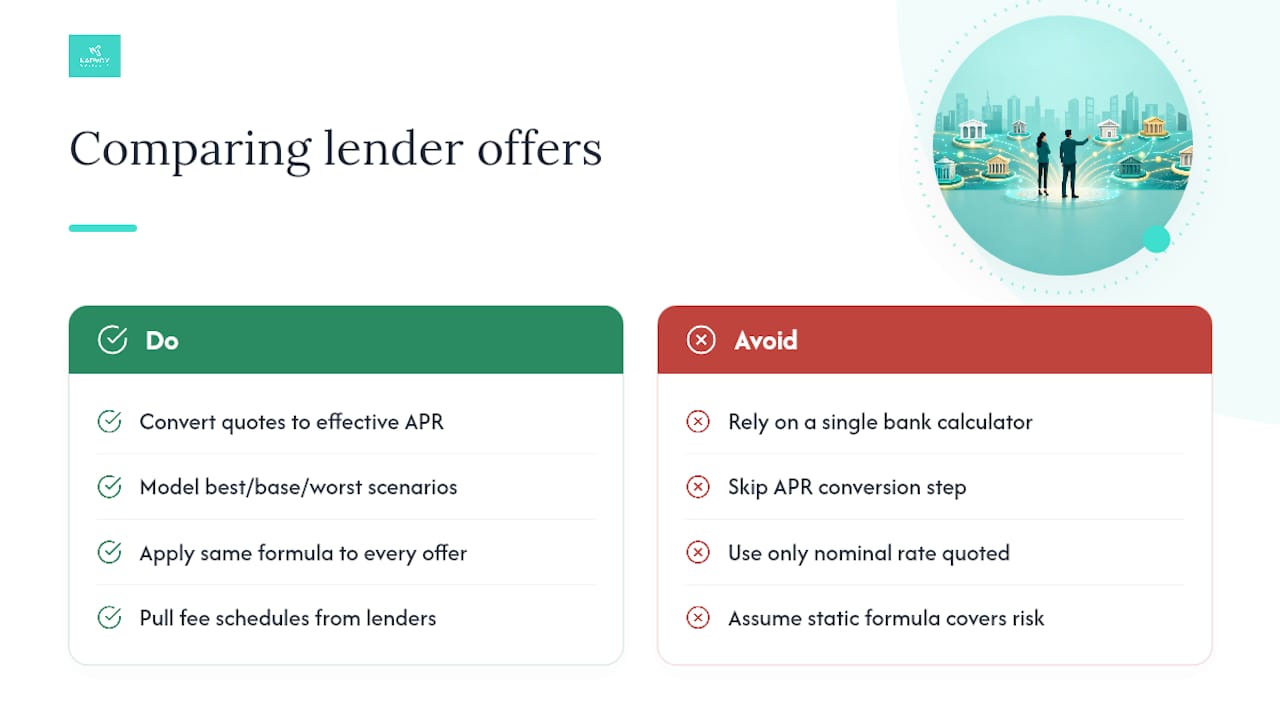
The pattern I've seen play out repeatedly: a borrower gets quoted a nominal rate that looks reasonable, skips the APR conversion, and only discovers the real cost once fees hit the amortization schedule. Variable rate products carry a second layer of risk that a static formula can't capture at all. You need a best case, base case, and worst case model, not a single number, and most calculators on lender websites are built to make their own product look good, not to help you compare it against alternatives.
That's the real value in running scenarios across a panel of lenders instead of one at a time. It's not about finding a fancier formula. It's about applying the same formula consistently across every offer on the table, so the comparison is actually fair.
— Viknesh