Cash Out vs Refinance: Which One Fits Your Goal?

A cash-out refinance replaces your mortgage with a bigger one and hands you the difference in cash. A rate-and-term refinance just swaps your loan for one with a better rate or term, no lump sum involved. Pick cash-out when you need real liquidity and can absorb a larger loan balance. Pick rate-and-term when your only goal is a lower rate or a shorter repayment period.
In Singapore, this decision runs into rules a US or UK homeowner never has to think about: loan-to-value caps, the Mortgage Equity Withdrawal (MWL) framework, and TDSR thresholds all shape what you can actually borrow.
- Cash-out refinance: new, larger loan; surplus paid out as cash
- Rate-and-term refinance: loan size stays roughly the same; only pricing or tenure changes
- Watch for: HDB flats and executive condos under the MOP face restrictions that private property owners don't
Key Takeaways
Choosing between cash-out and refinance comes down to whether your priority is cash in hand or a better rate, with Singapore's MWL and TDSR rules setting the real ceiling on what's possible.
| Point | Details | | --- | --- | | Define your need first | Cash-out delivers a lump sum by enlarging your loan; rate-and-term only adjusts price or tenure. | | Watch the rate-exchange trap | Cashing out can raise your effective rate on the whole mortgage, not just the new portion. | | Know your CLTV ceiling | Lenders typically cap combined borrowing near 75-80% of property value minus what you owe. | | Check the 50% TDSR exemption | An MWL can skip TDSR scrutiny if secured loans stay at or below half the property's value. | | Compare lenders before deciding | Kapvoy checks your profile against 30+ lenders and only charges a fee once funding is approved. |
Table of Contents
- Cash Out vs Refinance: How the Mechanics Differ
- Cash Out vs Refinance: Weighing the Risks and Benefits
- Borrowing Limits and Singapore's MAS Rules on Equity Withdrawal
- What Refinancing and Cash-Out Actually Cost You
- Choosing Between Cash-Out, Refinance, and a Home Equity Loan
- Applying for a Cash-Out or Refinance: What to Expect
- A Broker's View on Cash-Out vs Refinance Decisions
- Get Equity Out Without Guessing at the Right Lender
- Sources
Cash Out vs Refinance: How the Mechanics Differ
Both start the same way: a lender pays off your existing mortgage and issues a new one. What happens next is where they split.
With a rate-and-term refinance, the new loan roughly matches your outstanding balance. You're not pulling money out. You're just trying to lock in a better rate, shift from floating to fixed, or shorten your tenure to save on total interest.
A cash-out refinance works differently. The new loan is sized above your current balance, and the lender wires you the difference once the old mortgage is settled. A home equity loan or MWL in Singapore takes a third path entirely. It sits alongside your existing mortgage as a separate facility, rather than replacing it.
- Lender values the property
- Outstanding mortgage is calculated
- New loan amount is set based on the loan-to-value cap
- Old mortgage is paid off
- Any surplus (for cash-out) is disbursed to you
Here's a simplified example of how the numbers might shake out:
That $300,000 gap between the outstanding balance and the new loan is your cash-out amount, before fees.
Cash Out vs Refinance: Weighing the Risks and Benefits
Cash-out refinancing gives you a large lump sum at mortgage-level interest rates, which are almost always lower than personal loan or credit card rates. The catch is that you're increasing your total loan size and resetting the clock on interest across the whole balance, not just the new portion.
Cash-out refinance
- Pro: single, larger sum at a low blended rate
- Pro: can work well if it also secures a lower rate than your current one
- Con: replacing a historically low mortgage rate with a higher current one erodes savings even after you pocket the cash
- Con: resets amortization, so more of your payment goes to interest early on
Rate-and-term refinance
- Pro: lowers monthly payment or total interest without touching your equity
- Pro: simpler underwriting, fewer moving parts
- Con: does nothing if your real need is liquidity
Home equity loan or MWL
- Preferable when your existing mortgage rate is well below market and you don't want to disturb it
- Can be cheaper than a cash-out refinance for the same amount in certain rate environments, since the original loan stays untouched
A homeowner renovating a kitchen with a fixed six-month timeline usually leans toward a home equity loan. Someone consolidating high-interest debt permanently often does better with a full cash-out refinance, provided the new blended rate still beats what they're paying now.
Rate-exchange risk is the hidden cost most people miss. You can get cash in hand and still lose money long-term if the new rate on your entire mortgage is higher than your old one.

Borrowing Limits and Singapore's MAS Rules on Equity Withdrawal
Your maximum cash-out isn't just about your equity. It's capped by loan-to-value limits and shaped by MAS rules that determine how much scrutiny your application gets.
The core mechanics:
- LTV caps typically limit the new loan to a percentage of the property's valuation, minus what you still owe
- The Monetary Authority of Singapore's MWL framework governs tenure limits on equity-withdrawal loans and dictates when TDSR kicks in
- An MWL can be exempt from TDSR if your total outstanding loans secured on the property amount to 50% or less of its market value
- HDB flats face tighter constraints than private property, and executive condos can't tap this route until the Minimum Occupation Period ends
Here's a simplified calculation using combined loan-to-value (CLTV):
Property value: $1,000,000. Existing mortgage: $400,000. Subtract the $400,000 still owed, and the maximum cash-out lands around $350,000, before fees and subject to TDSR if applicable.
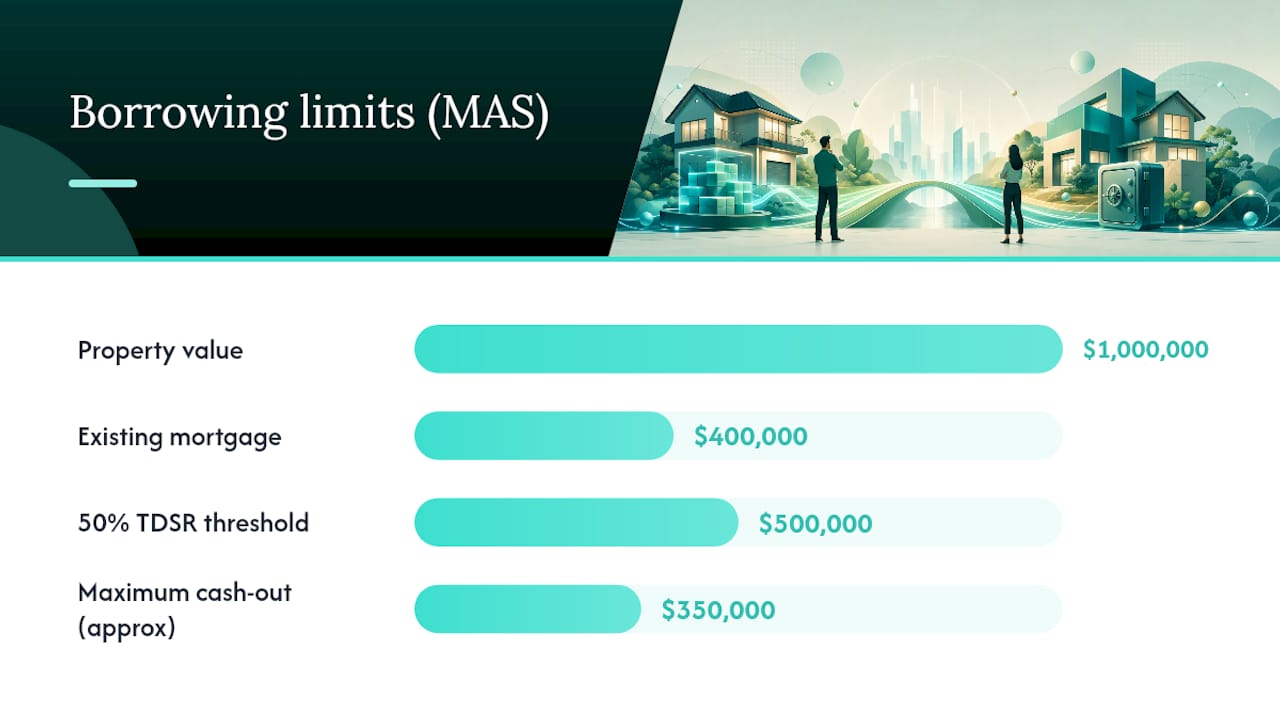
That 50% threshold is worth remembering. If your outstanding secured debt sits comfortably under half your property's value, you may sidestep TDSR entirely on the MWL portion, which can matter a lot if your income documentation is uneven or you're self-employed.
What Refinancing and Cash-Out Actually Cost You
The rate you're quoted is never the full price. Every refinance or cash-out deal in Singapore comes with valuation fees, legal fees, and admin charges, and banks sometimes offer legal or valuation subsidies as part of a promotional package, which changes the real math.
A reliable way to compare options over a 3 to 5 year horizon:
- Add up all closing costs (valuation, legal, admin, any early-repayment penalty on your current loan)
- Calculate your interest savings or cost from the rate change, multiplied across your remaining tenure
- Subtract closing costs from projected savings to get your net position at year 3 and year 5
If your closing costs run $8,000 and the rate change only saves you $150 a month, you're underwater for more than four years before the switch pays for itself. That's a bad trade if you plan to sell or refinance again sooner.
Pro Tip: Ask your current bank or a new lender whether valuation and legal fees can be waived or rolled into the loan. Many will do it to win your business, especially during promotional periods, and it can flip a marginal deal into a clearly good one.
Choosing Between Cash-Out, Refinance, and a Home Equity Loan
Run through this before you commit to anything:
- How much do you actually need, and is it a one-time sum or ongoing access to credit?
- Is your current mortgage rate above or below where the market sits today?
- How many years are left on your loan, and how would a reset affect total interest?
- Can your income comfortably support a larger monthly payment if TDSR applies?
- What's the money actually for?
Match the goal to the tool:
- Renovation with a defined budget: a home equity loan or MWL often fits better, since it leaves your primary mortgage rate untouched
- Consolidating multiple high-interest debts: cash-out refinance usually wins if the new blended rate beats your current unsecured debt rates
- Investment capital or a cash buffer: weigh the rate-exchange risk carefully; don't cash out purely because equity is sitting there
- Just want a lower rate or shorter tenure: rate-and-term refinance, full stop
Red flags that should stop you before you sign anything: you're on a rate well below current market and cashing out would force you onto a much higher one, your equity cushion is thin enough that fees eat most of the payout, or you need the money for less than two years, which rarely justifies refinancing costs.
Applying for a Cash-Out or Refinance: What to Expect
Lenders in Singapore will ask for a fairly standard packet: recent payslips or income tax statements, CPF contribution history, your latest mortgage statement, and property valuation documents. Self-employed applicants typically need two years of financial statements.
- Get a preliminary eligibility check before committing to a full valuation
- Submit income and property documents to your chosen lender or broker
- Lender orders a formal valuation
- Underwriting review checks LTV, TDSR (where applicable), and credit history
- Offer letter issued, followed by legal completion and disbursement
Timelines typically run from a few days for eligibility feedback to a few weeks for full disbursement, with valuation scheduling as the most common bottleneck.
Pro Tip: Clean up your credit utilization and avoid opening new credit lines in the months before you apply. Underwriters weigh recent credit behavior heavily, and a messy few months on paper can slow down or shrink your approved amount.
Working with a partner site covering property financing and related services can help you compare multiple lenders at once and shorten this timeline, since you're not waiting on one bank's queue before trying another.
A Broker's View on Cash-Out vs Refinance Decisions
Most homeowners approach this decision with a single bank's product sheet and no real basis for comparison. That's the actual problem, not the cash-out versus refinance question itself. A lender will always frame its own product as the sensible choice. It has no incentive to tell you a competitor's tenure structure would save you more over five years.
What actually moves the needle is comparing structures, not just headline rates: fixed versus floating splits, tenure length against your real payoff horizon, and whether a smaller MWL sidesteps TDSR entirely while a full refinance wouldn't. A lender with access to a wide panel can often restructure the deal to reduce rate-exchange pain while still delivering the cash you need, something a single bank rarely offers because it only has its own products to sell you.
Kapvoy reviews cash-out and refinance requests against more than 30 bank and non-bank lenders, checking CLTV treatment, TDSR exposure, and fee structures before recommending a path. For property owners weighing this decision, that comparison usually surfaces options a single-bank conversation never would.
— Viknesh
Get Equity Out Without Guessing at the Right Lender
Comparing cash-out refinance, rate-and-term refinance, and home equity loan structures on your own means calling multiple banks, waiting on separate valuations, and hoping you stumble onto the best fit. Kapvoy skips that legwork by submitting your profile to its panel of 30+ lenders at once, so you see real offers side by side instead of guessing which bank might say yes.

Fees only apply once financing is approved and funded, with no upfront or consultation charges either way. Most eligibility reviews take one to three days, and the same panel process applies whether you're weighing a straightforward property refinance or need financing structured for SME loans tied to your business.
For a broader read on documentation and timelines before you commit, the property financing guide walks through what lenders typically expect at each stage. If you'd rather check where you stand first, run a free eligibility check and get a clear answer in about three minutes.
Sources
- Cash-out refinance vs mortgage refinancing loans | Investopedia
- Applying for a new Mortgage Equity Withdrawal (MWL) | MAS
- Cash-out refinance vs home equity loan: which is better? | Experian