Founders and SMEs: Debt vs Equity By Stage, Decisions in 1–3 Days

Debt works best when your business generates predictable cash flow and can handle scheduled repayments at a lower overall cost. Equity works best when you need runway without the burden of repayment and you can live with giving up some ownership and control. The right answer almost always comes down to your stage, your monthly burn, and how much say you're willing to hand to someone else.
TL;DR:
- Debt is usually more cost-effective upfront due to tax-deductible interest, but requires predictable cash flow to meet scheduled repayments.
- Equities typically involve higher long-term costs and dilution but offer greater flexibility without repayment obligations, suitable for early-stage startups.
- Careful modeling of repayment scenarios is crucial, especially for convertible notes and stacked SAFEs, to avoid surprises at maturity or during conversions.
- Combining debt and equity instruments can suit different business stages, with short-term loans bridging gaps until larger funding rounds.
- Using multiple lenders and platforms like Kapvoy can significantly speed up access to tailored financing options, reducing time and risk.
Table of Contents
- Debt vs Equity Financing at a Glance
- How Debt Financing Works: Terms, Types, and Lender Expectations
- How Equity Financing Works: SAFEs, Priced Rounds, and Dilution
- Comparing the Real Cost: Debt vs Equity Analysis
- A Stage-First Framework for Choosing Debt, Equity, or Both
- Where Financing Deals Go Wrong
- What We See Working: A Practitioner's View
- How Kapvoy Helps You Secure the Right Financing Faster
- Sources
Debt vs Equity Financing at a Glance
The two paths differ on nearly every axis that matters to a founder or business owner, and seeing them side by side makes the trade-offs obvious fast.
- Cost: Debt is usually cheaper upfront because equity investors demand a higher expected return to compensate for their risk, what's known as the equity risk premium.
- Ownership impact: Debt preserves your cap table entirely. Equity dilutes it, sometimes permanently and sometimes in ways you don't see coming until a later round.
- Repayment obligation: Debt requires scheduled payments regardless of how business is going. Equity requires nothing back unless the company sells or goes public.
- Typical stage: Early-stage, pre-revenue companies lean equity. Established SMEs with steady receivables lean debt.
- Instrument examples: SAFEs and convertible notes for startups, term loans and working capital lines for SMEs, priced rounds for companies raising serious institutional capital.
One more distinction shapes the real cost more than most founders realize: interest payments on debt are typically tax-deductible, while dividends paid to equity holders come out of after-tax income and get no such break.
How Debt Financing Works: Terms, Types, and Lender Expectations
Debt financing means borrowing money you agree to pay back, with interest, on a set schedule. The lender doesn't take ownership. In exchange for that certainty, they'll look hard at your ability to actually repay.
A loan agreement usually specifies four things: the principal (amount borrowed), the interest rate, the maturity date (when it must be fully repaid), and often covenants (conditions you must maintain, like minimum cash reserves) or collateral (assets pledged if you default).
SMEs typically encounter debt in a few recognizable forms:
- Term loans for equipment or expansion, repaid over a fixed period.
- Working capital loans to smooth out cash flow gaps between invoicing and payment.
- Bridge loans to cover a short gap, like waiting on a receivable or a funding round to close.
- Bonds, mostly for larger, more established companies raising debt from public or institutional markets.
Convertible notes deserve a special mention here because they confuse a lot of founders. A convertible note is legally debt: it accrues interest and carries a maturity date, even though everyone expects it to convert into equity eventually. Convertible notes typically carry interest rates that are moderate and have maturities usually within one to two years, and that accrued interest quietly increases the principal that converts, meaning more shares and more dilution than the headline terms suggest.
Lenders evaluating any of these will look at cash flow consistency, available collateral, and your credit history before anything else. A business term loan sized against predictable revenue clears underwriting far faster than one pitched on projections alone.
Pro Tip: Match your loan's maturity to the useful life of what it's funding. A five-year loan for equipment that lasts five years makes sense; a 12-month bridge loan for a capital project that won't pay back for three years is how businesses end up in repayment trouble.
How Equity Financing Works: SAFEs, Priced Rounds, and Dilution
Equity financing means selling a slice of ownership in exchange for capital, with no repayment obligation and no interest. The trade is real, though: investors get a claim on future profits, sometimes voting rights, and occasionally board influence.

Not all equity instruments look the same. Founders raising early money typically choose between three structures, and the differences matter more than the paperwork suggests.
A SAFE is a contract for future equity with no interest and no maturity date, which makes it the fastest and cheapest way to raise a small seed round. A convertible note adds interest and a maturity date, essentially debt with an equity destination, and works well when a bridge investor wants downside protection. A priced round issues actual shares today at an agreed valuation, and that's usually where board seats and voting rights enter the picture.
Once you're negotiating a priced round, expect investors to ask about your cap table structure, and a resource like Bright Capital's equity management guidance is worth reviewing before that conversation, since messy option pools and unclear ownership stakes slow deals down.
Comparing the Real Cost: Debt vs Equity Analysis
Debt's stated interest rate rarely tells the full story, and neither does equity's lack of a rate at all.
Start with debt. Interest is generally tax-deductible, which lowers its after-tax cost below the sticker rate.
Equity has no interest rate, but it isn't free. Investors expect a return that compensates them for the risk of owning a piece of an unproven business, and that expected return often runs well above what a bank would charge. This is exactly why debt is generally considered cheaper than equity in isolation.
The hidden number that catches founders off guard: accrued interest on a convertible note directly increases the principal that converts into shares. A convertible note accrues interest over time, which increases the principal amount that converts into equity, leading to more dilution than the original amount invested.
- Legal fees for drafting and negotiating a priced round typically dwarf those for a SAFE.
- Ongoing reporting and board management carry real administrative cost.
- Cap-table cleanup before a new round can eat weeks of founder time.
A loan calculator is a fast way to model actual repayment cost before you sign anything.
A Stage-First Framework for Choosing Debt, Equity, or Both
Match the instrument to your actual situation, not to whatever raised money fastest for someone else's startup.
- Map your stage. Pre-seed with no revenue history generally points toward a SAFE. A seed-stage bridge before a larger round often calls for a convertible note. Raising above roughly $5 million with a lead investor setting terms usually means a priced round is the right structure.
- Calculate your runway in months, not dollars. Three months of runway with strong revenue predictability supports debt; twelve months of runway with no revenue yet points to equity.
- Estimate monthly burn against realistic repayment capacity. If you can't confidently project cash to cover payments, debt is the wrong tool right now.
- Score your tolerance for dilution against your tolerance for covenants. Both cost you something, just in different currencies.
- Ask lenders and investors direct questions: What triggers default or acceleration? What board rights come with this check? Red flags include vague maturity extension terms and broad "material adverse change" clauses.
- Consider combining instruments when a single one doesn't fit. A short-term startup loan can bridge a gap while you finish negotiating a priced round on your own timeline instead of a rushed one.
Pro Tip: If you're unsure whether you can service debt payments for the next 12 months, that uncertainty is itself the answer. Equity buys you the runway to find out.
Where Financing Deals Go Wrong
Most financing disasters aren't caused by picking the wrong instrument. They're caused by not modeling how that instrument behaves under stress.
- Maturity cliffs: If a follow-on priced round doesn't close before a convertible note's maturity date, founders can face forced repayment or an unfavorable conversion they never planned for.
- SAFE stacking: Multiple SAFEs issued at different valuation caps create dilution that's genuinely hard to predict until you sit down and model every conversion scenario together.
- Conversion order matters: convertible notes typically convert ahead of SAFEs, taking a senior slice, so stacking instruments without mapping that order produces surprises.
- Restrictive covenants: liquidity triggers or minimum cash requirements can force a default even when the business is otherwise healthy.
The fix is unglamorous: model every conversion scenario before you sign anything new, and clean up your cap table before you walk into a priced round, not during it.
What We See Working: A Practitioner's View
Viknesh has spent years watching Singapore SMEs and founders navigate exactly this decision, and the pattern is consistent: most rejections trace back to a mismatch between the instrument requested and the business's actual cash profile, not to the business itself.
Submitting to a single bank and waiting weeks for an answer is still the default for too many owners. A brokered approach that runs applications across multiple lenders simultaneously tends to surface approvals faster and with terms better matched to the business.
— Viknesh
How Kapvoy Helps You Secure the Right Financing Faster
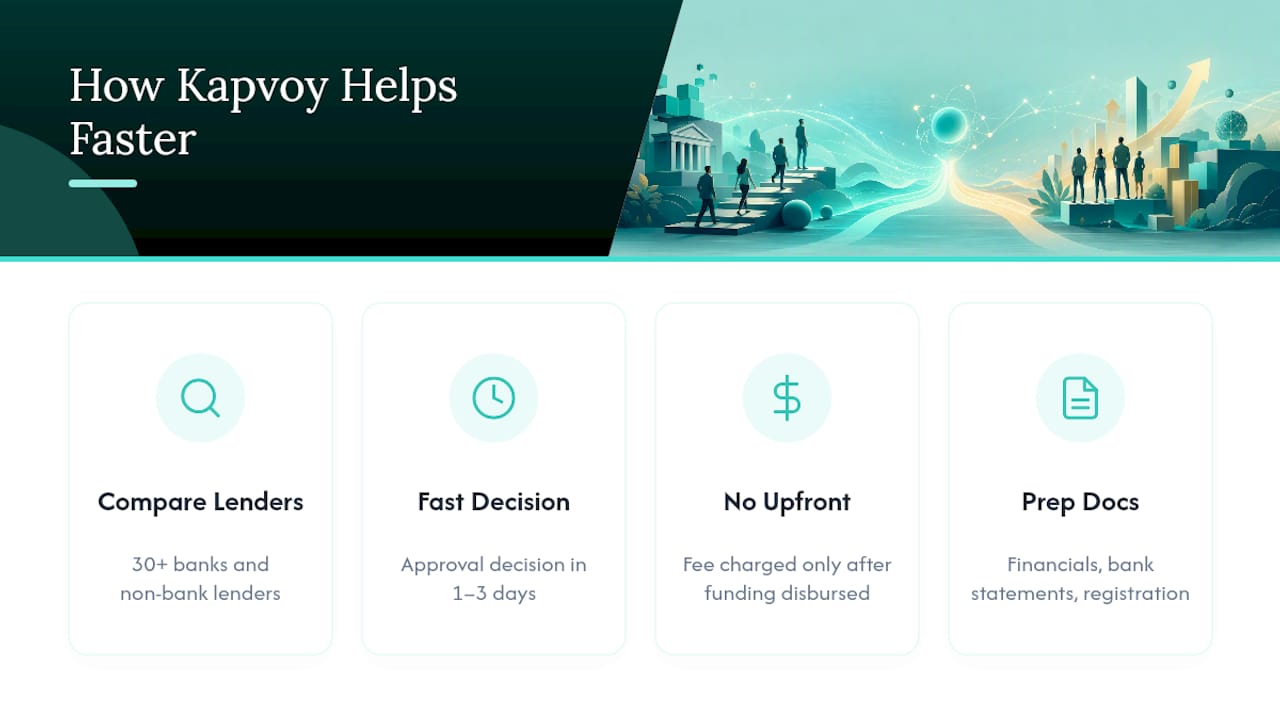
Kapvoy is the alternative to walking into one bank and hoping for the best. Instead of a single yes-or-no answer after weeks of waiting, Kapvoy compares your profile against more than 30 banks and non-bank lenders at once, and clients typically hear back with an approval decision within 1 to 3 days.
There's no upfront cost to find out what you qualify for. Kapvoy only charges a fee once financing is successfully approved and disbursed, so there's no financial risk in exploring your options before committing to one lender's terms. Before you apply anywhere, it helps to pull together the basics lenders always ask for: recent financial statements, bank statements, and business registration documents, laid out clearly in the SME loan documents checklist.
If steady cash flow makes debt the better fit for your business right now, start by comparing SME loan options matched to your specific profile, or check your eligibility in about three minutes to see what terms you'd actually qualify for.
This article is general information, not a substitute for advice from a qualified financial advisor. Consult a qualified financial professional about your own circumstances before acting on anything here.
Sources
- Corporate Finance Institute — Debt vs Equity
- SaaStr — an insider's guide to convertible debt vs equity
- OpenStax — Raising long-term financing (debt vs equity)