DSCR Business Loan Approval: What Your Ratio Really Decides

DSCR, or debt-service coverage ratio, measures whether your business generates enough operating cash flow to cover a loan’s principal and interest. It’s calculated as net operating income (or EBITDA) divided by annual debt service. A ratio of 1.0 means your income exactly covers your debt payments, with nothing left over.
Most lenders want to see roughly 1.15 to 1.40, depending on the loan type and lender risk appetite. Here’s what that number does to your application:
-
Below 1.0: You don’t generate enough cash flow to service the debt. Most lenders decline outright.
-
1.0 to 1.15: You’re in marginal territory. Approval depends heavily on collateral, guarantors, or lender flexibility.
-
1.15 to 1.40: This is the working range for most conventional and SBA-type products.
-
Above 1.40: You’re in a strong position for better rates and larger loan amounts.
A low DSCR usually shrinks your loan size or raises your rate rather than killing the deal outright. Lenders have more levers than a flat yes or no, and understanding those levers is what separates a rejected application from a restructured one.
Key Takeaways
DSCR determines both whether you qualify for a business loan and how much you can borrow, since most lenders size loans specifically to hit their target ratio.
| Point | Details | | --- | --- | | DSCR formula | Net operating income or EBITDA divided by annual debt service; 1.0 means income exactly covers payments. | | Typical lender range | Most conventional lenders target 1.20 to 1.40; SBA-type programs sometimes accept 1.15. | | Lender response to low DSCR | Lenders often shrink the loan, raise the rate, or require a guarantor rather than decline outright. | | Fastest ways to improve DSCR | Re-amortize debt, increase down payment, or normalize owner compensation before applying. | | Broader approval strategy | Kapvoy matches marginal DSCR profiles against 30-plus lenders with fee-on-success pricing and approvals in one to three days. |
Table of Contents
-
How Do Interest Rates and Market Conditions Move DSCR Thresholds?
-
What Should You Prepare Before Applying for a DSCR-Sensitive Loan?
What Is DSCR in a Business Loan and How Is It Calculated?
The standard formula lenders use is straightforward: DSCR equals net operating income divided by total annual debt service. But “net operating income” isn’t a single fixed number, and that’s where most confusion starts.
Lenders typically work with one of three income measures, depending on your business type and their underwriting model:
-
Net Operating Income (NOI): Revenue minus operating expenses, excluding debt payments, taxes, and depreciation. Common in commercial real estate underwriting.
-
EBITDA: Earnings before interest, taxes, depreciation, and amortization. More common for operating businesses without a single dominant asset.
-
EBIT: Similar to EBITDA but keeps depreciation and amortization as real expenses. Some conservative lenders prefer this because it doesn’t inflate cash flow with non-cash addbacks.
Annual debt service includes more than your monthly loan payment. Lenders typically add up principal, interest, any required sinking fund contributions, and in some cases a portion of lease payments if those leases function like debt obligations.
One adjustment that trips up first-time applicants: owner compensation. Underwriters routinely “normalize” your financials by adjusting owner salary to market rate and stripping out one-off expenses like a lawsuit settlement or a single bad year of inventory write-offs. If your income statement shows you paying yourself $40,000 when a market-rate manager would cost $90,000, expect the underwriter to make that adjustment before calculating your ratio.
How Do You Calculate DSCR Step by Step?
Grab three things before you start: your trailing twelve months of financials (or your most recent fiscal year), your existing debt schedule, and the proposed terms of the new loan you’re applying for.
Here’s the calculation in practice:
-
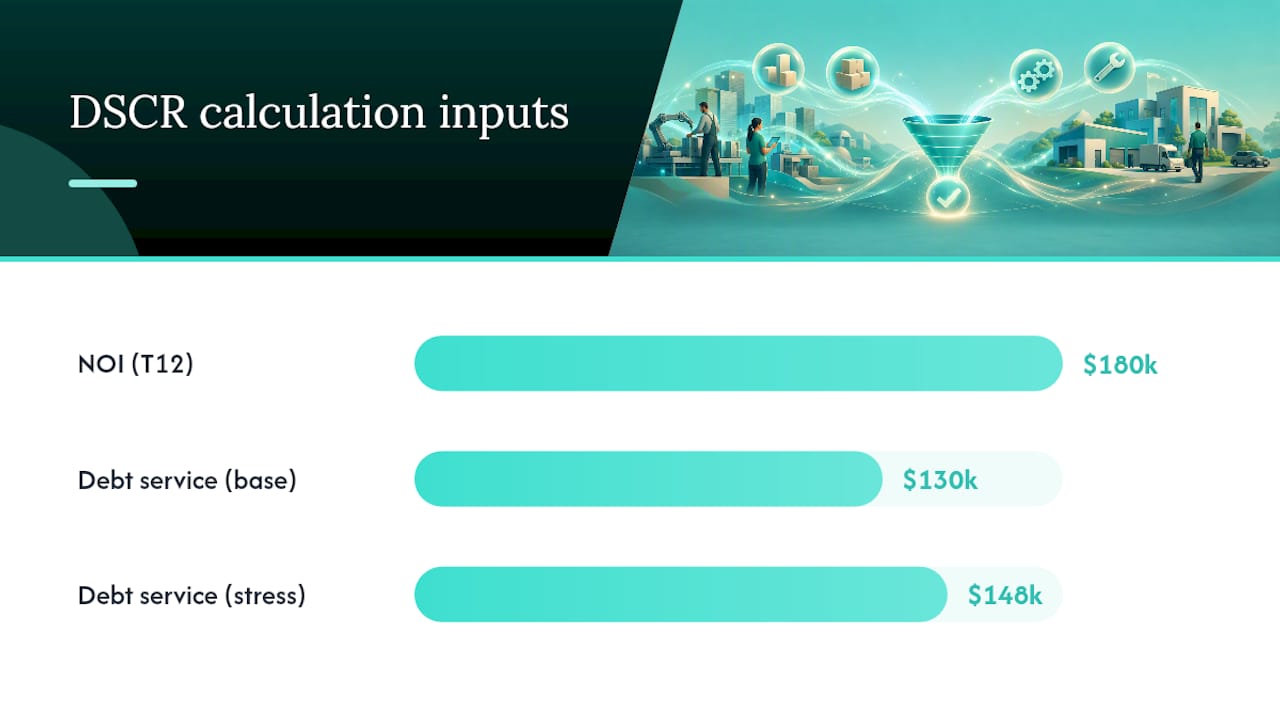
Pull your net operating income. Say your business generated $180,000 in NOI last year.
-
Total your annual debt service. Add up principal and interest on all business debt, including the new loan you’re seeking. Suppose that comes to $130,000 a year.
-
Divide NOI by debt service. $180,000 ÷ $130,000 = 1.38 DSCR.
That 1.38 sits comfortably inside most lenders’ target range, which typically runs 1.20 to 1.40 for conventional loans, with SBA-type programs sometimes accepting figures closer to 1.15.
Now stress-test it. Recalculating DSCR under a worst-case scenario is standard underwriting practice, and it’s smart to run it yourself before a lender does. If your rate rises and debt service climbs to $148,000 while NOI stays flat, your DSCR drops to 1.22, still workable, but with far less cushion.
Pro Tip: Run your DSCR calculation using the new loan’s proposed payment, not just your existing debt. A lot of applicants calculate DSCR on current obligations only, then get blindsided when the new loan pushes the ratio below the lender’s floor.
How Do Lenders Use DSCR to Set Loan Size and Pricing?
DSCR isn’t just a pass/fail gate. It’s an input lenders use to size the loan, price the risk, and decide what conditions to attach.
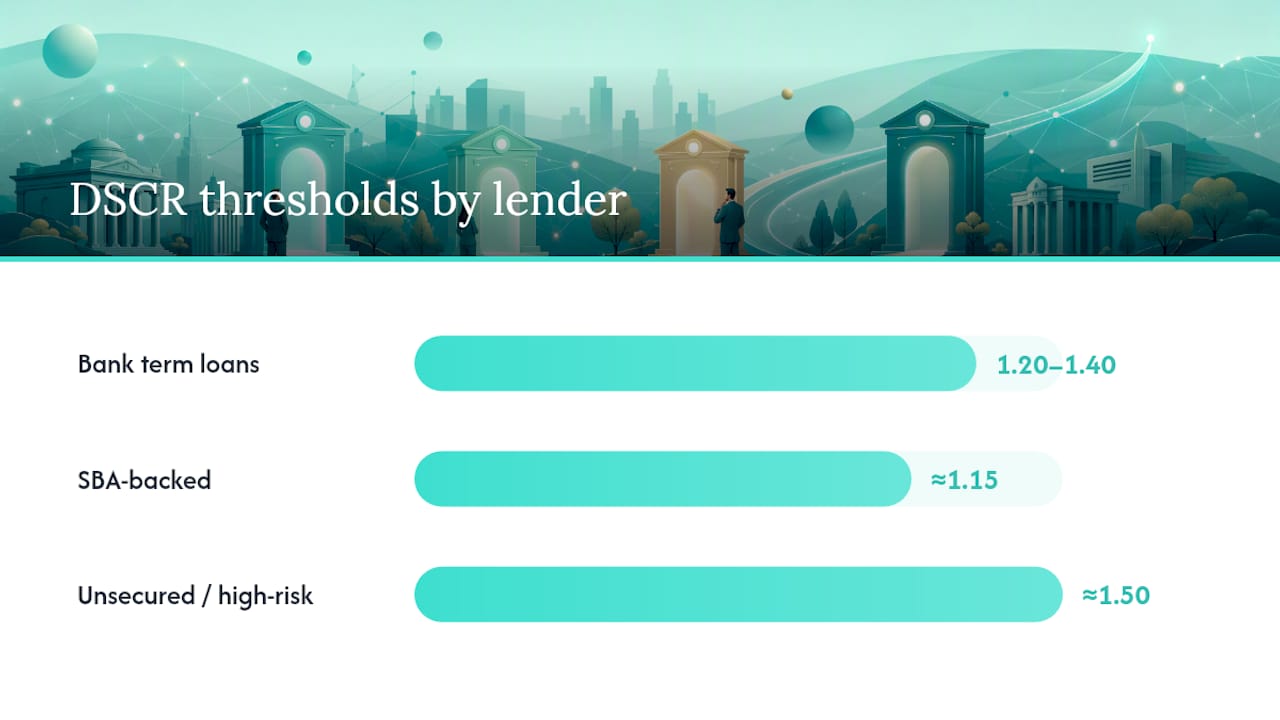
Thresholds vary by loan type and lender category:
-
Conventional bank term loans: Often require 1.20 to 1.40, with stricter documentation and full financial statement review.
-
SBA-backed or government-supported programs: Sometimes accept ratios closer to 1.15, since a partial guarantee offsets some lender risk.
-
Unsecured or higher-risk facilities: Frequently push the floor up toward 1.5, since there’s no collateral cushion if cash flow tightens.
-
Non-bank DSCR loan products: Underwrite primarily off the asset’s cash flow rather than the borrower’s full financial profile, often with faster approval but different pricing.
When your DSCR comes in below a lender’s floor, the response is rarely an automatic decline. Instead, lenders commonly reduce the loan amount, raise the interest rate, or require additional credit enhancements like a guarantor or extra collateral. A 1.10 DSCR might not get you the $500,000 you asked for, but it could get you $350,000 at a slightly higher rate.
Pro Tip: If a bank quotes you a smaller loan amount than you requested, ask directly whether DSCR drove that decision. Lenders often size loans specifically to hit their target ratio, and knowing that number tells you exactly how much you’d need to improve your cash flow to unlock the full amount.
The distinction between bank underwriting and no-doc or low-doc DSCR products matters here too. Traditional banks scrutinize tax returns, bank statements, and often require two to three years of financial history. Non-bank DSCR lenders frequently skip personal income verification entirely and underwrite almost purely on the cash flow the asset or business generates, which speeds up approval but usually costs more in rate.
How Can You Improve DSCR Before Applying for a Loan?
Revenue growth is the obvious fix, but it’s also the slowest one. If you’re weeks away from submitting an application, these moves work faster because they target the denominator or normalize the numerator, not the top line.
On the debt side:
-
Re-amortize existing loans over a longer term to lower your annual debt service, even if the total interest paid over the life of the loan increases.
-
Consolidate high-interest debt into a single facility with a lower blended rate.
-
Increase your down payment on the new loan, which directly shrinks the amount of debt service the lender calculates against.
-
Extend loan terms where possible, particularly on equipment or working capital facilities with shorter standard terms.
On the income side:
-
Normalize owner compensation honestly, but make sure your books reflect actual market-rate value rather than an artificially low draw that understates true operating profit.
-
Suspend discretionary owner draws temporarily in the months leading up to your application.
-
Accelerate accounts receivable collection to show stronger recent cash flow, since some lenders weight trailing three to six months more heavily than annual averages.
If those levers still leave you short, credit enhancements can bridge the gap. A guarantor with strong personal financials, additional collateral, or simply requesting a smaller initial loan amount can all shift a marginal deal into approvable territory.
Pro Tip: Re-amortizing debt is often the fastest DSCR fix because it changes the math instantly, unlike revenue growth, which takes months to show up in your financials. If you have any existing high-payment debt, ask about restructuring it before you apply for anything new.
Why Marginal DSCR Cases Often Need a Multi-Lender Approach
A DSCR of 1.05 might get flatly declined at one bank and comfortably approved at another lender with a lower floor or more flexible collateral requirements. That’s the core value of working with a broker rather than applying to a single institution and hoping.
Kapvoy compares your profile against a panel of 30-plus banks and non-bank lenders, matching your specific DSCR, industry, and documentation strength to the lenders most likely to say yes. Submitting to multiple lenders simultaneously, instead of sequentially, cuts the time you’d otherwise lose to one rejection before trying the next option.
If your DSCR sits below 1.15, a broker adds the most value because:
-
Different lenders weight NOI adjustments and debt service calculations differently.
-
Non-bank lenders may accept a ratio a conventional bank would reject.
-
Matching your file to the right lender the first time avoids repeated hard credit inquiries.
If your DSCR is comfortably above 1.4, applying direct to your existing bank relationship can still work fine.
Where DSCR Falls Short as a Credit Measure
DSCR tells you whether cash flow covers debt payments in a given period, but it says nothing about the quality or stability of that cash flow. A business with one large contract renewing annually can show the same DSCR as one with hundreds of diversified customers, yet the risk profiles are nowhere close to equal.
The ratio is also backward-looking by default. Most lenders calculate it off trailing twelve months or the last fiscal year, which means a business on a downward trend can still post a comfortable DSCR right before revenue craters.
DSCR also ignores balance sheet strength entirely. Two businesses with identical 1.25 ratios can have wildly different levels of cash reserves, working capital, or unfunded liabilities. One might weather a bad quarter easily; the other might not survive a single missed invoice payment.
Because of these gaps, most experienced underwriters treat DSCR as one input among several rather than a standalone verdict. A single ratio, calculated from a single snapshot in time, was never built to capture the full financial reality of a business, and lenders who rely on it exclusively tend to get burned by exactly the risks it doesn’t measure.
How Does Your Industry Change What DSCR Actually Means?
A 1.25 DSCR means something different for a dental practice than it does for a construction contractor, and lenders who work across industries know this instinctively.
Capital-intensive businesses, like manufacturing or logistics companies with heavy equipment financing, often carry naturally lower DSCRs because their debt service load is structurally higher relative to revenue. Lenders familiar with these sectors adjust their expectations accordingly, sometimes accepting ratios closer to 1.15 for equipment-heavy borrowers who show strong asset coverage.
Service businesses with low fixed costs, like consulting firms or professional practices, typically post higher DSCRs relative to revenue because they carry less debt per dollar of income. A 1.15 DSCR in that context might actually signal underlying weakness rather than a merely typical result.
Seasonal and cyclical industries, restaurants, retail, construction, need DSCR calculated with seasonality in mind. Sophisticated lenders ask for monthly or quarterly breakdowns rather than trusting the annual figure alone.
Recurring-revenue businesses, like SaaS companies or subscription-based services, sometimes get more favorable DSCR treatment because predictable income reduces the lender’s uncertainty about future cash flow, even if the current ratio sits closer to the lender’s floor.
How Do Interest Rates and Market Conditions Move DSCR Thresholds?
DSCR isn’t a fixed target. It moves with the cost of borrowing and the broader lending environment, which means the same business could qualify easily in one rate environment and struggle in another.
When interest rates rise, annual debt service climbs on every variable-rate facility and every new loan a business takes out. This is exactly why stress-testing DSCR at higher rate assumptions matters before you apply, not after a lender flags the risk.
Lenders also tighten their DSCR floors during periods of economic uncertainty. When default rates rise across a lender’s portfolio, underwriting teams typically respond by raising the minimum acceptable ratio, even for borrower profiles that would have cleared easily eighteen months earlier. This tightening tends to hit non-bank and higher-risk lenders first, since they carry less capital cushion than large banks.
The flip side matters too. In lower-rate, higher-liquidity periods, some lenders relax their DSCR floors slightly to stay competitive for good borrowers, particularly for asset classes they’re actively trying to grow. This is one reason the same business profile can get a flat decline from one lender and a fast approval from another operating with a different risk appetite in the same month.
How Does DSCR Compare to Other Ratios Lenders Check?
DSCR answers one specific question: does your cash flow cover your debt payments? Other ratios answer different questions, and lenders typically look at several together rather than relying on any single number.
The current ratio and quick ratio measure short-term liquidity, whether you can cover obligations due within a year using cash and near-cash assets. A business can have a strong DSCR but a weak current ratio if most of its cash is tied up in long-term assets or inventory.
Debt-to-equity ratio measures overall leverage rather than cash flow coverage. A business could show a healthy DSCR while still carrying dangerously high leverage relative to its equity base, which matters more for long-term solvency than short-term payment capacity.
Interest coverage ratio is narrower than DSCR since it only measures whether earnings cover interest payments, ignoring principal. A lender might check this separately to see how much cushion exists before interest alone becomes unaffordable, independent of the principal repayment schedule.
Gross and net profit margins tell a lender about operational efficiency and pricing power, factors that influence future DSCR stability even though they don’t appear in the calculation itself.
Most experienced underwriters treat DSCR as the primary cash-flow test and lean on these other ratios to fill in the gaps DSCR leaves open, particularly around liquidity and long-term leverage risk.
What Should You Prepare Before Applying for a DSCR-Sensitive Loan?
A clean application with the right documentation can move a marginal DSCR from a rejection to an approval, simply because the lender has enough information to make the normalization adjustments in your favor.
Gather these before you submit anything:
-
Two to three years of financial statements, plus your most recent trailing twelve-month figures if your fiscal year end is more than a few months old.
-
A complete debt schedule listing every existing loan, its balance, rate, and remaining term.
-
Tax returns for the same period as your financial statements, since lenders cross-check these against your P&L.
-
A letter explaining any one-off expenses or revenue anomalies in the trailing period, ideally with supporting documentation like invoices or settlement records.
-
Bank statements covering the past three to six months to support recent cash flow trends.
-
A clear breakdown of owner compensation if you plan to argue for a normalization adjustment.
Lenders may accept certain adjustments if you present them clearly: excluding a genuine one-time expense, normalizing owner salary to market rate, or adding back non-cash depreciation. What they won’t accept is an adjustment you can’t document. Walking in with the paperwork already organized signals to an underwriter that your numbers are defensible, which often speeds up the entire review.
What I’ve Seen Trip Up Applicants Presenting Their NOI
The most common mistake isn’t a weak business. It’s presenting NOI without showing how you got there. Applicants hand over a P&L and expect the lender to trust the bottom line, when underwriters actually want to see the addbacks, the owner-pay adjustment, and the one-off exclusions laid out explicitly.
Run your DSCR yourself using current amortization schedules, including the proposed new loan, before you submit anything. If the number surprises you, it will surprise the underwriter too, just later and with less room to fix it.
Get Help With a DSCR-Sensitive Business Loan Application
If your DSCR sits in that marginal 1.0 to 1.15 range, applying to a single bank and hoping for the best isn’t a strategy, it’s a coin flip. Kapvoy works differently: instead of one application to one lender, your profile gets matched against a panel of 30-plus banks and non-bank lenders simultaneously, so you’re not betting your approval odds on a single underwriter’s risk appetite.
There’s no upfront cost to find out where you stand. Kapvoy only charges a fee once your loan is successfully funded, and most clients get an approval decision within one to three business days rather than waiting weeks for a single bank to respond. If your business runs on tighter margins, whether you’re in F&B, retail, or construction, that speed and lender variety matter more, not less.
Check your eligibility in about three minutes and find out which lenders on the panel are the best fit for your actual DSCR, not a generic threshold.