Equipment Financing vs Leasing: Which Fits Your Business?

If you plan to keep the equipment for its full useful life and want ownership plus depreciation benefits, finance it. If you need the lowest monthly payment, expect to upgrade in a few years, or want to keep the asset off your balance sheet, lease it. That is the entire decision in one sentence, and almost every mistake business owners make comes from ignoring it.
Two quick signals tell you which camp you're in:
- Useful life test: if the equipment will still be productive for several years and doesn't obsolesce fast, financing usually wins on total cost.
- Cash test: if tying up capital in a down payment costs you more in lost opportunity than the interest on a loan, leasing or financing with lower money down makes more sense.
One caveat before you run any numbers: tax and accounting treatment varies by jurisdiction, by lease structure, and by your specific financial statements. Nothing in this article substitutes for a conversation with your CPA.
Key Takeaways
Financing usually wins on total cost for long-life equipment kept to term, while leasing wins on monthly cash flow and for fast-obsolescing assets, and the opportunity cost of cash decides the rest.
| Point | Details | | --- | --- | | Match the option to asset life | Finance equipment you'll keep 5+ years; lease equipment you'll upgrade within 3 years. | | Compare total cost, not monthly payment | Add interest or lease residual, maintenance, and tax effects before judging any quote. | | Watch buyout clauses | A $1 buyout lease is often taxed as a purchase, so read the residual terms carefully. | | Factor in opportunity cost | Paying cash can be the priciest option once forgone returns on that capital are counted. | | Compare lenders through Kapvoy | Kapvoy submits your profile to 30+ lenders at once, charging a fee only after funding closes. |
Table of Contents
- Equipment Financing vs Leasing: What Each One Actually Means
- Is the Lowest Monthly Payment Actually the Cheapest Option?
- How Do Taxes and Accounting Change the Math?
- What Lease Terms Should You Watch For Before Signing?
- How Do You Choose: A Practical Decision Checklist
- What Do Lenders and Lessors Check Before Approving You?
- What Does the Math Actually Look Like on $100,000 of Equipment?
- Why Work With a Financing Broker Instead of One Lender?
- What I'd Tell a Business Owner Weighing This Decision
- Ready to Compare Financing Options Without the Guesswork
- Sources
Equipment Financing vs Leasing: What Each One Actually Means
An equipment loan is an installment purchase. You borrow money, the lender places a lien on the asset, and you own it outright once the loan is repaid. A lease is a rental agreement: the lessor keeps ownership, and you pay for the right to use the equipment over a fixed term. That single distinction, who holds title, drives almost every other difference between financing and leasing.
Here's how the mechanics typically break down:
- Loan structure. You put down anywhere from 0% to 20% depending on the lender and your credit profile, then repay principal and interest on a fixed amortization schedule. Down payment requirements on loans tend to run higher than on leases, which is one reason leasing feels more accessible to newer businesses.
- Lease structure. You make payments for use, not ownership, over a set term, and the contract specifies what happens to the asset at the end: return it, renew, or buy it at a residual value.
- Operating (FMV) leases. These function like true rentals. You return the equipment or buy it at fair market value when the term ends, and payments are typically deductible as a straightforward operating expense.
- Capital or finance leases, including $1 buyout structures. These behave economically like a purchase. A $1 buyout at the end of the term signals you always intended to own the asset, and accountants (and tax authorities) tend to treat it that way.
Soft costs matter more than most buyers expect. Maintenance, insurance, and service contracts are sometimes bundled into a lease payment and sometimes left entirely on you. Leases with maintenance bundled in can shift the total-cost math meaningfully, especially for equipment with expensive upkeep, like commercial kitchen gear or diagnostic imaging machines. Always ask whether a quoted lease rate includes service, or whether that's a separate line item waiting to surprise you in year two.
Is the Lowest Monthly Payment Actually the Cheapest Option?
Almost never, and this is where most comparison shopping goes wrong. A lease quote with a lower monthly number can still cost more over the life of the equipment once you add up every payment, the buyout price, and what you gave up in tax deductions along the way.
To compare fairly, gather these inputs for every option on the table:
- Total of all payments over the full term, not just the monthly figure.
- Interest paid over the loan term, or the implicit finance charge baked into lease pricing.
- Residual value or buyout cost due at lease end, if you plan to keep the equipment.
- Maintenance and insurance costs, whether bundled or billed separately.
- The tax effect of depreciation (if you own) versus deducting lease payments as rent (if you lease).
Once you have those five numbers for each option, you can build a true apples-to-apples total cost of ownership, not just a monthly rate comparison. Ask any lender or lessor to itemize these figures. If they hesitate, that's worth noting.
The general pattern: leasing tends to produce a lower monthly payment, while financing tends to produce a lower total cost if you keep the equipment for its full useful life and can claim accelerated depreciation. Rapid obsolescence, IT hardware and imaging equipment being the classic cases, flips that math in leasing's favor even when the sticker price looks worse.
How Do Taxes and Accounting Change the Math?
Tax treatment is often the real tiebreaker, and it's the part most owners underestimate until their accountant flags it during tax season. Financed equipment lets you claim depreciation, and in markets that offer accelerated expensing (Section 179 is the well-known U.S. example, though local rules vary by country and Singapore has its own capital allowance framework), you may write off a large chunk of the purchase price in the first year. A true operating lease, by contrast, usually lets you deduct the full payment as a rental expense with no depreciation schedule to track.

Here's where it gets tricky: a $1 buyout lease is frequently reclassified as a purchase for tax purposes, regardless of what the contract calls it. If the structure signals you always intended to own the asset, your tax authority may treat it that way and deny you the clean operating-lease deduction you were expecting.
Before signing anything, bring these to your accountant:
- The full lease or loan contract, including any buyout or residual clause.
- Projected useful life of the equipment and your intended holding period.
- Current-year taxable income (accelerated depreciation is most valuable against a large tax bill).
- Whether the asset qualifies for any local capital allowance or accelerated expensing category.
Pro Tip: Ask your accountant to model both scenarios, financing and leasing, against your actual projected income for the next two years. The "better" option on paper can flip once you factor in whether you even have enough taxable income to use the deduction.
What Lease Terms Should You Watch For Before Signing?
The lease type on the cover page rarely tells the whole story. What actually determines your cost and risk sits buried in the residual value assumptions, the maintenance clauses, and the fine print on early termination.
- Know which lease category you're signing. Operating and FMV leases keep the asset off your balance sheet and treat payments as pure rent. Capital leases and $1 buyout structures function like a financed purchase with a different name.
- Scrutinize the residual value assumption. A lessor who assumes a high residual value at term end will quote you a lower monthly payment now, but that leaves you facing a larger buyout bill (or a walk-away decision) later.
- Check what's bundled and what isn't. Confirm whether maintenance, insurance, and usage caps are included, and ask what happens if you exceed hours or mileage limits.
- Price out early termination. Many leases carry stiff penalties for ending the contract early. If your business model involves frequent upgrades, this clause deserves as much attention as the payment amount.
Negotiable items include the residual percentage, maintenance inclusion, and termination penalties; almost none of these are fixed once you ask. Push for a written quote that separates the base payment from every add on, so you can see exactly what you're paying for.
How Do You Choose: A Practical Decision Checklist
Run through these questions in order, and the right path usually becomes obvious by question four or five.
- How long will you actually use this equipment? Under 3 years, or in a field that changes fast, points toward leasing. Beyond 5 to 7 years, financing usually wins.
- Do you expect to upgrade this category of equipment often? Frequent refresh cycles favor leasing's built-in exit ramp.
- What's the opportunity cost of your cash? If deploying that capital elsewhere earns more than the interest rate on a loan, don't pay cash, finance it and put the money to work.
- What's your tax posture this year? A strong taxable income position makes accelerated depreciation on a financed purchase more valuable.
- Do you want this asset on or off your balance sheet? Growth-stage companies courting investors sometimes prefer the cleaner balance sheet an operating lease provides.
- How confident are you in approval? Weaker credit profiles sometimes find leasing companies more flexible than traditional lenders, since the lessor retains the asset as built-in collateral.
Red flag to watch for: any quote that emphasizes the monthly payment and buries the total cost or buyout figure. Ask for both, every time.
Pro Tip: When evaluating a straight cash purchase, don't just compare it to loan interest. Factor in what that same cash could earn if deployed as working capital elsewhere in the business. Cash often looks free until you account for what it costs you to not have it.
What Do Lenders and Lessors Check Before Approving You?
Underwriting differs slightly between the two, but both sides want to see the same core story: a business that can pay reliably and an asset worth enough to backstop the deal if it can't.
Lenders and lessors typically evaluate:
- Business vintage, most want at least 6 to 12 months of operating history, sometimes more.
- Financial statements and cash flow, including bank statements and recent tax filings.
- Personal and business credit history.
- The resale or residual value of the equipment itself, since it doubles as collateral.
Lessors tend to weigh resale value more heavily since they retain ownership, while lenders focus more on your overall repayment capacity. In Singapore, Enterprise Singapore's Enterprise Financing Scheme for SME Fixed Assets helps participating lenders share risk on qualifying equipment purchases, which can improve both approval odds and terms, though eligibility depends on your incorporation vintage and local shareholding requirements. Businesses exploring this route often check EFS-backed fixed asset financing options specifically to see if they qualify.
Before applying, have ready: incorporation documents, the last two years of financials, recent bank statements, and a clear description of the equipment and its intended use. Preparation genuinely does shorten approval timelines.

What Does the Math Actually Look Like on $100,000 of Equipment?
Numbers make this concrete. Say you need $100,000 worth of equipment and you're weighing three paths: a term loan, a lease, and paying cash outright.
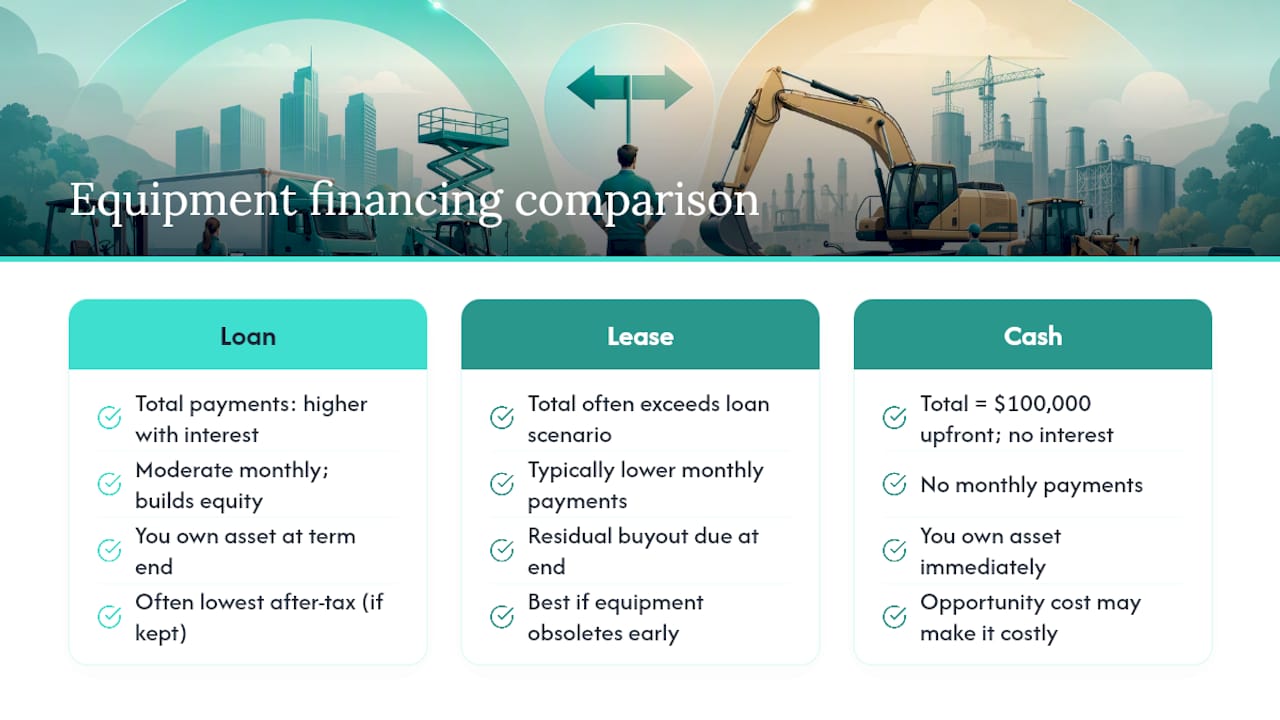
On a loan, assume a 5-year term at a mid-single-digit interest rate with a modest down payment. Total payments over the term will run higher than the sticker price once interest is added, but if you can claim accelerated depreciation against a healthy tax bill, the after-tax cost often lands lower than either alternative, provided you keep the equipment for its full useful life.
On a lease, monthly payments typically run lower than loan payments on the same asset, since you're not building equity. But add up 60 months of payments plus a residual buyout, and total cost frequently exceeds the loan scenario, unless the equipment obsolesces before the loan would have been paid off anyway.
On cash, you skip interest entirely, but that $100,000 stops earning anywhere else in the business. If your working capital could otherwise generate a return above what a loan would cost you in interest, paying cash is often the most expensive choice of the three once opportunity cost is counted honestly.
The takeaway that holds across most worked examples: loan financing tends to win on after-tax total cost for durable, long-life assets kept to term; leasing wins on monthly cash flow and for fast-obsolescing equipment; cash wins only when its opportunity cost genuinely runs below your loan rate.
Replace every assumption above with your actual quotes, your actual tax rate, and your actual cost of capital before deciding. The framework holds; the numbers are yours to plug in.
Why Work With a Financing Broker Instead of One Lender?
Approaching a single bank means accepting whatever underwriting box you happen to fit. Comparing lenders and lessors simultaneously changes that math considerably.
- Submitting one application across a panel of 30+ banks and non-bank lenders increases the odds that at least one underwriting profile matches your business.
- A broker handles the paperwork variance between lenders, since each one wants slightly different documentation and financial ratios.
- Kapvoy's process is charged only on successful funding, a 3 to 5% brokerage fee on the approved amount, with no upfront consultation costs.
- Average approval timelines through this process run 1 to 3 days once documents are complete.
A broker makes the most sense when your credit profile is complex, when speed matters more than shopping every lender yourself, or when you've already been turned down once and need a second read on which lender actually fits your numbers — explore more about business funding services to see how specialized funding options could benefit you.
What I'd Tell a Business Owner Weighing This Decision
The biggest mistake I see is chasing the lowest monthly payment without asking what it costs at the end of the term. A low payment with a large residual buyout isn't cheap, it's deferred.
Conservative, cash-generative businesses that plan to hold equipment for years usually do better financing and taking the depreciation. Growth-focused businesses juggling multiple priorities for their capital often do better leasing, even at a higher total cost, because the flexibility is worth more to them than the savings.
If you're not confident you'll get approved on your own terms, that's exactly when a broker earns its fee. Consult your accountant first. Then get more than one offer before you sign anything.
— Viknesh
Ready to Compare Financing Options Without the Guesswork
Kapvoy is the alternative to walking into one bank and hoping their underwriting fits your business. Instead of shopping lenders one at a time, Kapvoy submits your profile across a panel of 30+ banks and non-bank lenders simultaneously, so you see real financing terms to compare against any lease quote, without paying anything unless funding actually closes.
Reach out and expect a document request covering your financials, bank statements, and equipment details, the same list underwriters check regardless of which lender you choose. There's no consultation fee and no charge unless your financing gets approved and disbursed, with typical turnaround of 1 to 3 days once your paperwork is in. If your business also qualifies for EFS-backed support, that gets factored into the matching process automatically.
Check your financing options across Kapvoy's full panel or run a quick eligibility check to see where you stand before you commit to either a loan or a lease.
Sources
- Equipment Leasing Vs. Financing: Which Should You Choose? | Forbes Advisor
- Equipment Lease vs Loan vs Cash: 3-Way Math on $100K (2026) | Axiant
- EnterpriseSG — Enterprise Financing Scheme (EFS) — SME Fixed Assets
- Equipment Lease vs Loan: Which Is Right for You? (2026) | ClearLegalTips