3 Questions That Decide Fixed or Floating Home Loans in Singapore 2026

If your income is steady but your cash buffer is thin, a fixed-rate loan protects your budget from surprises. If you can absorb a few hundred dollars of swing in your monthly payment and want the lower rate SORA is currently offering, floating usually wins. Uncertain which camp you're in? A split loan hedges both ways. Read the checklist below, or check your eligibility with Kapvoy before you lock anything in.
TL;DR:
- Floating loans currently offer lower average costs due to recent SORA rate declines, making them more attractive than fixed options for many borrowers.
- Borrowers with variable income or planning to keep their loan short-term should lean toward floating, while those who prioritize budget certainty may prefer fixed rates despite higher initial costs.
- Refinance costs depend heavily on the contract’s penalty structure, with some using interest rate differentials that can be expensive if rates fall significantly.
- Hybrid loans split exposure, fixing part of the principal for certainty while leaving some floating to benefit from potential rate drops, ideal for uncertain market conditions or changing incomes.
- Using a broker that compares over 30 lenders can help borrowers find the best rate and structure, especially in a competitive market with narrow fixed-floating spreads.
Table of Contents
- Fixed vs Floating Home Loan: How Each One Actually Works
- Pros and Cons of Fixed vs Floating: The Budget-Focused Breakdown
- How to Choose Between Fixed and Floating: Your Decision Checklist
- Costs and Timeline When Switching or Refinancing
- Hybrid Loans: Splitting the Difference Between Fixed and Floating
- Why a Broker Matters When Rates Are This Close
- Get a Free Eligibility Check Before You Decide
- Sources
Fixed vs Floating Home Loan: How Each One Actually Works
A fixed-rate loan locks your interest rate for a set window, usually two to five years, sometimes called the "promotional" period. During that stretch, your monthly installment doesn't move, no matter what happens in the broader market. Once that window closes, the loan doesn't stay fixed. It typically reverts to a variable rate unless you actively refinance or convert, a mechanic MoneySense spells out clearly for local borrowers who assume the low rate they signed up for lasts the life of the loan.
Floating (also called variable) loans work differently from day one. Your rate tracks a reference benchmark, most commonly the Singapore Overnight Rate Average (SORA) or a bank's own Fixed Deposit Home Rate (FHR), plus a fixed spread the lender adds on top. When SORA moves, your installment moves with it, sometimes within the same billing cycle. DBS confirms this SORA/FHR pegging structure is now the standard floating format across Singapore banks.
Here's what that means for your wallet:
- A $500,000 loan at a 1% spread over SORA feels very different when SORA sits near 1% than when it sits near 4%.
- Compounded SORA rates have fallen since late 2023, which has made many floating packages cheaper than fixed ones for the first time in years, according to reporting from The Straits Times.
- Fixed borrowers who locked in during the high-rate years are now sometimes paying more than floating borrowers on an identical loan size.
That gap is exactly why so many owners are re-examining their choice this year.
Pros and Cons of Fixed vs Floating: The Budget-Focused Breakdown
Choosing between the two isn't about picking a winner. It's about matching the loan structure to how much payment uncertainty your household can actually tolerate.
- Fixed rate, upside: You know your exact installment for the entire lock-in period, which makes budgeting straightforward, and shields you if reference rates climb again.
- Fixed rate, downside: The advertised rate usually starts higher than floating, and breaking the loan early can trigger a break fee calculated in a way similar to an interest rate differential, sometimes a meaningful cost.
- Floating rate, upside: Rates have often been cheaper on a historical basis, and most floating packages allow cheaper partial prepayment along with penalty-free conversion to a fixed product within the loan's terms, per Straits Times reporting.
- Floating rate, downside: Your payment can rise without warning, which means you need a real emergency buffer, not just a mental one.
NerdWallet's comparison of fixed and variable products lands on the same basic trade-off: predictability costs you something upfront, and flexibility can save money but asks you to carry the risk yourself.
How to Choose Between Fixed and Floating: Your Decision Checklist
Start with three honest questions about your own situation before you look at a single rate sheet.
- How long do you plan to keep this loan or this property? Shorter horizons favor floating, since you won't be around long enough for a rate spike to do much damage.
- Could your household absorb a $300 to $500 jump in monthly payments for six months without missing other bills?
- Is your income variable (commission, business ownership, contract work) or fixed (salaried, stable)? Variable income pairs better with fixed-rate loans.
Once you know your profile, bring these exact questions to any lender or adviser:
- What is the lock-in length, and what happens the day it ends?
- How is the break fee or IRD-style penalty calculated if I exit early?
- What's the current spread over SORA or FHR, and has that spread changed recently?
- Do you offer free or discounted conversion from floating to fixed mid-term?
- What are the admin, valuation, and legal fees if I refinance instead of staying put?
- What notice period do you require before any rate change takes effect?
Pro Tip: Model two scenarios before you sign anything: one where SORA rises a full percentage point within a year, and one where it stays flat. If the "rises" scenario still fits your budget without stress, floating is probably safe for you. If it doesn't, fixed is the safer call regardless of today's headline rate.
If cash flow certainty wins every time you run that math, lean fixed. If the flat scenario and the rise scenario both feel manageable, floating's lower average cost is hard to ignore. Kapvoy's loan calculator lets you run both scenarios against your actual loan amount before you commit.
Costs and Timeline When Switching or Refinancing
Break costs aren't uniform across the market, and the calculation method matters more than most borrowers realize. Some fixed-rate contracts use an interest rate differential (IRD) style penalty, which factors in how much the current rate has dropped since you signed, and can get expensive if rates fell a lot. Others cap the penalty at a fixed number of months' worth of interest, a gentler structure that's easier to plan around.
Before you refinance, read your contract for:
- The exact notice period required to switch or exit (often one to three months).
- Whether valuation or legal fees apply, and who pays them.
- Any subsidy clawback if the bank covered your legal costs on the original loan.
Canstar's guidance on comparing fixed and variable products recommends modeling the "all-in" cost, meaning your new rate savings minus every fee you'll pay to get there, rather than comparing headline rates alone. Refinancing typically takes two to four weeks from application to disbursement once documents are in order. Kapvoy's refinancing guide breaks down the paperwork most Singapore banks request at each stage.
Hybrid Loans: Splitting the Difference Between Fixed and Floating
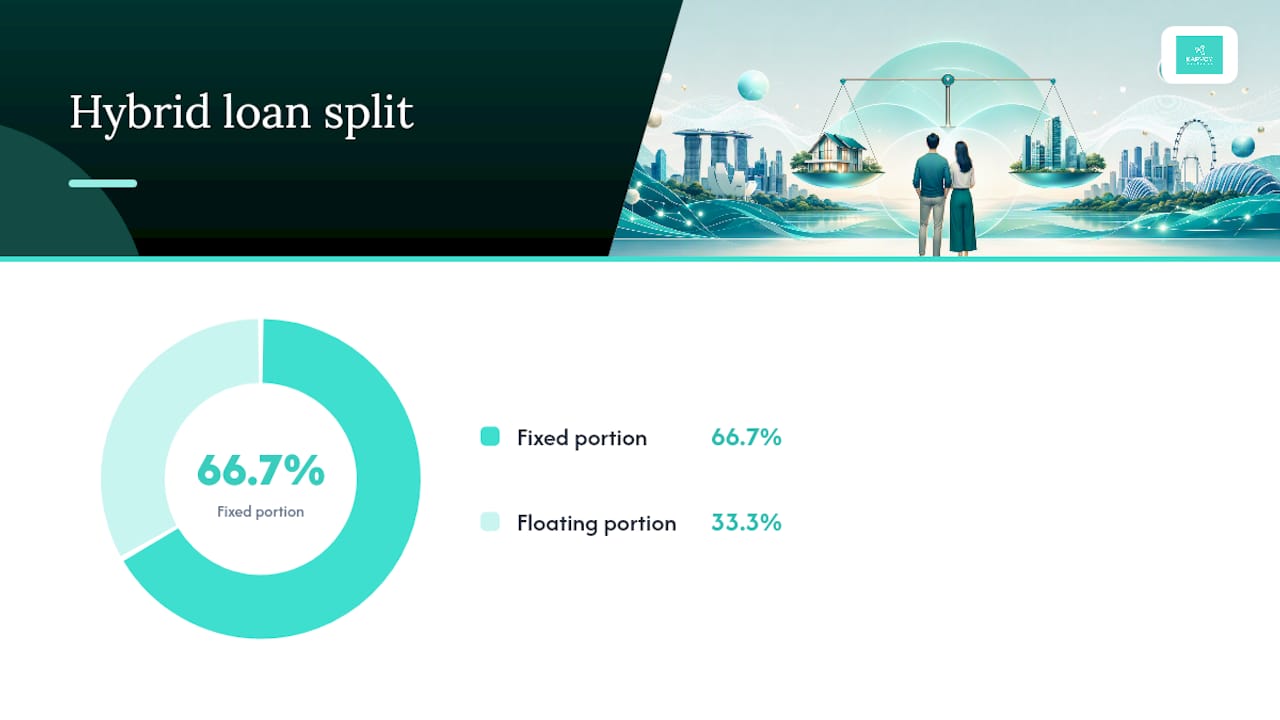
A split or hybrid loan divides your principal into two portions, one fixed and one floating, so you're never fully exposed to either outcome. If your loan is $600,000, you might fix $400,000 for certainty and leave $200,000 floating to catch any further rate drops.
This structure tends to make sense when:
- Your income is about to change (new job, business transition, retirement approaching).
- You expect rates to move but aren't confident which direction.
- You want a real hedge instead of guessing which side will win.
Staged approaches, short fixed terms followed by a review, work similarly and are a common defensive move when the market is uncertain rather than trending clearly one way.
Why a Broker Matters When Rates Are This Close
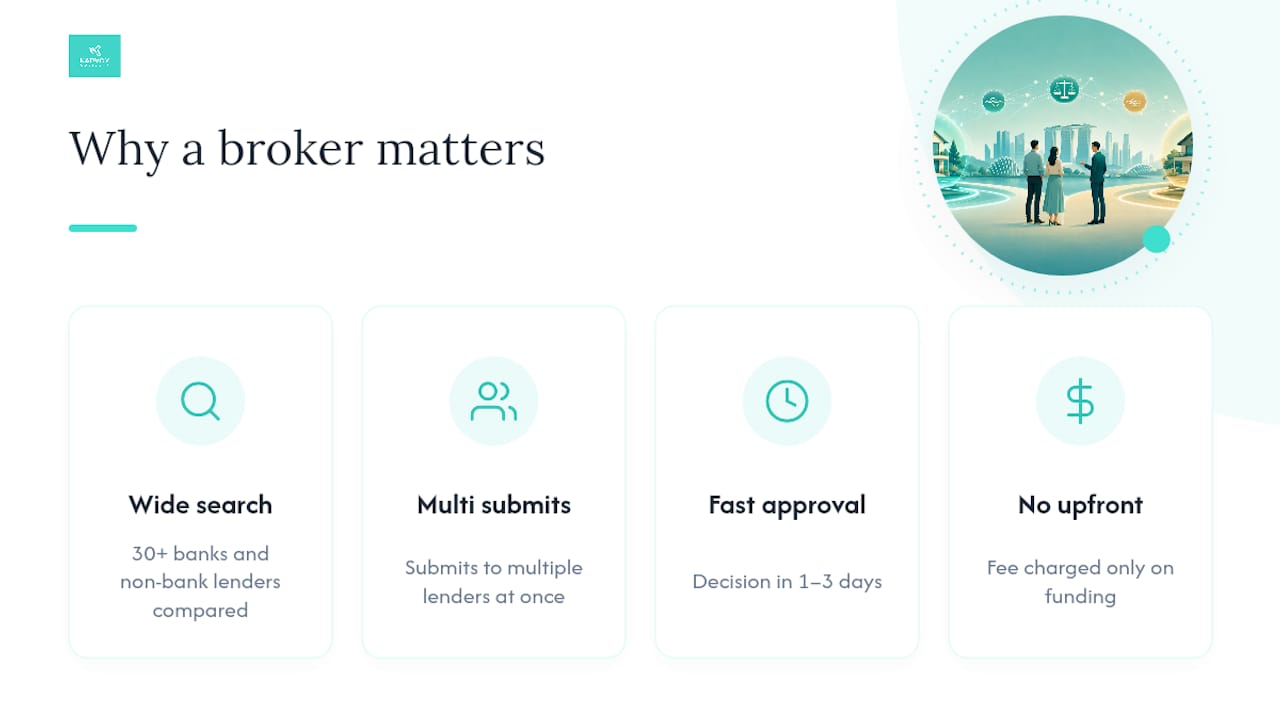
Choosing between fixed and floating gets harder when the gap between them is thin, which is exactly where 2026's market sits. Kapvoy compares packages across more than 30 banks and non-bank lenders, submitting to multiple lenders at once so you're not stuck negotiating with a single bank's rate sheet. That matters most when you're trying to time a refinance around a lock-in expiry or estimate a break fee before you commit to switching.
Clients typically get an approval decision within one to three days, and Kapvoy only charges a fee once funding is actually disbursed, never upfront...
Get a Free Eligibility Check Before You Decide
Comparing fixed and floating rates on paper only gets you so far. What actually changes your outcome is which lenders will approve you and at what spread, and that varies more than most rate tables show. Kapvoy is the alternative to walking into a single bank branch and taking whatever offer they hand you. We compare your profile against more than 30 lenders at once, and we only charge a fee once your loan is funded, never a consultation fee, never an upfront retainer.
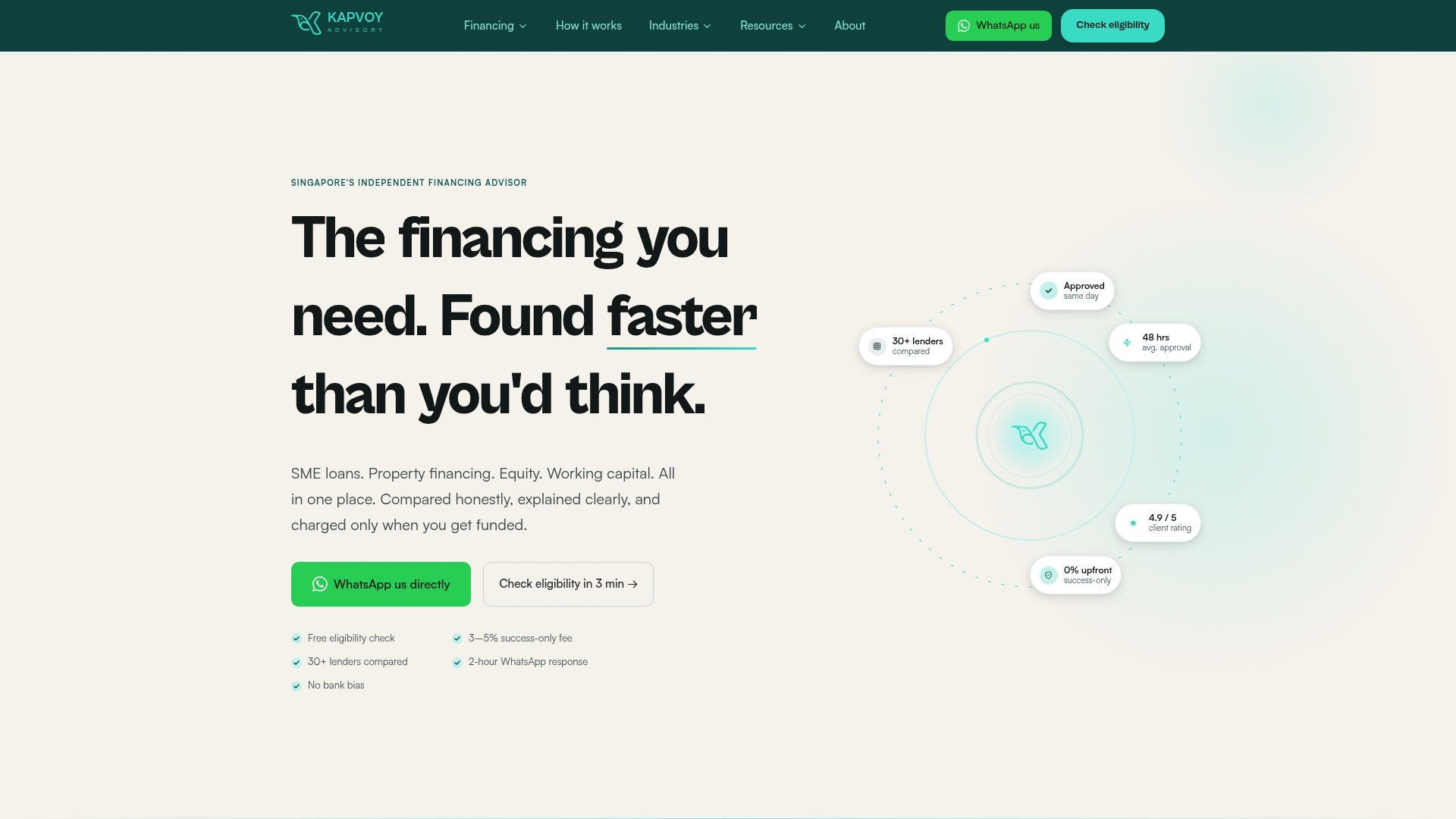
Starting is quick. A 3-minute eligibility check tells you which lenders are likely to approve your profile, followed by a short documents checklist and an estimated approval window, typically one to three days once your paperwork is complete. Browse the full range of financing options Kapvoy arranges, or start the eligibility check now to see what rate and structure actually fits your numbers.
This article is general information, not a substitute for advice from a qualified financial advisor. Consult a qualified financial professional about your own circumstances before acting on anything here.
Sources
- Most S’pore home owners still prefer fixed home loans despite lower floating rates | The Straits Times
- Fixed or floating home loan – which is better? | DBS
- How home loans work | MoneySense
- Fixed vs variable mortgage rates | NerdWallet