Singapore: Avoid SGD100–300 Broker Fees, Check Contracts, GST & Data

Most home loan borrowers in Singapore often pay nothing to a mortgage broker because the bank typically covers the commission on disbursement. Before signing anything, it's important to get the fee structure in writing and confirm whether GST applies.
TL;DR:
- Most home loan brokers in Singapore do not charge borrowers directly since their fees are covered by the bank's commission upon loan disbursement.
- SME and business loan brokers typically charge success fees ranging from 1% to 6%, with larger loans often having a minimum fee that can significantly impact costs.
- Upfront fees, usually SGD100 to SGD300, may be required for non-standard loans or higher-risk applications, but should be credited against the success fee whenever possible.
- A written agreement detailing the fee structure, payment timing, and conditions is essential to avoid disputes, with Singapore courts relying on the explicit terms stated in the contract.
- GST usually applies to broker fees, so borrowers should verify whether the quote is inclusive of tax and confirm that the broker is GST-registered to accurately assess total costs.
Table of Contents
- How Loan Broker Fees Work in Singapore
- Typical Fee Ranges By Loan Type
- When Might You Still Pay Upfront Fees?
- What Should Be in Your Broker Contract?
- How Does GST Apply to Broker Fees?
- How Do You Verify a Broker Is Trustworthy?
- Kapvoy operates on a success-only fee model, charging nothing unless financing is approved and funded, and takes no upfront costs, consultation charges, or retainer at any stage. This approach is often compared favorably to other broker fee models. Brokers may compare multiple banks and non-bank lenders for each application, submitting to several lenders at once rather than relying on a single relationship, which can increase the chances of approval compared to applying to one bank directly.
- Clients can find brokers who charge nothing until their loan is approved and funded, with no upfront costs, consultation fees, or retainer in between. Such brokers may provide access to a panel of multiple banks and non-bank lenders, submitting applications simultaneously rather than sequentially, potentially resulting in an average approval turnaround of one to three days once the application is complete.
- Where to Verify These Rules Yourself
- A Final Word on Fees and Trust
- Sources
- FAQ
How Loan Broker Fees Work in Singapore
The mechanics behind loan broker fees in Singapore depend almost entirely on which side of the transaction is paying. Understanding this distinction is the single most useful thing you can do before contacting a broker.
For residential mortgages, banks typically pay the broker a referral commission once the loan disburses. This is the same model used across most consumer credit brokering: the lender treats the broker as a distribution channel and pays for the introduction. You, the borrower, generally never see this fee on your statement. It is baked into the bank's cost of acquiring customers, not into your loan.
SME and business financing works differently. Because these deals often involve more underwriting complexity, non-standard lenders, or a panel of banks and alternative financiers, brokers frequently charge the borrower directly. This is the success fee model, and it only becomes payable once your loan is actually approved and funds are disbursed. No approval, no fee. Some brokers also work on flat consulting fees for discrete advisory tasks, such as reviewing a term sheet or restructuring an existing facility, though this is less common than success-based pricing.
A few fee structures you're likely to encounter:
- Bank-paid commission: The lender pays the broker on disbursement; you pay nothing extra.
- Success-only fee: A percentage of the approved loan amount, charged only after funding completes.
- Upfront admin fee: A modest fixed charge (often SGD100 to SGD300) collected before or during application processing.
- Flat advisory fee: A fixed dollar amount for a specific piece of work, unrelated to loan size.
Before agreeing to work with any broker, ask them to state plainly which model applies to your situation and put it in the engagement letter. If a broker hesitates to answer who pays and when, treat that as your first warning sign.
Typical Fee Ranges By Loan Type
Home loans sit at one end of the spectrum and SME financing at the other, with the difference in borrower cost being substantial. Mortgage brokers usually charge you nothing directly, since the bank's commission covers their work. When a mortgage broker does charge the borrower, it's typically a fixed fee for specialized advisory work rather than a percentage, and this is the exception rather than the norm.
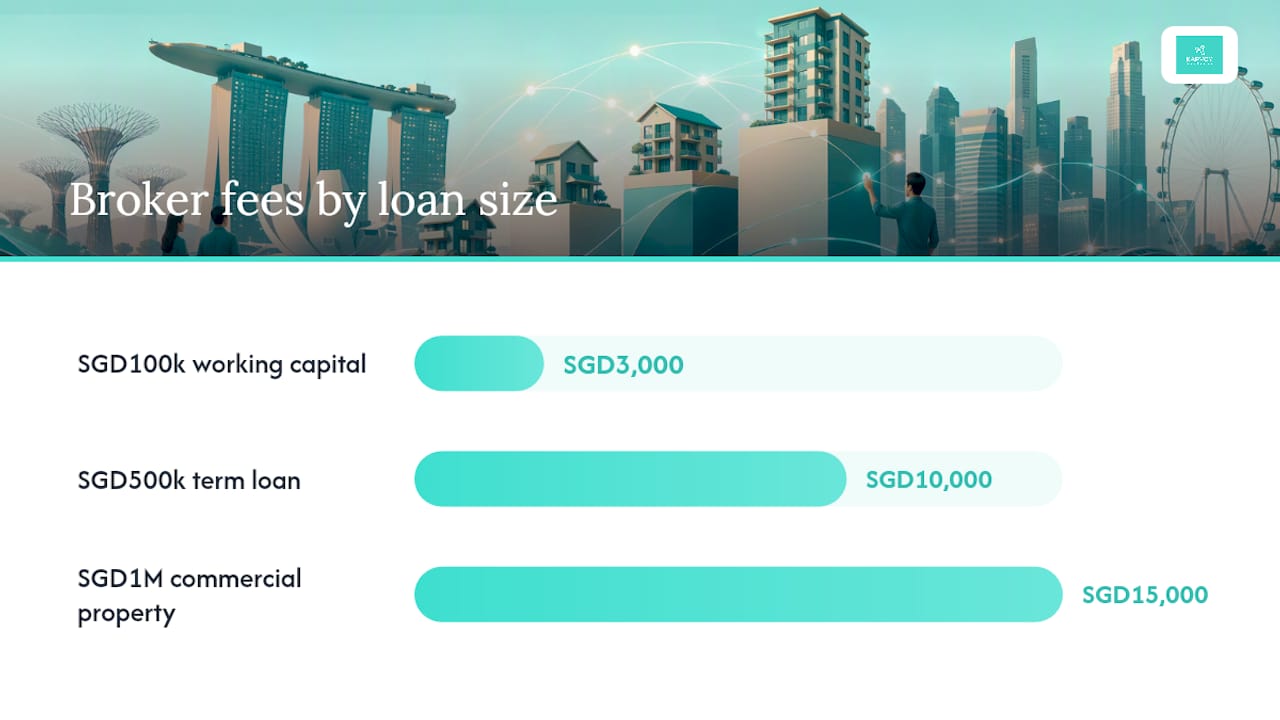
SME and business loan brokers commonly charge success fees in the 1% to 6% range/specific-business-sectors/finance), with many setting a minimum fee floor regardless of loan size. That floor matters more than it seems.
Here's how the percentages translate into real dollars for common loan sizes:
- SGD100,000 working capital loan at 3% success fee — you pay SGD3,000 upon disbursement.
- SGD500,000 term loan at 2% success fee — you pay SGD10,000 upon disbursement.
- SGD1,000,000 commercial property loan at 1.5% success fee — you pay SGD15,000 upon disbursement.
Larger, bespoke transactions (multi-lender syndications, cross-border structures, distressed refinancing) often use a sliding scale where the percentage drops as the loan size increases, but a minimum fee still applies. Always ask for the minimum fee in writing before you commit, because that single clause can quietly double your effective cost on a smaller facility. Running your own numbers through a loan calculator before signing gives you a sanity check against whatever percentage a broker quotes.
When Might You Still Pay Upfront Fees?
Not every broker works on pure success-only terms, and there are legitimate reasons some ask for money before approval comes through. Document preparation for non-standard lenders, credit assessments for higher-risk applicants, or specialized structuring work all take time regardless of outcome, and a handful of brokers pass a portion of that cost to you upfront.
Typical upfront charges sit in the SGD100 to SGD300 range. On paper that looks trivial, but run the math against a small loan and the picture changes.
Questions worth asking before you pay anything upfront:
- Is this fee refundable if my application is declined?
- Can this be credited against the success fee at disbursement instead?
- Why does this particular lender or loan type require an upfront charge?
- What exactly does this fee cover, and can I see an itemized breakdown?
Pro Tip: Ask the broker to convert the upfront fee into a credit against the final success fee rather than a separate charge. Most legitimate brokers will agree to this without pushback, and the ones who refuse are worth questioning further.
What Should Be in Your Broker Contract?
A written agreement is the difference between a smooth transaction and a fee dispute months later. Singapore's courts have made clear how much this matters: in Turms Advisors APAC Pte Ltd v Steppe Gold Ltd, the High Court found that because the mandate letter expressly stated a success fee, no implied "effective cause" requirement applied. The lesson is straightforward: whatever the contract says, in writing, is what governs.
Before signing, check the agreement covers these points:
- The exact fee amount or percentage, who pays it, in what currency, and when it becomes due (disbursement versus signing).
- The precise triggering event for the success fee, whether that's loan disbursement, a signed facility letter, or some other defined milestone.
- Exclusivity terms, including how long you're locked into working only with this broker and any tail clause that lets them claim a fee even after the engagement ends.
- Minimum fee floors and termination rights, spelled out in dollar terms, not vague language.
- Conflict-of-interest disclosures, confirming whether the broker receives incentives from any lender on their panel that might bias their recommendations.
Ask for a sample fee disclosure and a sample invoice before you sign anything. A broker confident in their process will hand these over without hesitation.
How Does GST Apply to Broker Fees?
Brokerage and advisory services are generally taxable supplies under IRAS guidance, which draws a clear line between the loan itself (an exempt financial supply) and the broker's service fee (a taxable one). That distinction catches a lot of borrowers off guard, since they assume financing-related costs carry the same exemption as the loan.
Before agreeing to any fee, ask two direct questions: is your quote GST-inclusive, and is the broker GST-registered in the first place? A broker that isn't GST-registered won't charge GST at all, which changes your effective cost calculation.
Once you get a tax invoice, check for:
- The broker's GST registration number displayed on the document.
- A clear breakdown showing the base fee and the GST amount separately.
- The total payable amount matching what you were quoted, inclusive of tax.
On a SGD10,000 success fee, a standard GST rate can add several hundred dollars to your actual outlay. That's not a rounding error. Get the GST treatment confirmed in writing before you factor a broker's fee into your overall loan affordability.
How Do You Verify a Broker Is Trustworthy?
Singapore gives you several free, official ways to check a broker before handing over any documents or fees. Running these checks takes maybe fifteen minutes and can save you from a costly mistake.
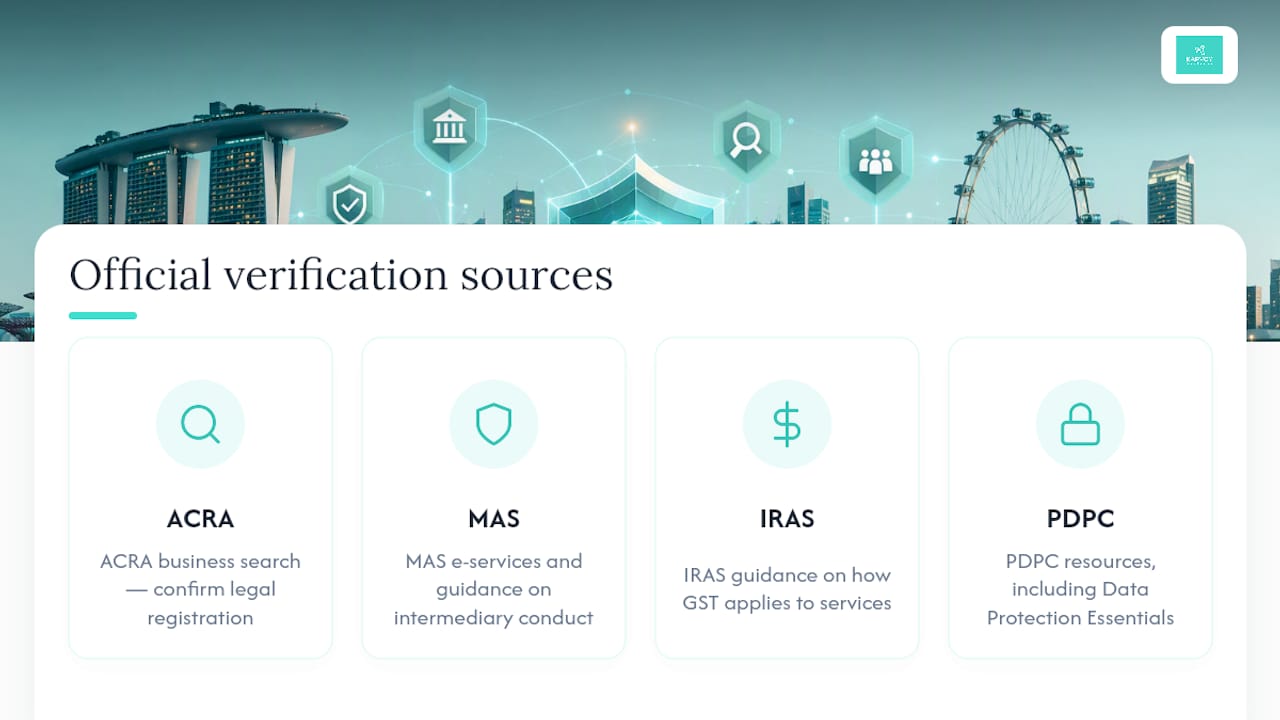
Start with the basics: confirm the brokerage is a registered entity through ACRA's business search, and review relevant guidance published by the Monetary Authority of Singapore on financial intermediary conduct. Neither check costs anything and both take minutes.
Data handling deserves equal scrutiny. Ask whether the broker has completed Data Protection Essentials or an equivalent program under PDPC and IMDA. This isn't a box-ticking exercise. Firms that complete DPE typically build inventory maps of where client data lives and set up incident response plans, which matters when you're handing over payslips, bank statements, and identification documents.
Watch for these red flags without exception:
- A broker asking for your Singpass credentials or online banking password.
- Guaranteed approval promises made before any document review.
- No written fee disclosure, or reluctance to put terms in writing.
- Pressure to sign an engagement letter within hours, with no time to review it.
Proper data handling isn't just about protecting you. Lenders are more willing to work with brokers who demonstrate clean compliance practices, which can translate into smoother approvals for you.
Kapvoy operates on a success-only fee model, charging nothing unless financing is approved and funded, and takes no upfront costs, consultation charges, or retainer at any stage. This approach is often compared favorably to other broker fee models. Brokers may compare multiple banks and non-bank lenders for each application, submitting to several lenders at once rather than relying on a single relationship, which can increase the chances of approval compared to applying to one bank directly.
Whichever broker you're evaluating, whether it's Kapvoy or anyone else, run through this checklist before signing:
- Who pays the fee, the bank or me, and under what circumstances?
- What is the exact percentage or dollar amount, and is there a minimum fee floor?
- Is the quote GST-inclusive, and are you GST-registered?
- Exactly when does payment become due: at disbursement, at signing, or at engagement?
- How many lenders are on your panel, and can you show me a sample fee disclosure clause?
Ask to see a sample fee disclosure document and a sample invoice before committing to anything. These two documents tell you more about a broker's transparency than any sales conversation will.
Pro Tip: Even with a success-only model, ask explicitly whether unusually complex deals (multi-lender syndications, distressed refinancing, cross-border structures) might carry different terms. A trustworthy broker will confirm any exception in writing rather than leave it as a verbal caveat.
Clients can find brokers who charge nothing until their loan is approved and funded, with no upfront costs, consultation fees, or retainer in between. Such brokers may provide access to a panel of multiple banks and non-bank lenders, submitting applications simultaneously rather than sequentially, potentially resulting in an average approval turnaround of one to three days once the application is complete.
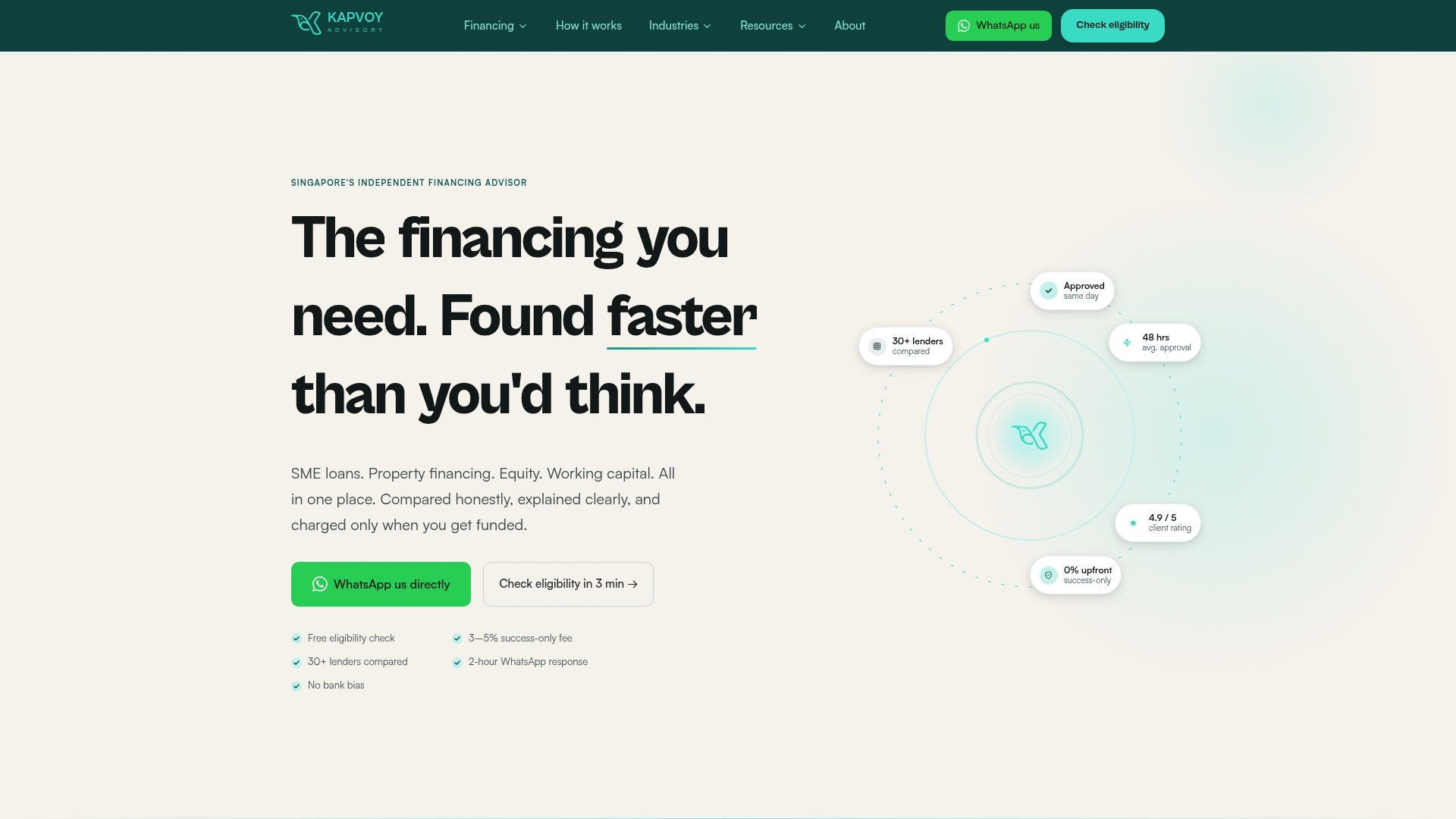
That multi-lender approach exists because a single bank's rejection often has nothing to do with your business, and everything to do with that particular lender's risk appetite that month. Submitting to a wider panel at once means one lender's "no" doesn't end your search. If you're weighing SME financing, Kapvoy's Working Capital Loan options give you a starting point, and property owners exploring refinancing or equity release can review property financing solutions built around the same success-only structure.
The fastest way to see where you stand is to check your eligibility in three minutes. There's no cost to check, and no obligation to proceed if the numbers don't work for you.
Where to Verify These Rules Yourself
Don't take any broker's word for legal or tax claims when you can check the source directly. The Monetary Authority of Singapore publishes e-services and guidance covering financial intermediary conduct. IRAS sets out exactly how GST applies to financial and advisory services. The PDPC maintains resources on data protection standards, including the Data Protection Essentials program referenced earlier. For confirming a brokerage's legal registration, ACRA's business search remains the quickest official check available to the public.
A Final Word on Fees and Trust
The biggest mistake I see borrowers make isn't overpaying a broker. It's failing to get the fee terms in writing before any document changes hands. Verbal promises about "no hidden fees" mean nothing once a dispute starts, and Singapore's courts have shown they'll enforce exactly what a mandate letter says, whether that favors you or the broker.
My advice is simple: insist on a written fee disclosure before you hand over a single document, and never, under any circumstance, share your Singpass credentials or banking passwords with a broker. No legitimate advisor needs either.
— Viknesh
Sources
FAQ
How Much Does a Loan Broker Charge in Singapore?
Mortgage brokers typically charge borrowers nothing, since banks pay their commission on disbursement. Kapvoy charges 3% to 5% of the approved amount, only upon successful funding.
Do Loan Brokers Charge a Fee if My Application Is Rejected?
Under a success-only model, no fee is charged if the application doesn't result in a funded loan. Some brokers do collect small upfront admin fees regardless of outcome, typically SGD100 to SGD300, so always confirm this before applying.
How Much Do Broker Fees Cost on a Typical SME Loan?
The exact percentage depends on loan complexity, lender panel size, and whether a minimum fee floor applies, so always get the calculation in writing before signing.
Which Broker Is the Best in Singapore?
The right broker depends on your loan type, deal complexity, and how transparent their fee terms are in writing. Look for a success-only fee structure, no upfront costs, a documented panel of multiple lenders, and clear GST treatment on their invoices, all signals of a trustworthy setup like the one Kapvoy documents on its site.
Are Loan Broker Fees in Singapore Subject to GST?
Yes, brokerage and advisory fees are generally treated as taxable supplies under IRAS rules, separate from the loan itself, which is GST-exempt. Always ask whether a broker's quote is GST-inclusive before comparing it against another offer.