Loan Interest Rate Types: Fixed, Variable, and Hybrid Explained

Every loan runs on one of three interest structures: fixed, variable (also called floating), and hybrid. Fixed locks your rate for predictable payments. Variable tracks a benchmark, so your cost rises and falls with the market. Hybrid gives you a fixed rate for a set period before switching to variable. The right pick comes down to how much payment certainty you need versus how much risk you can absorb if rates climb.
TL;DR:
- Variable loans are more suitable for short-term financing under three years, while fixed or hybrid rates are better for long-term property loans.
- Comparing the APR, which includes fees and additional costs, provides a more accurate measure of a loan's true expense than just the interest rate.
- Run a detailed analysis of the amortization schedule and penalty fees, especially when considering variable or hybrid options with adjustable caps.
- For floating-rate loans, knowing the benchmark index, margin, and caps is essential to model worst-case payment scenarios before committing.
- Using broker comparison tools can reveal margin differences across lenders that may not be apparent from individual quotes alone.
Table of Contents
- What Are the Main Loan Interest Rate Types?
- How Is Loan Interest Actually Calculated?
- Fixed vs. Variable vs. Hybrid: Which Fits Your Situation?
- APR vs. Interest Rate: What's the Real Cost?
- How Do You Compare Loan Offers Properly?
- How Brokers Compare Rate Types Across Lenders
- The One Thing Most Borrowers Get Wrong
- Tools and Reading to Verify Your Numbers
- Sources
What Are the Main Loan Interest Rate Types?
A fixed interest rate stays the same for the entire loan term. Banks typically offer it on mortgages, auto loans, and personal loans where borrowers want a payment they can plan around for years. If you take a five-year personal loan at 6% fixed, your monthly payment on day one looks identical to your payment in year four, no matter what happens in the broader economy.
Variable, or floating, rates move with a benchmark index plus a fixed margin the lender adds on top. In Singapore, that benchmark is usually SORA (the Singapore Overnight Rate Average), and your rate resets periodically, often monthly or quarterly, as SORA shifts. A loan quoted as "SORA plus 1.5%" will cost more when SORA climbs and less when it falls, which is the core tradeoff against a fixed structure.
Hybrid loans split the difference. A common structure fixes the rate for the first two or three years, then converts to variable for the remainder of the term. Someone financing a commercial property might take a three-year fixed period to stabilize cash flow, then accept market exposure once the business is established.
Here's how the three types typically compare on a typical loan over five years:
- Fixed: Rate and payment stay constant regardless of market moves.
- Variable: Rate adjusts with the benchmark, so early savings can turn into higher payments later.
- Hybrid: Payments stay flat during the fixed window, then behave like a variable loan afterward.
How Is Loan Interest Actually Calculated?
Lenders use one of three math methods, and the difference between them changes how much interest you actually pay over the life of the loan.
- Simple interest uses Principal × Rate × Time. A $10,000 loan at 5% for two years costs exactly $1,000 in interest, no matter how you structure repayments. Short-term and some personal loans use this method because it's easy to verify.
- Amortized interest recalculates monthly based on the declining balance. Your payment stays level, but the mix inside it shifts. Early on, most of each payment covers interest; later, more goes to principal. Amortization schedules front-load interest this way, which is why paying off a mortgage two years early saves less than borrowers expect.
- Compound interest charges interest on the principal plus any interest that's already accrued. Revolving credit lines and unpaid credit card balances work this way, and it's why carrying a balance snowballs faster than a fixed installment loan.
Quick math: On a $50,000 loan at 6% for five years, simple interest would total $15,000 flat. The same nominal rate on an amortized schedule produces roughly similar total interest, but the timing matters. In year one, close to 70% of each payment might go toward interest alone, based on how amortization math generally front-loads interest costs. That's the detail most borrowers miss until they check their own amortization table.
Fixed vs. Variable vs. Hybrid: Which Fits Your Situation?
Each structure carries a distinct risk profile, and picking wrong usually shows up in your budget within the first year of rate movement.
Fixed rate pros: predictable payments, easier budgeting, protection if benchmarks rise. Fixed rate cons: you pay a premium for that certainty, and refinancing before your lock-in ends often triggers a penalty.
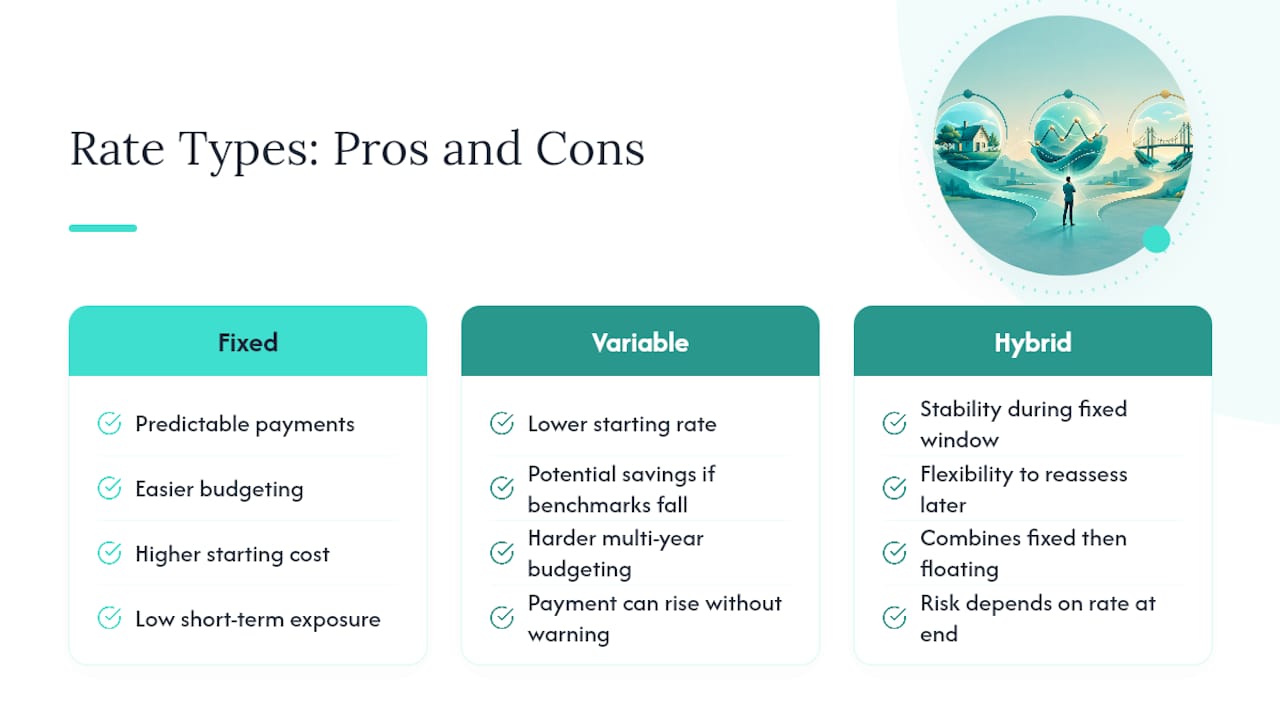
Variable rate pros: typically lower starting rate, potential savings if benchmarks fall. Variable rate cons: payment can rise without warning, and budgeting gets harder over a multi-year term.
Hybrid pros: stability during the fixed window, flexibility to reassess before the floating phase starts. Hybrid cons: you're essentially betting on where rates sit when the fixed period ends.
Many variable-rate products include adjustment caps (a limit on how much the rate can move per period) and lifetime caps (a ceiling for the full term). Knowing both numbers, not just the starting rate, is how you model a worst-case payment before you sign anything.
Pro Tip: If you're financing something with a horizon under three years, floating rates usually make more sense; the exposure window is short. For anything past five years, especially a mortgage, run the numbers on what happens if the benchmark rises two full percentage points before you commit to a floating structure.
A short-term working capital loan for a business with steady income can usually absorb variable-rate movement. A 20-year property loan for someone on a fixed salary generally can't, and that's exactly where fixed or hybrid earns its higher starting cost. If you're weighing this for a property purchase, comparing fixed and floating packages side by side before you sign is worth the extra hour it takes.

APR vs. Interest Rate: What's the Real Cost?
The quoted interest rate is not what you'll actually pay. APR (annual percentage rate) folds in the interest rate plus lender fees, including origination charges, admin fees, and sometimes mandatory insurance, giving you the true annualized cost.
Two loans can quote the same 7% interest rate and still cost very differently. Loan A charges no fees, so its APR stays at 7%. On a $50,000 loan, that gap alone can mean well over $1,000 in extra cost you wouldn't see by comparing rates alone.
When you're reading loan documents, watch for:
- "Processing fee" or "admin fee" charged separately from the quoted rate
- "Rate subject to change" language buried in variable-rate contracts
- Insurance or "protection plan" add ons bundled into the payment
- A prepayment penalty clause that only appears in the fine print
Comparing APRs, not headline rates, is the single fastest way to spot which offer is genuinely cheaper.
How Do You Compare Loan Offers Properly?
Run through this order before signing anything, and don't skip steps just because a rate looks attractive upfront.
- Confirm the rate type. Is it fixed, variable, or hybrid, and for how long does each phase last?
- Ask for the APR, not just the rate. Request a written breakdown of every fee folded into that number.
- Request the amortization schedule. See exactly how much of your early payments goes to interest versus principal.
- Check the lock-in period and penalty. Ask what it costs to refinance or repay early during that window.
- Identify the index and margin. For variable loans, ask which benchmark applies and what fixed margin sits on top of it.
- Ask about caps. Confirm both the per-adjustment cap and the lifetime cap before assuming a worst-case scenario is manageable.
If a lender can't clearly answer what index they use or hedges on the prepayment penalty, treat that as a red flag, not a formality. Lock in a fixed or hybrid rate when you value certainty over the loan term; consider floating when your horizon is short or you can absorb payment swings. When the math gets complicated across multiple lender quotes, that's usually the point to bring in an advisor rather than guess.
How Brokers Compare Rate Types Across Lenders
Brokers pull quotes across a panel of lenders at once, which surfaces margin differences a single bank visit never shows you. Kapvoy compares offers from more than 30 banks and non-bank lenders, submitting applications in parallel rather than one at a time, with an average approval turnaround of one to three days and no upfront fees or consultation charges. That matters most when a fixed package from one lender carries a lower margin than a competitor's variable offer, a gap that's easy to miss without comparing side by side.
The One Thing Most Borrowers Get Wrong
Most people fixate on the headline rate and skip the amortization schedule entirely, which is backwards. The rate tells you the price; the schedule tells you when you actually pay it. A fixed rate that feels expensive on paper can beat a variable rate that looks cheap today but resets twice before your loan matures. Run the numbers on both structures before you sign, and if the comparison gets messy across lenders, that's exactly when a second opinion pays for itself.
— Viknesh
Tools and Reading to Verify Your Numbers
Model your own amortization with Kapvoy's loan calculator or CashflowCalcs, and explore brokered options at Kapvoy's financing page.
This article is general information, not a substitute for advice from a qualified financial advisor. Consult a qualified financial professional about your own circumstances before acting on anything here.
Sources
- Fixed interest rate definition and guidance | Investopedia
- How To Calculate Loan Interest: Simple And Amortized | Bankrate