Singapore Home Loans: 1–5 Year Lock In and How to Calculate Exit Cost

A lock-in period is a contractual window, usually one to five years from your first loan disbursement, during which repaying early or refinancing triggers penalty fees. It doesn't stop you from selling or switching banks; it just makes both cost more. Before you act, request a written redemption statement from your bank and check your Residential Property Loan Fact Sheet so you know the exit cost, not just the outstanding balance.
TL;DR:
- Lock-in periods typically last two to three years but may have different start dates, so confirm the exact duration and start point in writing.
- Penalties for early repayment or refinancing vary widely and require asking your bank directly for an itemized, written redemption statement.
- The lock-in period differs from the fixed-rate period; always check both dates separately and understand their impact on penalties.
- During lock-in, refinancing to another bank will usually involve redemption fees, clawbacks, and legal costs, often taking two to eight weeks to process.
- Running a break-even analysis with actual redemption costs, not outstanding balances, will help determine if refinancing makes financial sense within your planned property holding period.
Table of Contents
- What Is a Lock-In Period for a Home Loan in Singapore?
- How Long Do Lock-In Periods Usually Last, and What Do They Cost?
- Lock-In Period vs. Fixed-Rate Period: Why the Difference Matters
- Selling, Repricing, or Refinancing During Lock-In: What Actually Happens
- How to Run a Break-Even Test Before You Refinance or Reprice
- What Brokers See Go Wrong With Lock-In Periods
- Get Help Comparing Exit Costs and Refinancing Offers
- Where to Verify These Rules Yourself
- Sources
- FAQ
What Is a Lock-In Period for a Home Loan in Singapore?
A lock-in period is a clause in your mortgage contract, not a law that restricts what you can do with your property. You can sell, refinance, or make a partial prepayment at any point. The lock-in clause simply determines whether the bank charges you a fee for doing it early.
The clock typically starts on the date of your first loan disbursement, not the date you signed the letter of offer. This distinction matters more than most buyers realize. If you bought a new launch or are building on a construction loan with progressive disbursements, banks may interpret the lock-in start date differently. Some count it from the first drawdown, others from the first full disbursement. Confirm this in writing before you assume your lock-in has expired.
Singapore banks are required to issue a Residential Property Loan Fact Sheet that spells out your loan's core terms in one document. Under MAS Notice 632A, this sheet must disclose:
- The exact length of the lock-in period
- A rate-change illustration covering at least one year beyond the lock-in
- The effective interest rate (EIR), not just the headline rate
- Penalty fees and how they're calculated
Keep this fact sheet with your loan documents. It's the fastest way to check your terms without waiting on hold with the bank.
How Long Do Lock-In Periods Usually Last, and What Do They Cost?
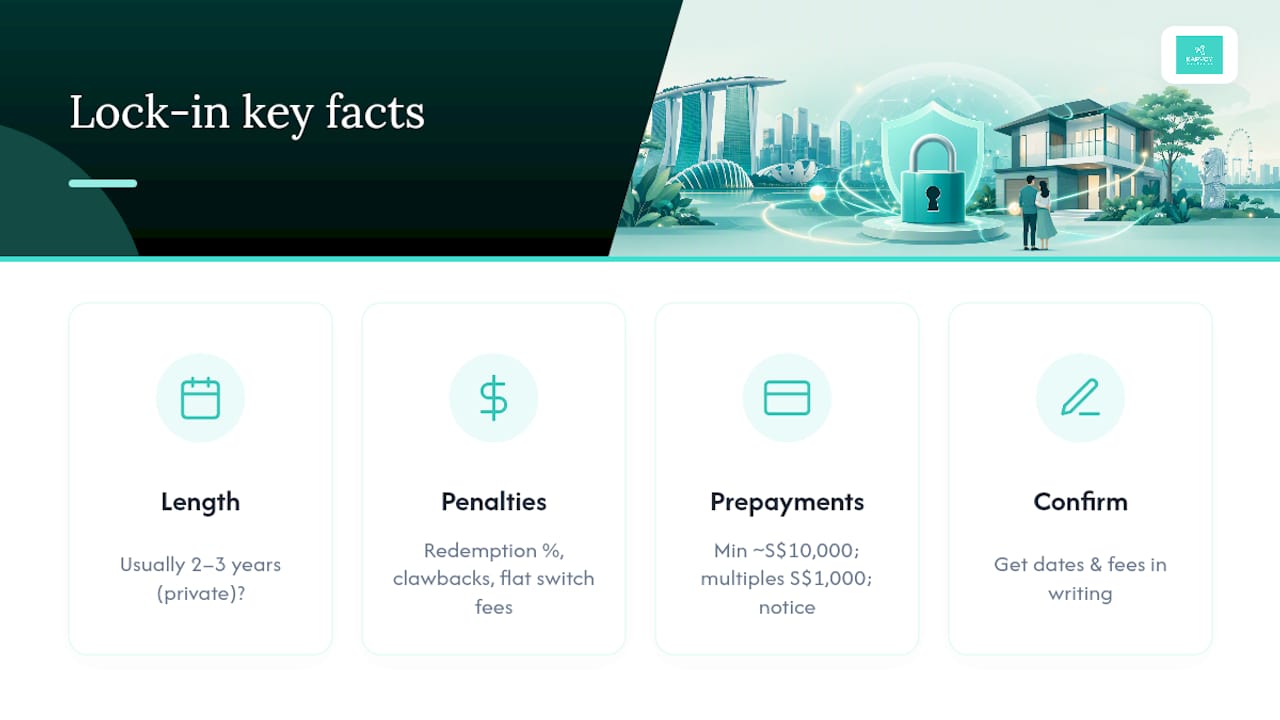
Most Singapore home loans carry lock-in periods typically lasting a few years, with two and three years being common for private property packages. Banks describe these in marketing language like "2-year lock-in" or "3-year fixed with lock-in," but the fine print on penalties varies more than the headline suggests.
Pro Tip: Don't assume "fixed rate" and "lock-in" always expire on the same date. Ask your bank to confirm both dates separately, in writing, before you plan a refinance.
Penalties generally fall into categories such as redemption penalties (often a small percentage of the outstanding loan), subsidy clawbacks of fees you received, and smaller flat fees for switching packages within the same bank.
On minimum prepayment amounts, ABS guidance notes that banks commonly set a floor for partial prepayments, often starting around S$10,000 and in multiples of S$1,000, along with a required notice period before the prepayment date. Miss the notice window and the bank can reject the payment date you wanted or apply an extra charge.
None of these figures are standardized across the industry. The only reliable way to confirm your exact penalty percentage, clawback window, and notice period is to ask your bank directly and get it in writing, ideally as part of an itemized redemption statement.
Lock-In Period vs. Fixed-Rate Period: Why the Difference Matters
These two terms get used interchangeably, but they answer different questions. The fixed-rate period tells you how long your interest rate stays flat. The lock-in period tells you how long penalties apply if you leave. They frequently run for the same duration, but not always.
Consider a package with a 2-year fixed rate and a 3-year lock-in. Your rate becomes variable after year two, potentially rising with market conditions, but you're still locked into penalty exposure for a third year if you try to refinance away from that variable rate. Borrowers who assume both periods end together sometimes budget for a rate change without realizing they'd still pay an exit fee to escape it.
- Check both dates separately on your Fact Sheet.
- Use the rate-change illustration required under MAS Notice 632A, which projects payments for at least one year past the lock-in, to see what your installment could look like if rates move.
- Mark both dates in your calendar, not just one.
Selling, Repricing, or Refinancing During Lock-In: What Actually Happens
If you're selling. You'll need a redemption statement from your bank showing the exact payoff amount, including any penalty and clawback, plus a CPF refund estimate covering the principal you withdrew and the accrued interest owed back to your CPF account. CPF's refund guidance is the source to model your actual cash proceeds, since sale price minus outstanding loan is not the same as what lands in your bank account.
If you're repricing with your current bank. Repricing means switching to a new rate package without changing lenders, and it's usually the first option to explore because it often avoids legal and valuation fees entirely. MoneySense recommends asking your bank directly whether lock-in still applies to the new package and getting written confirmation of any waiver before you sign.
If you're refinancing to another bank. Budget for the redemption penalty, any subsidy clawback, new legal and valuation fees, and the fact that your new loan will trigger its own TDSR assessment and processing timeline, typically two to eight weeks.
- Request your current bank's itemized redemption statement.
- Ask if repricing is available and whether lock-in penalties are waived for existing customers.
- If refinancing, get at least two competing rate quotes before committing.
- Confirm notice periods with your current bank so you don't miss the redemption date window.
- Time your legal and valuation appointments to align with the notice period, not after it.
Pro Tip: Ask your bank to confirm in writing whether a partial prepayment is treated as reducing your monthly installment or shortening your tenure. The wrong assumption here can throw off your break-even math by months.
How to Run a Break-Even Test Before You Refinance or Reprice
The math is simple once you have the right numbers, and the number most people get wrong is the exit cost. Don't estimate it from your outstanding balance. Get the itemized figure.
Your itemized redemption statement should list:
- Prepayment or redemption penalty (usually a percentage of the loan)
- Subsidy clawback amount, if any, and its expiry date
- Accrued interest up to the payoff date
- Admin, legal, and valuation fees for the new loan
MAS guidance on disclosures requires banks to explain how these fees are calculated, so if a line item looks unclear, you're entitled to ask for the formula.
Once you have the exit cost, compare it against your projected savings. MoneySense's framework is straightforward: estimate the interest you'd save on the new rate over the period you plan to hold the loan, then subtract every exit cost from your current package.
If you plan to hold the property for less than the break-even period, the switch likely costs more than it saves. If you're planning to keep the loan for a decade or sell within two years, that same $13,800 exit cost tells two very different stories. Run this test with your own numbers using a loan calculator before signing anything, and ask your bank or broker for written proof of every figure in the table.
What Brokers See Go Wrong With Lock-In Periods
The most common mistake isn't misreading the lock-in length. It's assuming repricing is automatically free of penalties just because you're staying with the same bank. Some banks still apply a conversion fee or require the lock-in to reset on the new package.
The second trap involves progressive disbursement loans. Borrowers on new launches often calculate their lock-in from the signing date instead of the first disbursement, then get blind sided by a penalty they thought had expired.
What a broker typically does differently is coordinate the timeline: pulling the redemption statement, lining up valuation and legal work, and cross-checking notice periods against the new lender's processing schedule so nothing falls through a gap. A structured approach to timing around lock-in penalties tends to save more money than chasing the lowest headline rate.
— Viknesh
Get Help Comparing Exit Costs and Refinancing Offers
Working out whether refinancing beats staying put takes more than one rate comparison; it takes redemption statements, clawback figures, and quotes from multiple banks lined up side by side. An advisory service does that legwork for you, comparing offers across a panel of banks and lenders instead of the one or two you'd get quotes from on your own.
There is typically no fee unless your refinancing or new mortgage actually funds, and the average approval turnaround can run one to three business days once your documents are in. The process starts the same way this article recommends: get your current bank's redemption statement first, then bring it to Kapvoy so the comparison against new lender offers is based on real numbers, not estimates. If you're ready to see what a refinance or new home loan could actually save after accounting for your lock-in exit cost, consider starting there.
Where to Verify These Rules Yourself
- MoneySense's home loan guidance explains repricing versus refinancing and recommends getting a written redemption statement before deciding. Use it when comparing your net savings.
- ABS's housing loans guide covers minimum prepayment amounts and notice periods. Check it if you're planning a partial prepayment.
- MAS Notice 632A sets the disclosure rules banks must follow on your Fact Sheet. Reference it if a bank's disclosure looks incomplete.
- CPF's refund guidance determines what you owe back to your CPF account when you sell. Use it before estimating your sale proceeds.
- HDB's loan and interest guidance applies specifically to HDB loans, which follow different rules than bank mortgages.
Sources
- How home loans work | MoneySense
- Housing loans guide | ABS
- MAS Notice 632A on Residential Property Loan Fact Sheet (excerpt)
- CPF: Refund when selling or transferring property
FAQ
Does an HDB Home Loan Have a Lock-In Period?
HDB loans don't carry a lock-in period the way bank loans do, since HDB sets its own interest rate and repayment rules rather than a package-based mortgage structure. If you're comparing an HDB loan against a bank loan for a flat purchase, check a side-by-side breakdown of how the two are structured differently.
Can I Reprice a Home Loan During the Lock-In Period?
Yes, in many cases, but you should confirm with your bank in writing whether the lock-in penalty is waived for repricing or whether a new lock-in period starts. Some banks allow existing customers to switch packages penalty-free while others still charge a conversion fee.
Will Mortgage Rates Go Down in Singapore in 2026?
Rate direction depends on broader interest rate movements that no borrower can predict with certainty, so the safer approach is to plan around your break-even number rather than a rate forecast. Use the rate-change illustration on your Fact Sheet to stress-test your installment under different scenarios instead.
Can a 65-Year-Old Take Out an HDB Loan?
Age affects loan tenure and eligibility under HDB's own rules, and older applicants typically face a shorter maximum tenure tied to the loan-to-value limits HDB sets. Because these rules sit outside standard bank lock-in terms, check current eligibility directly with HDB's loan guidance or a broker familiar with age-based tenure caps.
What Does Kapvoy Charge to Help With Refinancing?
Kapvoy charges a success-only fee of 3% to 5% of the approved loan amount, billed only once your financing is funded. There's no upfront consultation charge, so you can compare offers before committing to anything.