S$30,000 MCA Example for Singapore SMEs: MAS Checks, Broker Checklist

For Singapore SMEs that rely on steady card sales and need cash within days, a merchant cash advance (MCA) delivers speed at a real cost, often the highest of any financing option available to you. It suits retail, F&B, and e-commerce businesses covering a short, revenue-generating gap, not a permanent fix for thin margins. If you can wait two to three weeks, a term loan or invoice financing almost always costs less.
TL;DR:
- Merchant cash advances are expensive, with effective APRs often reaching high triple digits if repaid quickly, due to fixed fees and holdback percentages.
- They suit cash-flow-dependent businesses with stable card sales, like retail and F&B, but are unsuitable for long-term investments or thin margins.
- Faster funding from platform-based providers takes 1 to 2 days, but contracts often include red flags such as personal guarantees and account sweep clauses.
- Alternatives like term loans or invoice financing typically cost less if the business can wait two to three weeks for approval.
- Using a broker panel can help compare multiple financing options quickly, avoiding the high cost and risk of unsuitable MCA contracts.
Table of Contents
- What Is a Merchant Cash Advance and How Does It Work in Singapore?
- How Do You Calculate the True Cost of an MCA?
- Which Singapore Businesses Actually Qualify for an MCA?
- How Do You Apply for a Cash Advance in Singapore?
- What Are the Lower-Cost Alternatives to an MCA?
- What Contract Red Flags Should You Watch For?
- What Does an MCA Cost Compared to a Bank Loan in Practice?
- When Does a Brokered, Multi-Lender Approach Help?
- A Practical Decision Checklist Before You Sign
- How Kapvoy Helps You Compare Financing Options Without the Guesswork
- Where to Verify These Figures Yourself
- Sources
- FAQ
What Is a Merchant Cash Advance and How Does It Work in Singapore?
A merchant cash advance is not a loan. It's a purchase of your future receivables. A provider gives you a lump sum today in exchange for a cut of your daily card sales until you've paid back the agreed amount, plus a fee. That distinction matters legally: because MCAs are structured as receivables purchases rather than credit, they often fall outside the interest rate protections that apply to conventional lending, which is why the contract terms themselves, not an advertised rate, deserve your closest read.
Two numbers define every MCA offer: the holdback rate and the factor rate.
- Holdback (or retrieval) rate: the percentage of your daily card sales the provider automatically deducts, typically 5% to 20% depending on your sales volume and the provider's risk appetite.
- Factor rate: the multiplier applied to your advance to calculate the total you owe, commonly between 1.10 and 1.50. A factor rate of 1.30 on a S$20,000 advance means you repay S$26,000 total, regardless of how quickly you pay it off.
How the deduction actually happens depends on who is funding you. Platform-based providers, payment processors and e-commerce platforms that already see your transaction data, deduct their cut automatically as a percentage of each day's card settlement. Third-party MCA providers without direct access to your payment rails often collect through fixed daily or weekly bank debits instead, calculated to approximate the same holdback percentage over your sales cycle.
Repayment speed and cost are locked together in a way that trips up a lot of first-time borrowers. Because the factor rate is fixed regardless of timeline, a business with strong sales that repays in two months pays the same total dollar fee as one that takes six months, but the faster repayer is effectively paying a much higher rate for the money on an annualized basis. That's the mechanic behind the eye-watering effective APRs you'll see quoted for this product, and it's the single most important thing to understand before you sign anything.
How Do You Calculate the True Cost of an MCA?
Start with the simplest formula in business financing: total repayable = advance amount × factor rate. Everything else is detail on top of that.
Say you take a S$30,000 advance at a factor rate of 1.35. You owe S$40,500 total, a flat fee of S$10,500 no matter how fast you pay it back. If your provider sets a 15% holdback on daily card sales and your business processes roughly S$4,000 a day, you're handing over S$600 daily until the S$40,500 is cleared, which works out to about 68 business days, or roughly three months.
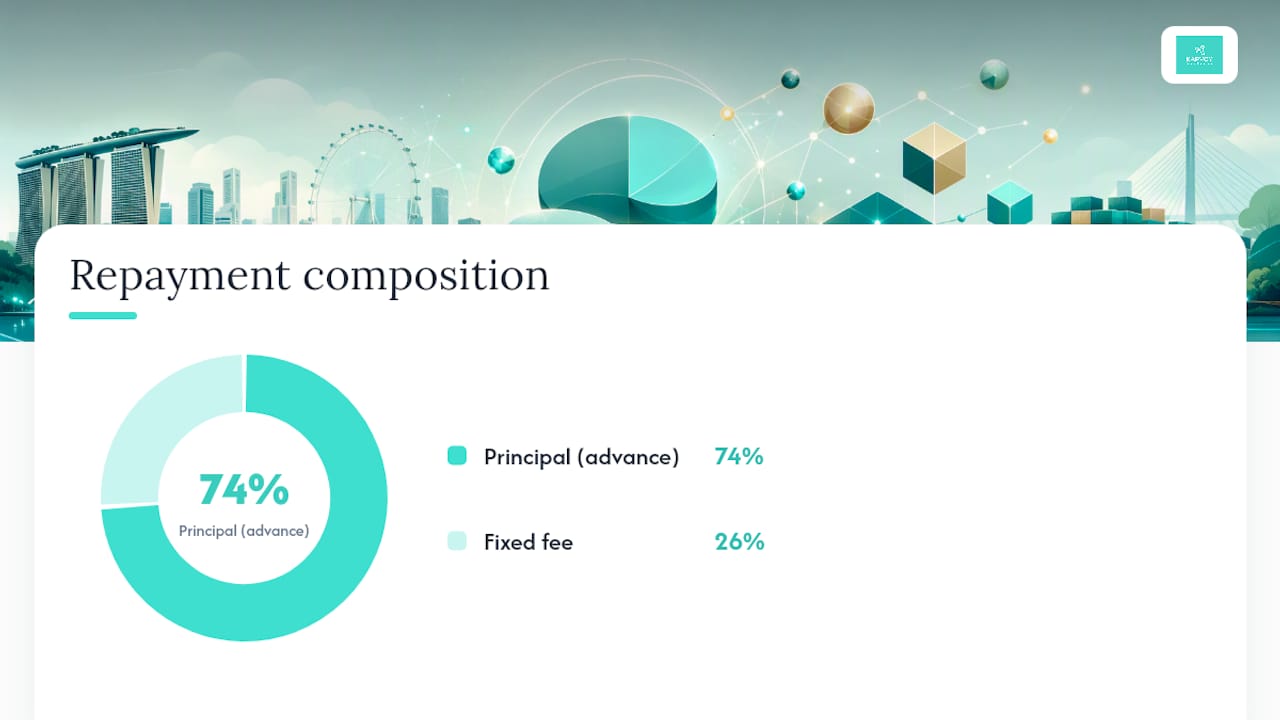
Here's where it gets expensive. Spread that S$10,500 fee over three months and annualize it, and effective APRs on merchant cash advances can be very high, sometimes reaching very high levels depending on how quickly the balance clears. The faster your sales pay it down, the higher your effective rate, because the same fixed fee gets compressed into fewer days.
Quick math: what a S$30,000 advance actually costs Advance: S$30,000 | Factor rate: 1.35 | Total repayable: S$40,500 | Fee: S$10,500 | Repayment window: ~68 business days | Effective APR: well into triple digits on this timeline.
Before comparing any two offers, check for these cost multipliers that don't show up in the headline factor rate:
- Origination or admin fees deducted from the advance before you even receive it.
- No discount for early repayment, meaning you owe the full factor rate fee even if you clear the balance in three weeks instead of three months.
- Renewal or "top-up" fees if you take a second advance before the first is fully repaid.
- NSF or missed-payment penalties if your daily sales dip below what the provider expects.
- Weekly minimum payment clauses that kick in if your card sales fall short, effectively converting a percentage-based deduction into a fixed obligation.
Run every offer through the same three questions: what's the total repayable in dollars, how many days will it realistically take to clear based on my sales, and what does that work out to as an annualized rate. If a provider won't help you answer all three plainly, treat that as information in itself.
Which Singapore Businesses Actually Qualify for an MCA?
MCAs are built for one specific profile: card-heavy, consistent-revenue businesses that need cash fast and can absorb a daily sales deduction without breaking. Retail shops, F&B outlets, and e-commerce sellers with steady transaction volume are the clearest fits, because providers underwrite primarily against your card processing history rather than your balance sheet.
Typical eligibility benchmarks in the Singapore market include:
- At least 4 to 6 months of trading history with a payment processor or platform.
- Minimum monthly card sales often start in the low thousands Singapore dollars, scaling up to much higher amounts for established SMEs with strong sales histories](https://formvalidation.io/blog/merchant-cash-advance-in-singapore/).
- A business bank account with visible, regular deposit activity, not just cash transactions.
The right use cases are narrow and time-bound: restocking inventory ahead of a seasonal spike, covering an emergency equipment repair that would otherwise halt operations, or bridging a short gap between a big order going out and payment coming in. What an MCA is not built for is funding a long-term investment, hiring expansion, or propping up a business with margins too thin to absorb a 15% daily bite out of revenue. If your gross margin can't comfortably survive the holdback, the advance will starve your operating cash before it solves the problem it was meant to fix.
Pro Tip: Before applying, run your last three months of card sales through the holdback percentage a provider is quoting. If that daily deduction would leave you unable to pay staff or suppliers, the advance is too aggressive for your business right now, even if you qualify for it.
How Do You Apply for a Cash Advance in Singapore?
The application process for a merchant cash advance is faster than almost any other SME financing product, which is exactly why it's attractive when you're under time pressure. The path differs slightly depending on whether you're going through a payment platform or a standalone third-party provider.
- Gather your sales and banking records. You'll typically need 3 to 6 months of card processing statements, recent business bank statements, a copy of your NRIC or company registration, and GST or IRAS documentation if your business is GST-registered.
- Choose your provider type. Platform-based providers, meaning payment processors or e-commerce platforms that already hold your transaction data, can underwrite directly from that data and often fund within 1 to 2 business days. Third-party MCA providers not connected to your payment rails need the documents submitted manually, which usually stretches the timeline to 24 to 72 hours after approval.
- Submit your application and wait for underwriting. Providers assess your average monthly card sales, sales consistency, and time in business rather than pulling a traditional credit check.
- Review the offer terms carefully before accepting. Confirm the exact factor rate, the holdback percentage, whether there's a minimum payment clause, and whether a personal guarantee is required.
- Accept and receive funds. Once signed, funding typically lands in your account within the timeline your provider quoted, with automatic deductions starting on your next settlement cycle.
Before you sign anything, get clarity on three things: the exact collection method (percentage-based holdback versus fixed debit), any minimum payment requirement that could bite if sales slow down, and whether you're personally guaranteeing the advance. These three items separate a manageable advance from one that quietly strangles your cash flow.
What Are the Lower-Cost Alternatives to an MCA?
If your timeline allows even two or three weeks of breathing room, a merchant cash advance is rarely your cheapest option, and you should look at the alternatives first.
- Term loans offer fixed monthly repayments and considerably lower effective rates than an MCA, but require more documentation and a longer approval cycle, usually one to two weeks rather than days.
- Working capital loans (including government-backed schemes such as the Enterprise Financing Scheme) suit ongoing operational needs and typically carry lower borrowing costs, with approval timelines similar to term loans.
- Invoice financing fits B2B businesses sitting on unpaid invoices rather than daily card sales, unlocking cash tied up in receivables without the daily deduction structure of an MCA.
- Business lines of credit give you a revolving facility to draw against as needed, useful if your cash flow gaps are recurring rather than a single one-off event.
The trade-off across all of these is consistent: more documentation and longer approval in exchange for meaningfully lower cost. Financial guides generally frame MCAs as short-term bridge financing to be used only when the timeline genuinely doesn't allow for a loan application to clear. If you can wait two to three weeks, run the math on a term loan or invoice financing first. A quick pass through a loan calculator will usually show the gap in total cost immediately.
What Contract Red Flags Should You Watch For?
The biggest risks in an MCA sit in the contract clauses that don't show up in the headline factor rate. Read every offer for these before signing.
- Personal guarantees. Many MCA agreements require you to personally guarantee the advance even though no collateral changes hands, a common practice that significantly increases the provider's recourse against you if the business can't repay.
- Confession of judgment clauses. Some contracts include language that lets a provider obtain a judgment against you without a court hearing if you default, a serious legal exposure that's easy to miss in dense fine print.
- Account sweep or lockbox clauses. These give the provider direct control over your merchant account, sometimes allowing them to redirect all incoming payments, not just the agreed holdback percentage, if they deem you at risk.
- Minimum payment and processor lock-in clauses. A minimum payment requirement converts what looks like a percentage-based, sales-linked deduction into a fixed obligation during slow months, and some contracts lock you into a specific payment processor for the advance's duration.
- Stacking risk. Taking a second MCA to cover the first is one of the fastest routes into a debt spiral, since each new advance adds another daily deduction on top of the one already eating your cash flow.
Pro Tip: Any contract with a personal guarantee, a confession of judgment clause, or an account sweep provision is worth a solicitor's review before you sign, even if it costs you a day's delay. That delay is cheaper than the clause.
What Does an MCA Cost Compared to a Bank Loan in Practice?
Numbers make the trade-off concrete. Picture a F&B business needing S$25,000 to stock up ahead of a festive season sales spike, expecting the inventory to drive an extra S$40,000 in revenue over the following ten weeks.

The bank loan costs roughly S$6,500 less over the same period but takes one to two weeks to approve, time this business may not have if the seasonal window is closing fast.
The decision comes down to one question: does the speed premium of the MCA get you inventory on the shelf in time to capture sales you'd otherwise lose entirely? If yes, the extra cost can be justified as a revenue-generating expense. If the seasonal window is more than two weeks out, the loan wins on every measure that matters.
When Does a Brokered, Multi-Lender Approach Help?
Comparing MCA and loan offers one provider at a time eats the exact time you're trying to save. A broker that submits your profile to a panel of lenders simultaneously, rather than one application at a time, generally improves your odds of approval and gives you real offers to compare side by side instead of guessing which lender fits.
A broker can compare offers across multiple banks and non-bank lenders at once, with fees charged only on successful funding and no upfront or consultation cost. Average approval across such panels often runs 1 to 3 days, competitive with direct MCA timelines but with the added benefit of comparing across financing types, not just one product.
Before working with any broker, ask:
- How many lenders are on the panel, and does that include both banks and non-bank alternatives?
- Is the fee charged only on successful funding, and is that fee disclosed upfront in writing?
- What's the realistic approval timeline based on my profile?
- Will I see and choose between multiple offers, or just one?
A Practical Decision Checklist Before You Sign
An MCA earns its cost only when the cash it unlocks generates more revenue than the fee it charges, fast. Before accepting any offer, run three checks: does the expected revenue uplift clearly exceed the total repayable, can your daily cash flow absorb the holdback without missing payroll or supplier payments, and does the contract avoid the red flag clauses covered above. If any of those three fails, wait and pursue a lower-cost alternative instead.
— Viknesh
How Kapvoy Helps You Compare Financing Options Without the Guesswork
An MCA might be the right call for your timeline, or a term loan might save you thousands once you see the numbers side by side, and finding that out shouldn't require filling out five separate applications. Kapvoy compares your profile against a panel of 30-plus banks and non-bank lenders at once, covering MCAs, term loans, working capital facilities, and invoice financing, so you see real offers instead of a single quote from a single provider.
There are typically no upfront fees or consultation charges. Brokers usually earn a fee only when your financing is successfully funded, aligning incentives with getting you approved rather than billing you for advice. Approval across panels often runs 1 to 3 days, fast enough to matter when you're weighing an MCA against a cheaper option under a real deadline.
If you want to see what you actually qualify for before committing to any single provider's offer, check your eligibility in a few minutes or browse the full range of SME loan options Kapvoy compares on your behalf.
Where to Verify These Figures Yourself
- MAS entities notified under the Payment Services (Exempt Payment Service) framework
- How a merchant cash advance works, Stripe
- What is an MCA, NerdWallet
This article is general information, not a substitute for advice from a qualified financial advisor. Consult a qualified financial professional about your own circumstances before acting on anything here.
Sources
- How a merchant cash advance works | Stripe
- What Is a Merchant Cash Advance (MCA)? - NerdWallet
- Entities that have notified MAS pursuant to the PS (ESP-R)
- Merchant cash advances: pros, cons, and alternatives - Shopify Singapore
FAQ
Is a Merchant Cash Advance Legal in Singapore?
Yes. MCAs operate as receivables purchases rather than regulated loans, and when collected via payment processors, those processors may fall under MAS payment services notifications.
What Credit Score Do I Need for an MCA?
MCA providers generally underwrite against your card sales history and time in business rather than a personal credit score, which is why approval is often faster than for a bank loan.
How Fast Can I Get Funded?
Platform-based providers can fund in 1 to 2 business days, while third-party providers and broker-submitted applications typically fund within 24 to 72 hours of acceptance.
Can I Pay Off an MCA Early to Save Money?
Usually not. Most MCA contracts charge the full factor rate fee regardless of repayment speed, so paying early rarely reduces your total cost.
Is an MCA or a Term Loan Better for My Business?
If you can wait one to two weeks for approval, a term loan or invoice financing almost always costs less; an MCA only makes sense when speed itself protects revenue you'd otherwise lose.