Prequalify First: Multiple Loans in Singapore Cost Under 5 Points

Multiple loan applications can lower your credit score, but usually by a small amount per hard inquiry, and the damage fades within about 12 months. The real risk isn't the applications themselves. It's applying carelessly, without prequalifying first or bunching your applications into a tight window. Check your options with soft-pull tools before you let lenders run hard inquiries.
TL;DR:
- Multiple loan inquiries can cause a small credit score drop, but the impact is minimal if inquiries are made within the rate-shopping window.
- Soft prequalification checks do not affect your credit score, so use them first to narrow down options before applying.
- Grouping similar loan applications within a short period can prevent multiple inquiries from compounding, especially for mortgages, auto, or student loans.
- Having a thin credit file or recent late payments makes your score more sensitive to new inquiries, which can have a more pronounced effect.
- Using a brokered matching service can minimize uncoordinated hard pulls by submitting simultaneous applications to multiple lenders, protecting your credit profile.
Table of Contents
- Multiple Loan Applications and Credit Score: Soft vs. Hard Inquiries
- How Scoring Models Actually Weigh Multiple Credit Inquiries
- The Rate-Shopping Window: When Multiple Checks Count as One
- How to Compare Lenders Without Hurting Your Score
- What Lenders Actually Look at Beyond Your Inquiries
- When a Managed, Multi-Lender Approach Makes Sense
- Balancing Rate Shopping and Credit Health
- Compare Lenders Without the Guesswork
- Sources
- FAQ
Multiple Loan Applications and Credit Score: Soft vs. Hard Inquiries
Not every credit check counts against you. A soft inquiry happens when you check your own score, when a lender prescreens you for a promotional offer, or when you get prequalified before formally applying. None of these touch your score.
A hard inquiry happens when you submit an actual application for a loan or credit card and a lender pulls your full file to decide. This is the type that can nudge your score down.
Lenders can see both types of inquiries when they review your file, but only hard inquiries factor into the score itself. That distinction matters more than most borrowers realize:
- Soft inquiries: self-checks, prequalification offers, promotional prescreens
- Hard inquiries: formal loan applications, credit card applications, mortgage applications
- Visibility: lenders see both but scoring models only react to hard inquiries
How Scoring Models Actually Weigh Multiple Credit Inquiries
New credit activity, including hard inquiries, makes up about 10% of your FICO score. For most borrowers, a single hard inquiry causes a small, generally less than five point, decrease. That's a small dent for one loan application. Stack several unrelated applications close together, though, and the cumulative effect grows because scoring models read a burst of activity as a signal, not just a series of isolated checks.
The 10% Rule: Inquiries stay on your credit report for 24 months, but myFICO's own guidance confirms their effect on your actual score fades within roughly 12 months. The visible record outlasts the real damage by a full year.
Credit file thickness changes how hard this hits. Someone with a long history, several accounts, and years of on-time payments barely notices a couple of extra inquiries. Someone with a thin file, maybe one credit card and no loan history, can see a proportionally bigger swing, since thin files are more sensitive to any new activity. If you're new to credit, self-employed with limited borrowing history, or rebuilding after a rough patch, treat every hard inquiry as more costly than it looks on paper.
The Rate-Shopping Window: When Multiple Checks Count as One
Scoring models were built with a specific problem in mind: penalizing someone for comparing mortgage rates would be unfair, since shopping around is exactly what a responsible borrower should do. That's why FICO groups similar inquiries made within a short window and counts them as a single event rather than several.
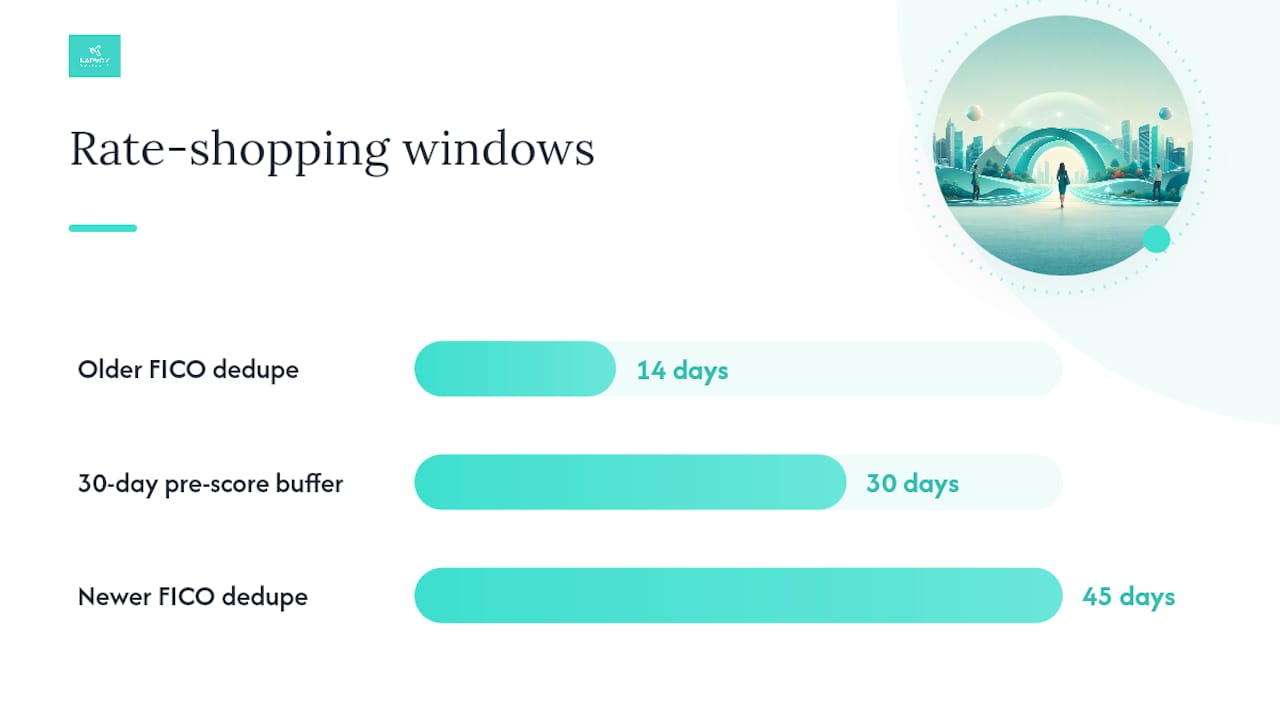
The exact window depends on which FICO version a lender uses. Older models deduplicate inquiries made within 14 days, while newer versions extend that to 45 days. Some models also ignore inquiries from the 30 days immediately before scoring, giving you a buffer while you're actively shopping.
A few practical distinctions matter here:
- Gets rate-shopping treatment: mortgages, auto loans, and student loans
- Does not get this treatment: credit card applications, most personal loan applications from unrelated lenders
- Rule of thumb: compress all your formal loan applications for the same purpose into a two-week span whenever possible, since that satisfies even the stricter 14-day window
If you're comparing mortgage offers, understanding how lenders structure loan estimates alongside the rate-shopping window helps you avoid paying more in points than you save in interest.
How to Compare Lenders Without Hurting Your Score
You don't have to choose between comparing offers and protecting your score. Follow these steps in order:
- Prequalify first. Most lenders offer soft-pull prequalification that estimates your rate without a hard inquiry. Use this to narrow your list before anyone touches your actual file.
- Shortlist and compress. Once you know which lenders are worth a real application, submit them within the same short window rather than spacing them out over weeks.
- Check your own reports before applying. Errors on your credit report can tank your approval odds. Checking and correcting mistakes ahead of time avoids wasted hard pulls on applications that were doomed from the start.
- Consider alternatives if your file is thin. A co-signer or a secured loan can sometimes get you approved without needing to shop as aggressively across five or six lenders.
Pro Tip: If you already have several recent hard inquiries on file, don't add more right away. Write down the dates of your existing inquiries and give your score a few months to recover before applying again, since the effect is concentrated in that first year.
What Lenders Actually Look at Beyond Your Inquiries
A hard inquiry is a minor data point next to what lenders weigh most heavily. Underwriters focus on:
- Payment history: have you paid on time, consistently, over years
- Debt-to-income ratio (DTI): how much of your income already goes to existing debt
- Outstanding balances relative to your credit limits
- Account age and overall credit mix
A cluster of recent inquiries does send a signal, though. Lenders reading several applications in a short span may interpret it as a sign of financial stress rather than smart comparison shopping, and that correlation is baked into how scoring models penalize frequent applications. That perception can affect approval odds or the rate you're offered even when your underlying finances are solid.
Here's the trade-off worth remembering: payment history alone accounts for roughly 35% of your score, more than three times the weight of new credit. A couple of inquiry points lost while shopping matter far less than one missed payment. Protect your payment record first; treat inquiry management as a secondary, short-term concern.
When a Managed, Multi-Lender Approach Makes Sense
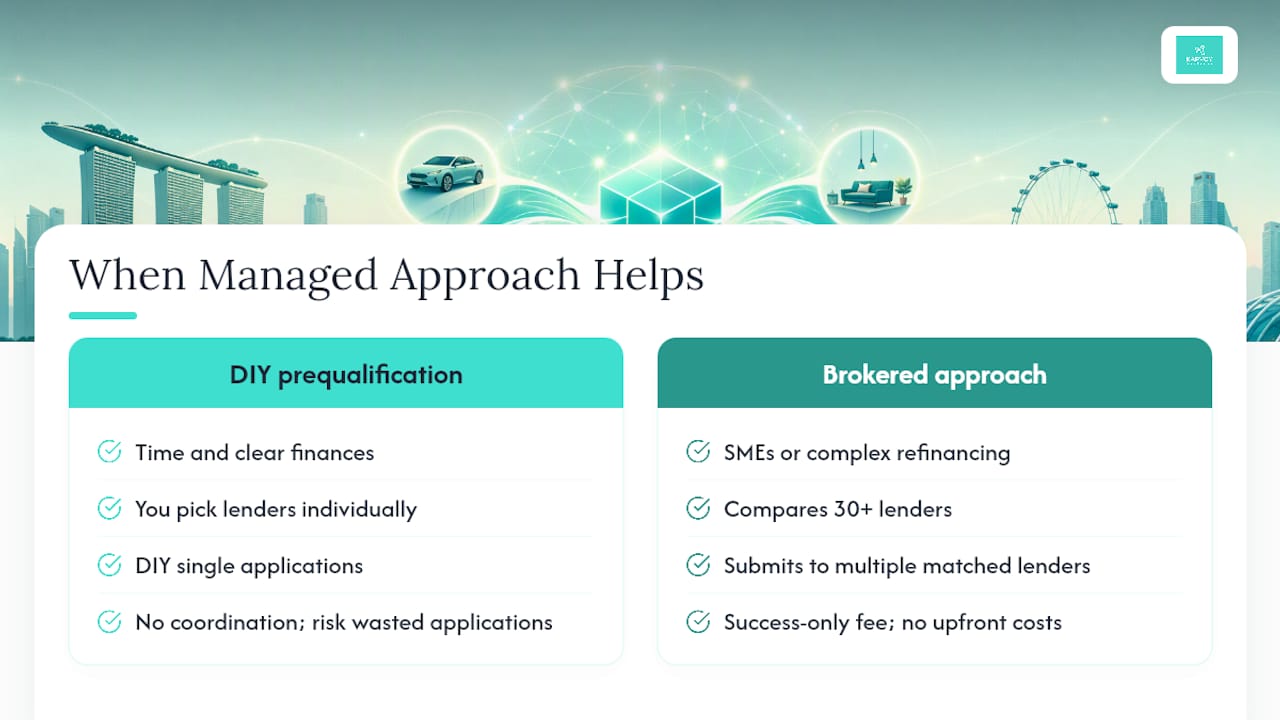
DIY prequalification works well when you have time, a clear picture of your finances, and a straightforward request. It gets harder when you're an SME owner juggling working capital needs, or a property owner comparing refinancing across a dozen bank criteria you don't have time to decode.
This is where a brokered approach earns its place. Kapvoy Advisory compares more than 30 lenders and submits applications to multiple matched lenders at once, rather than leaving you to guess which ones are worth a hard pull. The fee structure is success-only, charged only when funding is successful, with no upfront costs. The process is built around the exact problem this article covers: reducing wasted, uncoordinated applications while still giving you real lender comparison. If your situation is more complex than a single personal loan, a managed route can replace guesswork with matched submissions.
Balancing Rate Shopping and Credit Health
Rate shopping is safe when it's consolidated into a short window and you already have a stable file behind you. It gets riskier fast if your credit history is thin or you've had recent late payments; in those cases, every inquiry carries more weight than it should. Fix payment history and debt-to-income first. Those levers move your score far more than any inquiry count. For SMEs and property owners juggling multiple lender criteria at once, a managed matching service often protects your file better than applying solo.
— Viknesh
Compare Lenders Without the Guesswork
Kapvoy is the alternative to applying blind across a dozen banks: instead of you submitting separate applications and racking up uncoordinated hard inquiries, Kapvoy matches your profile against its panel of 30+ lenders and submits to the ones most likely to approve you, simultaneously.
That matters most for SME owners chasing working capital or a term loan, and for property owners comparing refinancing or a private mortgage across lenders with very different criteria. There's no upfront cost and no consultation fee. The service only charges its success-only fee once funding is disbursed, and approvals typically come through quickly. If you're weighing multiple applications right now and want to avoid needless hard pulls, check your eligibility in a few minutes and let Kapvoy handle the lender matching from there.
Sources
- Do Credit Inquiries Lower Your FICO Score? | myFICO
- Do Multiple Loan Inquiries Affect Your Credit Score? - Experian
FAQ
Do Multiple Loan Applications Affect Credit Score?
Yes, but usually only slightly. Each hard inquiry typically costs fewer than five points, and the effect fades within about 12 months even though the inquiry stays on your report for 24 months.
Will Three Hard Inquiries Hurt My Credit Score?
Three hard inquiries in a short span can cause a noticeable dip, especially if your credit file is thin, but it's rarely severe on its own. If they're all for the same type of loan (a mortgage or auto loan) within the rate-shopping window, they may count as a single inquiry instead of three separate ones.
Is It Bad to Have Two Hard Inquiries Within 30 Days?
Not necessarily. Two inquiries within 30 days for comparable loan types often fall inside the deduplication window scoring models use for rate shopping. It's a bigger concern if those two inquiries are for unrelated credit products, like a credit card and a personal loan, since those don't get grouped together.
Is Four Hard Inquiries Too Many?
Four inquiries isn't automatically a problem if they're concentrated in a short window for the same type of loan, since rate-shopping rules can treat them as one event. It becomes a real concern when those four inquiries span different credit products or several months, since scoring models associate frequent, scattered applications with higher risk.