When an Offset Mortgage in Singapore Beats Prepayment: The 20% Rule

An offset mortgage can cut your interest bill in Singapore, but only if you keep a large, steady cash balance sitting in the linked account. Banks charge a small rate premium for the feature, so if your balance runs low or you plan to spend that cash soon, prepayment or refinancing may save more. HDB loans generally don't offer this feature. The math below shows exactly where the breakeven point sits.
TL;DR:
- An offset mortgage in Singapore requires maintaining a large, stable cash balance, typically around 20% of the loan, to offset interest effectively.
- The offset benefit is capped at the outstanding loan amount, with most packages applying a percentage offset rather than a one-to-one match.
- Banks usually charge a small rate premium of 0.1% to 0.2% for offset features, which can negate benefits if your balance is too low.
- Offset accounts offer high liquidity, allowing easy withdrawal of cash, but the savings depend heavily on discipline to keep funds parked consistently.
- The advantage over prepayment or refinancing diminishes if your cash buffer is small or inconsistent, as premiums and caps can offset potential savings.
Table of Contents
- How an Offset Mortgage Account Works in Singapore
- Who Benefits and the Practical Pros and Cons
- When the Math Justifies an Offset: Breakeven and Worked Examples
- Availability and Rules in Singapore: What to Check on Bank Fact Sheets
- How to Choose Between Offset, Partial Prepayment, or Refinancing
- How Kapvoy Helps Borrowers Evaluate Offset-Friendly Packages
- When I'd Recommend an Offset
- If You Want Help: Kapvoy's Property Financing and Application Service
- Official Guides and Product Pages to Check
- Sources
- FAQ
How an Offset Mortgage Account Works in Singapore
An offset mortgage links your home loan to a deposit or current account. Every day, the bank calculates your loan interest on a reduced principal: your outstanding loan balance minus a percentage of what sits in the linked account. That's the daily-offset mechanism, and it's the whole reason this product exists.
You don't earn separate interest on the parked cash. Instead, the bank effectively lets that cash "earn" a return equal to your mortgage rate, since it directly reduces the interest you'd otherwise pay. Citibank's explainer on this mechanism describes it as using a deposit account to offset mortgage interest rather than earning a competing savings rate.
Banks don't match your deposit balance one-for-one. Most Singapore offset packages apply a set percentage, typically a large portion of your deposit offsets the loan, varying by lender.
- The offset amount is usually capped at your outstanding loan balance, so parking more cash than you owe delivers no extra benefit.
- Any deposit beyond the matched cap typically earns the account's prevailing bank rate instead.
- Withdrawals are usually unrestricted, which is the core liquidity advantage over a straight prepayment.
- Minimum loan size and property-type restrictions apply, and these differ by bank.
Pro Tip: Ask specifically how the bank calculates the "outstanding loan cap" on your fact sheet — some lenders apply it to the original loan amount, others to the current reducing balance, and that difference changes your real offset ceiling over time.
Offset features aren't free. Lenders often build in a small rate premium, generally cited in the 0.1% to 0.2% range according to practitioner breakeven analyses, to cover the cost of the flexibility they're extending you.
Who Benefits and the Practical Pros and Cons
Offset accounts suit a specific kind of borrower. If you fit one of these profiles, the product tends to pay off:
- You hold a large, stable cash buffer, whether from savings, an inheritance, or a business owner's retained cash, and you're not ready to lock it into a fixed prepayment.
- Your salary and bonuses land in the linked account, so idle cash automatically reduces daily interest without you doing anything.
- You value liquidity, meaning you might need that cash for a renovation, a business opportunity, or an emergency, and you don't want it trapped inside your loan.
Ordinary savings accounts pay a fraction of what an offset effectively returns, since typical deposit rates in Singapore sit well below most mortgage rates, based on Statista's deposit rate tracking. That gap is exactly why parking cash in an offset account often beats parking it in a savings account.
The downsides are real, though. The rate premium erodes savings if your balance is small. There's an opportunity cost too: money sitting idle in an offset account isn't invested elsewhere. The benefit depends entirely on discipline, because withdrawing funds for a big purchase immediately shrinks your offset and pushes your effective interest rate back up. And HDB concessionary loans generally don't carry this feature at all, since CPF's own comparison of HDB and bank loans confirms HDB loans run on a different structure than bank offset products.
Weigh liquidity against permanence carefully. Prepayment locks in savings forever; an offset only saves you money for as long as the cash stays parked.
When the Math Justifies an Offset: Breakeven and Worked Examples
The rate premium is the hurdle you need your parked cash to clear. If a bank charges 0.15% extra for the offset feature, your linked balance needs to be large enough that the interest it saves outweighs that premium across your entire loan.
Practitioner breakeven models commonly point to keeping roughly 20% or more of your outstanding loan balance parked consistently before an offset clearly beats a standard loan, according to Winfred Quek's analysis of Singapore offset mortgages. Below that threshold, the premium tends to cancel out most of the benefit.
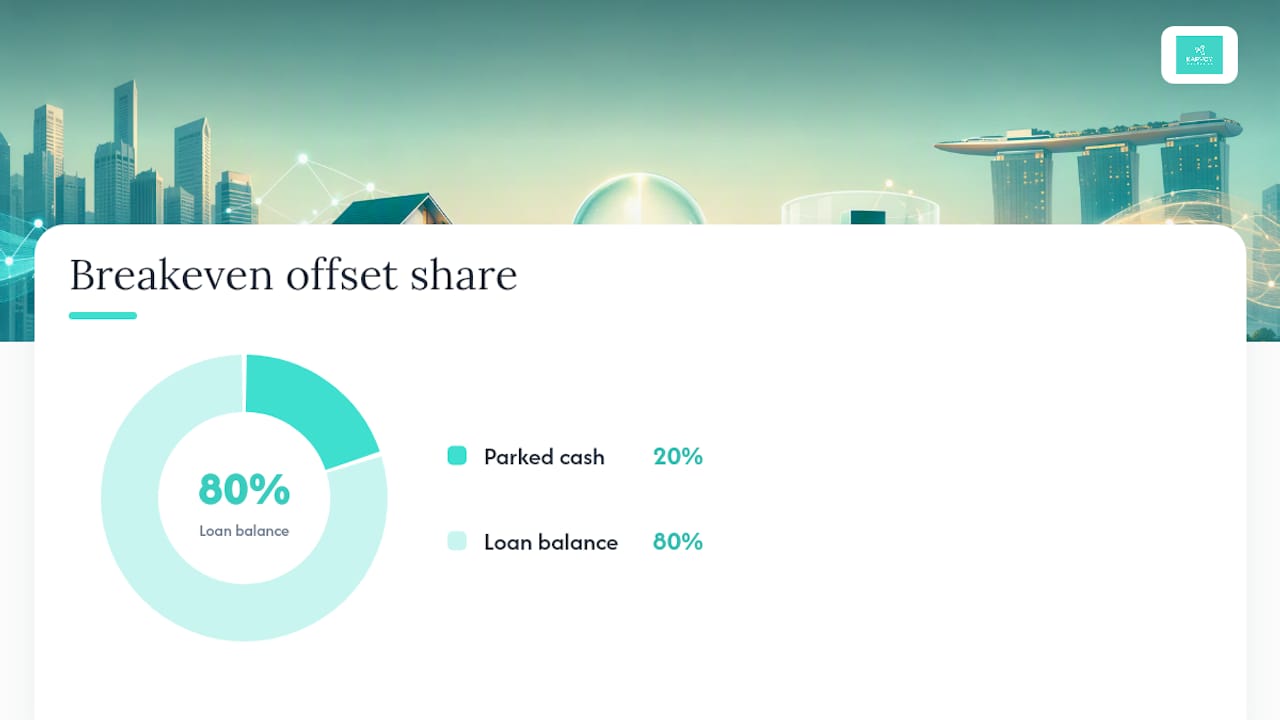
Illustrative example: on a $700,000 loan with a 2.8% mortgage rate and a 0.15% offset premium, keeping around $140,000 (20%) consistently parked in the linked account could offset a meaningful chunk of daily interest, enough in many practitioner models to outweigh the premium cost over a year. Keeping only $30,000 parked, by contrast, usually isn't enough to clear the premium hurdle.
Sensitivity matters more than the headline example. Adjust your own numbers with this quick guide:
- Higher offset balance relative to loan size: bigger net savings, since more principal gets excluded from daily interest.
- Higher mortgage rate: each dollar offset saves you more, so the breakeven balance needed actually shrinks.
- Higher rate premium: you need a proportionally larger balance parked to break even.
- Inconsistent balances (large swings month to month): savings shrink because daily calculations punish every day the cash isn't there.
Treat these as directional, not exact. Your bank's actual fact sheet and effective-rate illustration are the only numbers that matter for your loan.
Availability and Rules in Singapore: What to Check on Bank Fact Sheets
Before comparing offset offers, pull the property loan fact sheet every Singapore bank is required to provide, as MoneySense outlines. Check these items line by line:
- Matched percentage applied to your deposit balance.
- Cap on how much of your deposit can offset the loan.
- Any rate premium charged for the offset feature versus a standard package.
- Minimum loan size and eligible property types.
- Lock-in period and early repayment or exit fees.
Structures genuinely differ across lenders. Propwise's breakdown of Singapore offset accounts notes two-thirds matching and 70% matching as common in-market variations, alongside current-account-linked (CMA-style) setups. Always request the effective-rate illustration before signing, not just the headline rate.
How to Choose Between Offset, Partial Prepayment, or Refinancing
Match the tool to your situation rather than chasing the lowest headline rate:
- Choose offset if you keep a large, stable cash buffer and want daily interest reduction without losing access to that money.
- Choose partial prepayment if you're certain you won't need the cash again and want a permanent reduction in principal with no ongoing premium.
- Choose refinancing if your current lock-in has expired and a lower base rate elsewhere beats what an offset feature could save you.
Before deciding, answer honestly: how large and steady is your liquid buffer? What penalties apply if you break your current lock-in? Where do you expect rates to head over your remaining loan term? And does CPF or HDB eligibility rule out the offset option entirely, as it does for most HDB loans?
Pro Tip: Run your own numbers through a loan repayment calculator before requesting fact sheets. It's faster to rule out an offset than to compare five bank quotes only to find your buffer is too small.
How Kapvoy Helps Borrowers Evaluate Offset-Friendly Packages
Comparing offset premiums across Singapore banks by yourself means reading several fact sheets and effective-rate illustrations side by side. A brokerage service compares offers across multiple lenders and submits applications to several banks at once, which speeds up finding a package where the matched percentage and premium actually fit your cash buffer. Typically, there is no upfront fee and charges apply only once funding is approved, with many clients receiving an approval decision within 1 to 3 days. If you want a tailored breakeven read on your loan size, check your property financing options directly.
When I'd Recommend an Offset
Recommend an offset to a client with a large, stable cash buffer who genuinely needs liquidity, someone running a business with irregular income, or a family sitting on a lump sum they're not ready to commit permanently. Skip it for someone with a modest buffer who mainly wants to shrink debt for good. Whichever camp you're in, request the bank's actual fact sheet and effective-rate illustration before deciding. Numbers on a product brochure rarely match your specific loan once premiums and caps are applied.
— Viknesh
If You Want Help: Kapvoy's Property Financing and Application Service
This type of broker service is an alternative to walking into bank branches yourself to compare offset premiums, matched percentages, and caps one by one. Such services compare offers across numerous banks and non-bank lenders, match your profile against eligibility rules, and submit applications to multiple lenders simultaneously.
The fee structure stays simple: nothing upfront, no consultation charge, and payment only happens once your financing is approved and disbursed. Most clients hear back within 1 to 3 days. If you're weighing an offset account against prepayment or a refinance, check your eligibility in a few minutes and get a clearer read on which package actually fits your loan size and cash buffer.
Official Guides and Product Pages to Check
For consumer-facing rules on Singapore home loans, lock-ins, and fact sheets, MoneySense's home loan guide is the primary reference. For HDB versus bank loan mechanics and CPF usage, see CPF's comparison guide. For bank-specific offset structures, check Standard Chartered's MortgageOne page and HSBC's SmartMortgage page directly.
This article is general information, not a substitute for advice from a qualified financial advisor. Consult a qualified financial professional about your own circumstances before acting on anything here.
Sources
- How home loans work | MoneySense
- Offset Your Mortgage Interest with a Deposit Account | Citibank Singapore
- Interest offset mortgage Singapore: How It Works and When the Maths Justifies It | Winfred Quek
FAQ
Is an Offset Mortgage a Good Idea?
It's a good idea if you can consistently keep a large liquid balance, often cited around 20% or more of your outstanding loan, parked in the linked account. Below that, the bank's rate premium tends to erase most of the benefit.
Do Banks Still Offer Offset Mortgages in Singapore?
Yes. Several Singapore banks offer offset or linked-account mortgage packages, though structures vary, and HDB concessionary loans generally don't include this feature.
How Much Money Should I Keep in an Offset Account?
Enough to clear the bank's rate premium, which practitioner models place near 20% of your outstanding loan balance as a rough threshold. Brokerage services may provide tailored breakeven calculations based on your actual loan size and premium.
What Is an Offset Loan and How Does It Work?
It's a mortgage linked to a deposit account where your cash balance, up to a matched percentage and capped at your loan amount, reduces the principal used to calculate daily interest. The bigger and steadier your balance, the more interest you avoid each day.