5 Questions SMEs Must Answer Before Choosing an Overdraft or Term Loan

Choose an overdraft for short, unpredictable cash gaps, and choose a term loan for planned, longer-term investments. Which one costs less depends heavily on how long you actually need the money, and plenty of businesses end up using both at once rather than picking a single winner.
TL;DR:
- Overdrafts are most cost-effective for short-term, irregular cash gaps, especially when the company needs quick access to funds without long commitments.
- Term loans are better suited for planned, long-term investments with predictable costs, lower interest over time, and less operational risk.
- Combining both options allows businesses to fund specific assets with a term loan while maintaining an overdraft as a flexible buffer for recurring shortfalls.
- Overdraft limits depend on current account cash flow and can be withdrawn by banks at any time, unlike the fixed nature of term loans that carry stricter repayment obligations.
- Both products impact credit profiles differently: term loans affect credit through installment payments, while overdraft utilization signals financial health based on how close usage is to the approved limit.
Table of Contents
- Overdraft vs Term Loan: How Each Facility Actually Works
- Overdraft vs Personal Loan Logic: How Overdrafts Work for Businesses
- Should I Choose an Overdraft or a Term Loan?
- Can You Combine an Overdraft and a Term Loan?
- Does an Overdraft or Term Loan Affect Your Credit Score Differently?
- Eligibility Criteria and Documentation for Each Facility
- Typical Loan Amounts and Overdraft Limits
- Tax Implications of Overdraft Usage vs Term Loans
- What Are the Risks of Overdrafts and Term Loans?
- An Advisor's Note on Getting This Choice Wrong
- Get Matched to the Right Facility, Not Just Any Facility
- Sources
- FAQ
Overdraft vs Term Loan: How Each Facility Actually Works
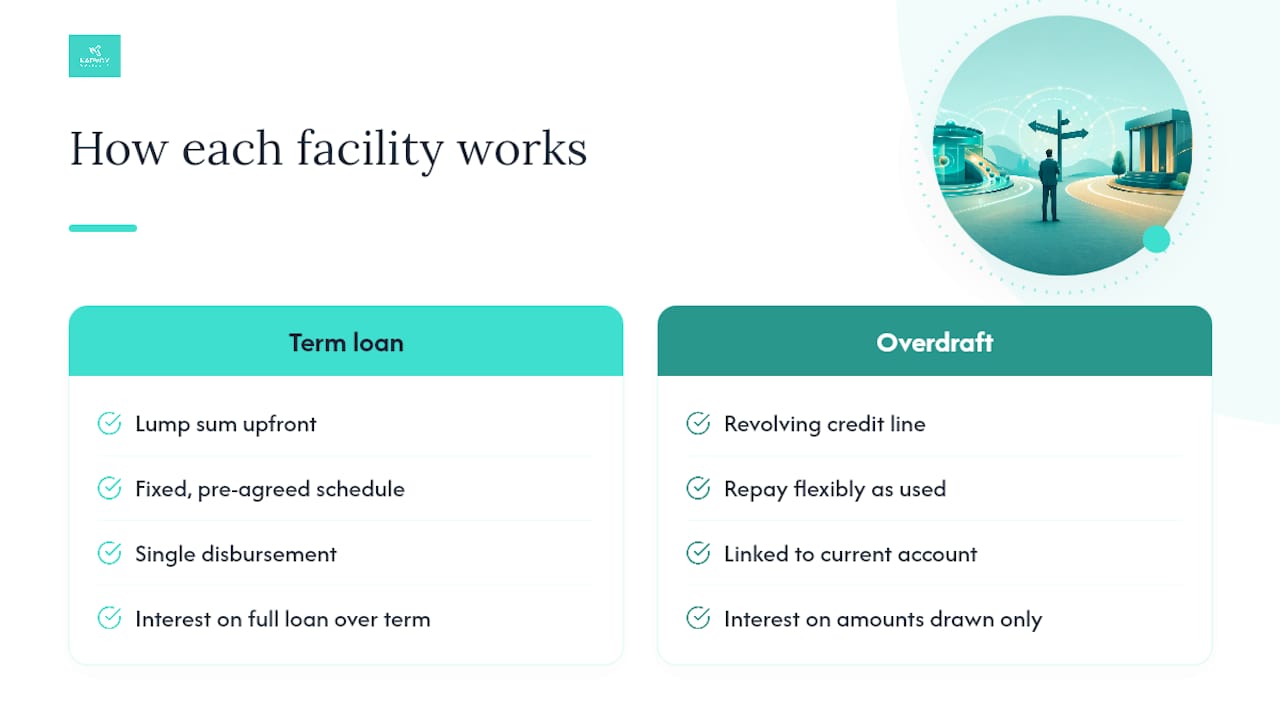
A term loan gives you a lump sum upfront, repaid on a fixed schedule you agree to before you sign, typically over a set period. An overdraft is a revolving credit line tied to your business current account, and you only draw what you need, when you need it. That structural difference, lump sum versus draw-as-you-go, shapes almost everything else about how each product behaves in practice.
What a term loan looks like in practice
You apply for a set amount, the lender disburses it in full, and you start paying it back through equal installments (interest plus principal) over an agreed term, often several years for SME facilities. Interest accrues on the full disbursed principal from day one, not just the portion you have "used," since there is no such thing as partial use with a lump sum. Lenders frequently attach an origination fee, and secured term loans may require collateral or covenants such as minimum working capital ratios.
Pros of a term loan:
- Predictable installments make cash-flow forecasting simple
- Often a lower effective rate than revolving credit over the life of the loan
- Fixed terms cannot be called early the way an overdraft facility can
Cons of a term loan:
- Slower to arrange, since underwriting a lump sum takes longer than approving a credit line
- Collateral or a personal guarantee is common for larger amounts
- Locked-in repayments regardless of whether your cash flow shifts
A restaurant group buying a second kitchen build-out, a logistics firm financing three delivery vans, or a clinic purchasing diagnostic equipment are all classic term loan situations: one big, defined cost with a clear payback horizon.
Overdraft vs Personal Loan Logic: How Overdrafts Work for Businesses
An overdraft lets you dip below zero on your business account up to an agreed limit, and you only pay interest on the daily amount actually drawn, not the full facility size. That is the single biggest cost difference between the two products, and it is why overdraft advantages show up most clearly for short, uneven cash needs rather than one big purchase.
The catch is that the flexibility comes with strings. Beyond interest, lenders often charge an arrangement fee, a commitment fee on the unused portion, and steep penalty rates if you breach your limit. Banks also reserve the right to review, reduce, or withdraw the facility, sometimes with little notice, which is a real operational risk a fixed-term loan simply does not carry.
Pros of an overdraft:
- Fast to arrange and often already sitting on your existing business account
- Interest applies only to what you draw, so idle capacity costs little
- Repays itself automatically as inflows hit the account
Cons of an overdraft:
- Rates are usually variable and can rise without warning
- The facility can be reviewed or pulled at the bank's discretion
- Unarranged or over-limit use gets expensive fast
A seasonal retailer bridging the gap between stock purchases and holiday sales, or a contractor waiting 60 days on an invoice while payroll is due, are textbook cases for a working capital overdraft rather than a loan.
Should I Choose an Overdraft or a Term Loan?
Five factors decide this more reliably than gut instinct: how long you need the money, how predictable that need is, how much you need, how fast you need it, and how much collateral or covenant exposure you're willing to accept. Run through them in order, and the right product usually becomes obvious.
- Estimate your holding period. A three-week gap behaves nothing like an eighteen-month build-out, even if the dollar amount looks similar on paper.
- Run the cost flip calculation. Overdrafts tend to win for short-to-medium draws, but term loans typically win once you hold the balance long enough for origination fees to amortize across more months. Plug your actual rate, fee, and timeline into a calculator rather than guessing.
- Check for repayable-on-demand language. Before you sign an overdraft agreement, confirm exactly what triggers a review or reduction, and how much notice you get.
- Match the amount and speed to the product. Large, defined purchases favor a term loan; smaller, recurring gaps favor an overdraft.
- Ask about collateral and covenants up front, since a facility that looks cheap on rate can get expensive fast if it locks up assets you need free for other financing.
When you talk to a lender, ask directly: What triggers a facility review? Is there a commitment fee on unused overdraft capacity? What happens if I go over the limit by even a small amount? Vague answers to any of these are a red flag worth walking away from.
Pro Tip: *Don't choose a product by comparing headline interest rates alone.
Can You Combine an Overdraft and a Term Loan?
Plenty of SMEs run both facilities at once, and it's often the smarter move rather than a compromise. The logic is simple: use a term loan to fund the stable, one-time asset purchase, and keep a smaller overdraft alive purely as a buffer for the recurring timing gaps that hit every business, like a client paying 45 days late or a seasonal inventory buy.
A workable sizing rule is to fund the asset's full cost through the term loan, plus a modest contingency, while sizing the overdraft to comfortably cover your expected peak shortfall rather than your average one. Average shortfalls underestimate the bad months.
Once both are in place, treat the overdraft as a safety net, not a spending account. Lock in the term loan rate, monitor any covenants tied to it (some loans include cash-sweep clauses that can inadvertently eat into the working capital you were counting on the overdraft for), and revisit the overdraft limit annually as your revenue grows.
- Fund the asset purchase entirely through the term loan
- Size the overdraft to your peak, not your average, cash gap
- Watch for covenant clauses that conflict with your overdraft buffer
Does an Overdraft or Term Loan Affect Your Credit Score Differently?
Both products get reported to credit bureaus and both affect your business credit profile, but the mechanics differ. A term loan shows up as an installment account, and lenders watch whether your payments land on time, every time, across the full term. Missing even one installment can dent your score meaningfully because it breaks a fixed, predictable pattern the lender was relying on.
An overdraft behaves more like a revolving line. What matters most is utilization: how much of your approved limit you're actually using at any given time. Sitting consistently near your overdraft ceiling signals financial strain to lenders and credit bureaus alike, even if you never technically breach the limit. Businesses that draw an overdraft down to zero regularly and let it sit unused tend to look stronger on paper than ones that live permanently near the edge.
Here's a wrinkle owners miss: a well-managed overdraft that you barely touch can actually help your creditworthiness by demonstrating access to credit you don't need to lean on. A term loan you're steadily paying down does the same thing, just through a different signal. The two products aren't competing for your credit score, they're building different parts of the same profile, which is part of the case for holding both.
Eligibility Criteria and Documentation for Each Facility
Lenders underwrite these products differently because the risk profile is different. A term loan, being a larger, longer commitment, typically demands a deeper paper trail:
- Two to three years of financial statements and tax filings
- Recent bank statements, often six months or more
- A clear statement of purpose for the funds
- Collateral documentation or a personal guarantee for larger amounts
- Business registration and ownership structure documents
An overdraft, tied to an existing operating account, usually asks for less because the bank already has visibility into your cash flow through that account. Expect to provide recent statements, a shorter financial history in some cases, and evidence of stable recurring inflows. Newer businesses without a track record often struggle to get an overdraft approved at all, since banks want proof of consistent deposits before extending revolving credit.
Startups without years of financials aren't shut out entirely. Some lenders offer dedicated startup financing structured around shorter operating histories, which is worth exploring before assuming neither product is available.
Typical Loan Amounts and Overdraft Limits
Term loans scale with the asset or project they're funding, and SME facilities can range from tens of thousands of dollars for equipment purchases up to significantly larger amounts for property, fleet expansion, or major capital projects. The loan size is essentially set by the cost of what you're buying plus a reasonable contingency, not by an arbitrary bank formula.
Overdraft limits work differently. Banks size them against your account's typical cash flow, usually as a multiple of average monthly turnover or deposits, rather than against any specific purchase. A business with steady, six-figure monthly deposits will typically qualify for a larger overdraft ceiling than one with the same total assets but choppier, unpredictable cash flow. This is part of why overdrafts suit working capital gaps so well: the limit is inherently tied to how the business actually moves money day to day.
Tax Implications of Overdraft Usage vs Term Loans
Interest paid on both overdrafts and term loans is generally treated as a deductible business expense, provided the borrowed funds are used for business purposes rather than personal ones. That's the good news, and it applies fairly evenly across both products.
Where it gets more nuanced is documentation. Because a term loan disburses as a single lump sum for a stated purpose, tracing the interest expense back to a business use is usually straightforward. An overdraft, being a revolving facility that might get drawn for a dozen different reasons across a year, requires cleaner bookkeeping to substantiate that the interest claimed genuinely relates to business activity rather than personal draws mixed through the same account. Keeping business and personal spending separate isn't just good hygiene, it directly protects your ability to claim the deduction cleanly.
Tax treatment of business financing varies by jurisdiction and by your specific structure, so this is one area where a conversation with your accountant before you draw either facility saves more than it costs.
What Are the Risks of Overdrafts and Term Loans?
The risks aren't symmetrical, and understanding the shape of each one changes how you should structure your financing.
With an overdraft, the sharpest risk is the repayable-on-demand clause most banks build into the agreement. Your facility can be reviewed, reduced, or pulled entirely if your financial position weakens or even during a routine annual review, sometimes with limited notice. Breaching your limit, even briefly, tends to trigger penalty rates and fees that can turn a cheap facility expensive within a single billing cycle. Businesses that lean on an overdraft as if it were permanent financing are the ones most exposed when a bank tightens its lending appetite.
Term loans carry a different kind of exposure. Default consequences are typically more severe and immediate, since missing installments on a secured loan can trigger acceleration clauses, collateral seizure, or damage to personal guarantees if the business structure involves one. There's also less room to maneuver: a fixed schedule doesn't flex if revenue dips the way an overdraft naturally can.
The practical takeaway is that neither product's risk is inherently worse, but each rewards a specific kind of financial discipline. An overdraft rewards businesses that never treat it as permanent capital. A term loan rewards businesses confident enough in their forecast to commit to fixed payments regardless of what the next eighteen months bring.
An Advisor's Note on Getting This Choice Wrong
The mistake we see most often isn't picking the wrong product on purpose, it's mismatching product to need and not noticing until the cost stacks up. Businesses treat an overdraft as permanent working capital for a year or two, then get surprised when a bank review shrinks the limit right when they need it most.
Kapvoy Advisory works through a panel of more than 30 banks and non-bank lenders precisely because the right fit depends on your specific cash-flow shape, not a generic rule. We submit applications across multiple lenders simultaneously, which meaningfully improves approval odds compared to going to a single bank and hoping. Fees are only charged on successful funding, with no upfront consultation costs, and approvals typically land within 1 to 3 days.
— Viknesh
Get Matched to the Right Facility, Not Just Any Facility
Comparing rates across a handful of banks yourself takes weeks and still leaves you guessing whether you're seeing the best terms available. This service skips the guesswork by submitting your application across a panel of multiple lenders at once, so you see real offers side by side instead of settling for whichever single bank replies first.
There's no upfront fee to start, no consultation charge, and no cost at all unless your financing actually gets approved and funded. Whether you've landed on a term loan for a planned purchase or think a working capital overdraft fits your cash-flow gap better, the next step is the same: check your eligibility in a few minutes and let Kapvoy line up lenders who actually match your business profile.
Sources
For deeper product definitions, see Tide's overdraft versus loan breakdown. To run your own numbers, use the holding-period cost calculator from PayoffMath. For a practitioner view on matching product to need, see Cashtech's cheat sheet.
- Business Loan vs Business Overdraft: Key Differences | Tide Business
- Business Overdraft vs Term Loan vs Credit Card — Which Costs Least? | PayoffMath
FAQ
What Is Better, a Term Loan or an Overdraft?
Neither is universally better; a term loan suits planned, long-term investments, while an overdraft suits short, unpredictable cash gaps, and the cheaper option depends on how long you hold the balance.
What Are Two Disadvantages of an Overdraft?
Overdrafts carry variable rates that can rise without warning, and banks can review, reduce, or withdraw the facility on short notice through repayable-on-demand clauses.
Can I Convert an Overdraft to a Term Loan?
Yes, many lenders let you refinance a persistent overdraft balance into a term loan with fixed installments, which is a common fix when a business realizes its "short-term" gap has become permanent. Kapvoy can help identify lenders open to this kind of restructuring.
What Is the Difference Between a Loan and an Overdraft?
A loan disburses a lump sum upfront with fixed repayments over a set term, while an overdraft is a revolving credit line you draw against as needed, paying interest only on the amount actually used.
When Should a Business Use a Term Loan Instead of an Overdraft?
Use a term loan when the need is large, defined, and long-term, such as equipment, property, or fleet purchases, where fixed installments make more sense than open-ended revolving credit.