What a Personal Guarantee on a Business Loan Really Costs You

A personal guarantee is a legal promise that you, personally, will repay a business loan if the company can’t. Sign one, and your house, savings, and personal credit score become collateral the moment your business misses a payment. The good news: most guarantees are negotiable, and in many cases you can avoid one entirely.
Before you sign anything, know this:
-
The guarantee is separate from the loan itself — the lender can pursue you even if the business later closes or restructures.
-
Caps, sunset clauses, and proportionate liability are all things you can ask for, and lenders grant them more often than borrowers assume.
-
If a lender won’t budge, that’s often a sign to shop your application elsewhere rather than accept unlimited exposure.
Key Takeaways
A personal guarantee is negotiable in most cases, and the strongest protections, caps, sunset clauses, and several liability, come from asking before you sign, not after.
| Point | Details | | --- | --- | | Definition matters | A personal guarantee makes you personally liable for business debt if the company defaults. | | Type changes exposure | Limited guarantees cap liability by dollar or percentage; unlimited guarantees cover the full balance plus fees. | | Joint and several is riskier | Lenders can pursue any one guarantor for the full debt under joint and several liability. | | Negotiate before signing | Ask for caps, sunset clauses, and carve-outs while you still have leverage, not after the contract is final. | | Compare lenders for better terms | Kapvoy’s multi-lender submission across 30+ banks and non-bank lenders helps surface more favorable guarantee structures. |
Table of Contents
-
Limited, Unlimited, and Joint Guarantees: What Each One Means for You
-
Your Pre-Signing Checklist: Questions to Ask Before You Sign
-
Get Better Guarantee Terms Without the Single-Lender Guesswork
How a Personal Guarantee Business Loan Actually Works
A personal guarantee is a standalone contract, legally distinct from the loan agreement. That distinction matters because a lender doesn’t need to exhaust every remedy against the business before coming after you. Some guarantees are “payment guarantees,” triggered the moment the borrower misses a scheduled payment. Others are “conditional,” requiring the lender to first pursue collateral or judgment against the company.
-
Enforcement typically starts after a default notice period, followed by demand letters, then legal action if unpaid.
-
Lenders often want both collateral and a guarantee. Collateral gets seized first; the guarantee covers whatever shortfall remains after liquidation.
-
Investopedia notes that guarantees exist precisely to give lenders a second route to recovery when the business’s own assets fall short.
Limited, Unlimited, and Joint Guarantees: What Each One Means for You
Not all guarantees expose you the same way. The wording your lender uses determines whether you’re on the hook for a fixed number or an open-ended one.
-
Limited guarantees cap your liability at a stated dollar amount or a percentage of the loan, say a portion of the facility amount, meaning your maximum exposure is limited regardless of how much the business ultimately owes.
-
Unlimited guarantees leave you liable for the full outstanding balance, plus interest, fees, and collection costs, with no ceiling.
-
Joint and several liability lets the lender chase any one guarantor for the entire debt, not just their proportional share. A guarantor who pays can later seek contribution from co-guarantors, but only after covering the full amount themselves. Several (proportionate) liability limits each guarantor to their own agreed slice from the start, which is the safer structure to request when multiple owners are signing.
Watch for “continuing guarantee” language and bad-boy carve-outs that spring full recourse if you breach unrelated covenants.
When Do Lenders Ask for a Personal Guarantee?
Lenders lean on personal guarantees when the business itself doesn’t offer enough security on its own.
-
Startups and young companies with limited operating history get asked almost by default, since there’s no track record to underwrite against.
-
Unsecured loans and lines of credit carry more guarantee requests than asset-backed facilities, because there’s no collateral to fall back on.
-
Equipment leases and commercial leases frequently bundle in a personal guarantee, even when the lease itself feels routine.
-
Director or major-shareholder ownership raises the odds. DBS notes that banks commonly request joint-and-several guarantees from directors of SME facilities when business collateral falls short.
Practices vary by lender and product, so the same business might get a clean offer from one bank and a full guarantee demand from another.
What Are the Real Risks for a Guarantor?
Signing doesn’t just create paper liability. It opens direct routes to your personal life.
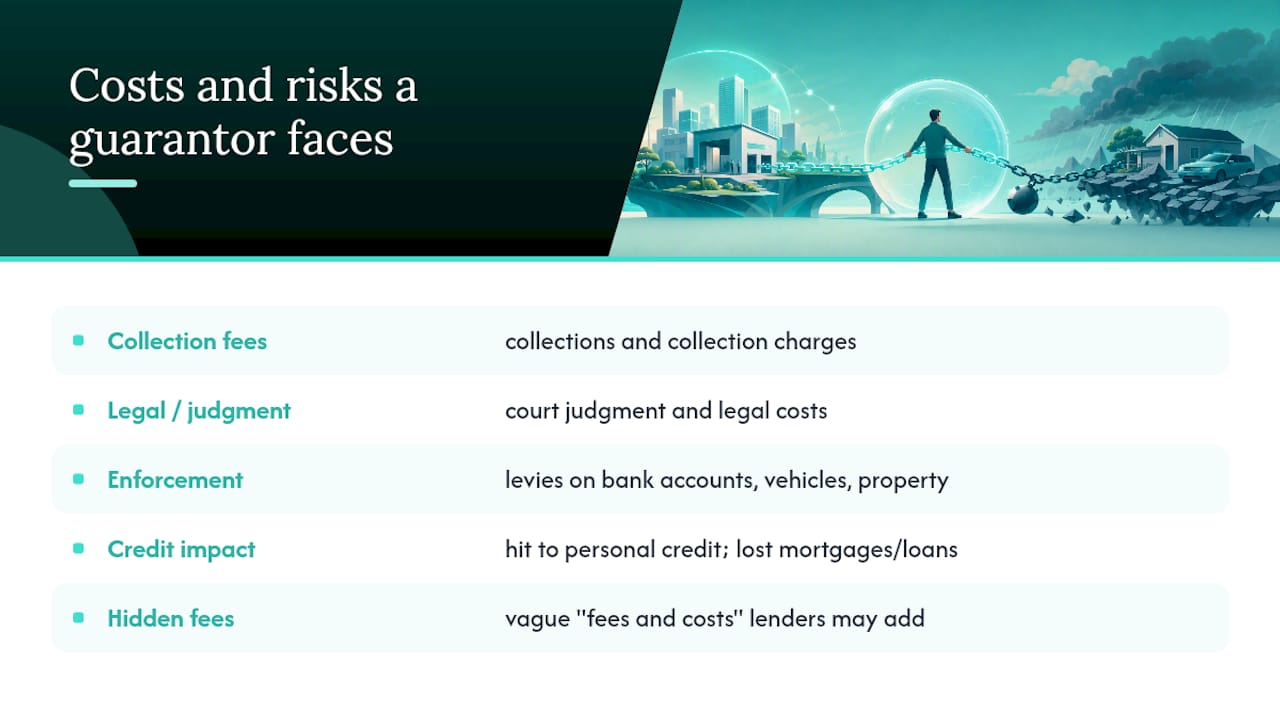
Lenders that go unpaid can pursue collections, obtain a court judgment, and levy non-exempt personal assets, bank accounts, vehicles, sometimes property, depending on what the guarantee and local law allow. A default tied to your name also lands on your personal credit report, which can choke off your ability to get a mortgage, a car loan, or credit cards for years afterward.

The less obvious risks are the ones that catch owners off guard. Cross-company guarantees, where one entity’s debt is backstopped by a guarantee tied to a completely different business you own, can drag a healthy company into another’s mess. Commercial leases and supplier credit agreements often carry their own personal guarantee clauses buried in boilerplate. And as Sbo, a signed guarantee creates a direct path to your personal assets even though your company is a limited-liability entity, a fact many first-time borrowers don’t fully register until it’s too late.
Pro Tip: Before signing anything, ask your lender to itemize exactly which “fees and costs” the guarantee covers beyond the principal. Vague language here is where guarantors get blindsided by collection charges they never budgeted for.
How to Negotiate a Safer Personal Guarantee
Your negotiating power peaks before you sign, not after. Once the ink is dry, you’re negotiating from a position of almost zero leverage.
Ask for these, specifically:
-
A dollar cap or percentage cap instead of unlimited exposure.
-
Several liability if there’s more than one guarantor, so you’re not on the hook for partners’ shares.
-
A sunset or burn-down clause that releases you once the business hits agreed milestones, like two years of on-time payments or a debt-to-equity ratio below a set threshold.
-
Substitution of collateral, where you offer business assets or equipment in place of a personal guarantee, or to shrink its scope.
-
Carve-outs excluding you from liability triggered by fraud or misconduct you didn’t commit.
Lenders grant these concessions more readily when your financials are strong, when you have a competing offer in hand, or when your collateral coverage is already solid. Getting multiple offers running at once is often the single biggest lever you have.
Pro Tip: Never negotiate a guarantee in isolation. Get competing term sheets first, then use the better offer to push your preferred lender toward a capped or several structure. Lenders move fastest when they think they might lose the deal.
Have a lawyer review the definitions section, the trigger events, and the release conditions before you sign anything. That’s a few hundred dollars well spent against six figures of exposure.
Can You Avoid a Personal Guarantee Entirely?
Sometimes, yes. It usually comes down to trade-offs between cost, speed, and how much collateral you can offer instead.
-
Building business credit over time reduces how often lenders ask for a personal backstop on future facilities.
-
Asset-backed lending, where equipment, receivables, or property secure the loan, often reduces or eliminates the need for a personal guarantee.
-
Invoice financing ties the facility to outstanding invoices rather than your personal balance sheet.
-
Larger deposits or down payments sometimes convince a lender that business-side security is enough on its own.
-
Third-party guarantors or guarantee insurance products exist in some markets, shifting risk away from you personally, though they add cost and aren’t universally available.
None of these routes are free. They tend to cost more in fees, take longer to arrange, or require assets you may not have. That’s the real trade-off.
Your Pre-Signing Checklist: Questions to Ask Before You Sign
Run through these before you put your name on anything:
-
Confirm exactly who is the borrower and who is the guarantor, on paper, not just in conversation.
-
Check whether the guarantee is capped by dollar amount or percentage, and get that figure in writing.
-
Identify every fee and cost the guarantee covers, not just principal and stated interest.
-
Read the joint and several liability wording closely if there’s more than one guarantor.
-
List the exact trigger events for enforcement, missed payment, covenant breach, or something broader.
-
Confirm the release or sunset conditions and get them written into the contract, not promised verbally.
-
Run the loan-affordability math assuming worst-case enforcement, not just the monthly repayment scenario.
-
Consider whether personal liability insurance or a risk-transfer product makes sense for your situation.
For lawyer review, bring the loan agreement, the guarantee itself, your latest financials, and any collateral documents. A personal guarantee should clearly name both parties, state the type of guarantee, and specify caps and signatures, so confirm those basics are actually on the page before you sign. Keep a signed copy along with all correspondence about caps or release terms, you’ll need it later if you’re ever pushing for release.
Getting Better Terms Through a Multi-Lender Approach
One overlooked lever: which lender you approach in the first place. Guarantee terms aren’t standardized across the market, and different lenders will offer meaningfully different structures for a similar loan.
Kapvoy submits SME loan applications across a panel of more than 30 banks and non-bank lenders simultaneously, which means you’re not stuck negotiating with a single institution’s take-it-or-leave-it guarantee language. Running multiple offers side by side is exactly the leverage that gets caps, sunset clauses, or several liability approved instead of unlimited joint guarantees.
-
Multiple simultaneous submissions mean more chances to compare guarantee terms, not just interest rates.
-
Average approval turnaround runs 1 to 3 days, with no upfront fees or consultation charges.
-
A broker who understands lender-specific guarantee practices can flag which institutions are more flexible on caps before you commit to one.
Start with the SME loan documents checklist to see what you’ll need prepared, then get legal review before signing.
Where Conventional Advice on Guarantees Gets It Wrong
Most guidance on personal guarantees treats them as a binary: sign or don’t get funded. That framing does owners a disservice. The research is fairly consistent that guarantees are negotiable contracts, and borrowers routinely accept unlimited terms by default simply because nobody asked whether a capped version was on the table.
The bigger blind spot is timing. Owners tend to focus their energy on interest rates and loan terms during negotiation, then treat the guarantee as a formality to sign at closing. That’s backward. Your leverage on guarantee terms is highest before you commit to a single lender, and it evaporates almost completely afterward. If you’re only comparing rate sheets, you’re negotiating the wrong variable.
I’d also push back on the idea that a personal guarantee is inherently a red flag. For a young business with no credit history, it’s often the price of getting funded at all. The real skill isn’t avoiding guarantees at all costs. It’s knowing which structure protects you and having enough competing offers to actually get it.
Get Better Guarantee Terms Without the Single-Lender Guesswork
Shopping a loan application to one bank at a time means accepting whatever guarantee language that lender defaults to, with no comparison point. Kapvoy runs your application across more than 30 banks and non-bank lenders at once, so you can weigh guarantee structures, caps, and release terms against each other instead of negotiating blind with a single institution.
There’s no upfront cost to find out what’s on the table. Kapvoy only charges a fee once your financing is approved and disbursed, and most applications get a lender response within 1 to 3 days. If you’re weighing a term loan, working capital facility, or another SME product and want to see which lenders offer the most favorable guarantee terms for your profile, check your eligibility in a few minutes or explore the full range of financing options available through Kapvoy’s lender panel.
Frequently Asked Questions
Is a personal guarantee the same as collateral? No. Collateral is a specific asset the lender can seize, like equipment or property. A personal guarantee is a promise to repay personally, regardless of which assets end up covering the shortfall.
Can I get a business loan without a personal guarantee? Yes, particularly with strong business credit, sufficient collateral, or through invoice financing and asset-backed lending. Availability depends heavily on the lender and your business profile.
How long does a personal guarantee last? It typically lasts until the loan is fully repaid or until a sunset clause you negotiated triggers a release. Some guarantees are “continuing,” meaning they cover future advances too, unless you specifically limit that scope.
What happens if I default and can’t pay as guarantor? The lender can pursue collections, obtain a judgment, and go after non-exempt personal assets. This is also reported on your personal credit file, affecting future borrowing.
Can multiple business partners share a personal guarantee? Yes, but check whether it’s structured as joint and several or several liability. Joint and several means any one partner can be pursued for the whole amount; several liability limits each partner to their agreed share.
This article is general information, not a substitute for advice from a qualified financial advisor. Consult a qualified financial professional about your own circumstances before acting on anything here.