Model Exact Cash Needs for Progressive Payment Loans in Singapore

Buying a new launch in Singapore under the Progressive Payment Scheme means you commit an initial portion in cash and CPF upfront (5% at booking, 15% at Sale & Purchase), while the bank releases the remaining amount in stages as construction hits certified milestones. The catch: your loan must still be fully approved for the entire amount from day one, under the Monetary Authority of Singapore's LTV and TDSR limits, even though the money trickles out over three to four years.
TL;DR:
- Buyers should model their full loan repayment plan at a higher interest rate before signing the Sale & Purchase agreement to account for rising rates during construction.
- Developer milestone notices, which trigger payment within 14 days, can sometimes combine stages, increasing the due amount unexpectedly, especially near TOP.
- Most initial costs involve disbursements from the bank loan, with the first 20% of the purchase requiring cash and CPF payments, and stamp duties due as a lump sum within 14 days.
- Banks disburse construction loans incrementally based on milestone certification, meaning the loan balance and repayment amounts increase as construction progresses.
- Applying for multiple lenders early and securing in-principle approval before signing can improve financing options, especially due to the long timeline of milestone disbursements.
Table of Contents
- What Is the Progressive Payment Scheme in Singapore?
- How Do the Payment Milestones and Percentages Break Down?
- Which Costs Come From Cash, CPF, or the Bank Loan?
- When Do Loan Repayments Start, and How Do They Change?
- What Costs Fall Outside the Progressive Payment Schedule?
- How Do You Model a Progressive Payment Cashflow Plan?
- Why Do Lenders Weigh BUC Applications Differently?
- What Contract Traps Should You Watch For in S&P Notices?
- Where to Verify These Rules and Numbers
- Why the Standard Advice on Progressive Payment Undersells the Real Risk
- Get Your BUC Loan Structured Before the Next Payment Notice Lands
- Sources
What Is the Progressive Payment Scheme in Singapore?
The Progressive Payment Scheme (PPS) is not a marketing term. It's the legally mandated payment structure for private residential units bought directly from a licensed developer, set out under the Housing Developers (Control and Licensing) Act and the accompanying Housing Developers Rules. Every project sold under a Building Under Construction (BUC) status, whether a private condo or an executive condominium, must follow this framework.
That legal grounding matters because it means the milestone percentages you'll see quoted everywhere aren't a lender's invention. They're standardized to protect buyers from developers who might otherwise demand large lump sums before construction actually happens. PPS applies only to new sales from developers. Resale of a completed unit, or a sub sale of a BUC unit from an existing owner, doesn't follow this schedule at all.
Here's the mechanic that catches first-time buyers off guard: payment isn't automatic. A project's architect must certify that a construction stage is complete (foundation laid, structural framework up, and so on) before the developer can issue a payment notice. Once that notice goes out, Singapore's rules give you 14 days to pay. Miss it, and you're exposed to interest charges and, in a worst case, default under the Sale and Purchase Agreement (S&P).
How Do the Payment Milestones and Percentages Break Down?
The standard schedule rarely deviates from project to project, because it's built into the Housing Developers Rules rather than left to individual developer discretion. What can shift slightly is how developers bundle stages, particularly the smaller ones near completion.
Here's the canonical breakdown used across Singapore new launches:
A few things to understand about this table. First, developers sometimes combine two adjacent milestones (say, roofing and doors/windows) into a single notice, which is legal, but it also means you get less warning before a larger sum is due. Second, notice every stage after the S&P downpayment demands a bank drawdown, meaning your loan disbursement schedule mirrors this exact table.
Payment is due within 14 days of the developer's written notice regardless of which milestone triggered it. There's no grace period built into the standard S&P.
Which Costs Come From Cash, CPF, or the Bank Loan?
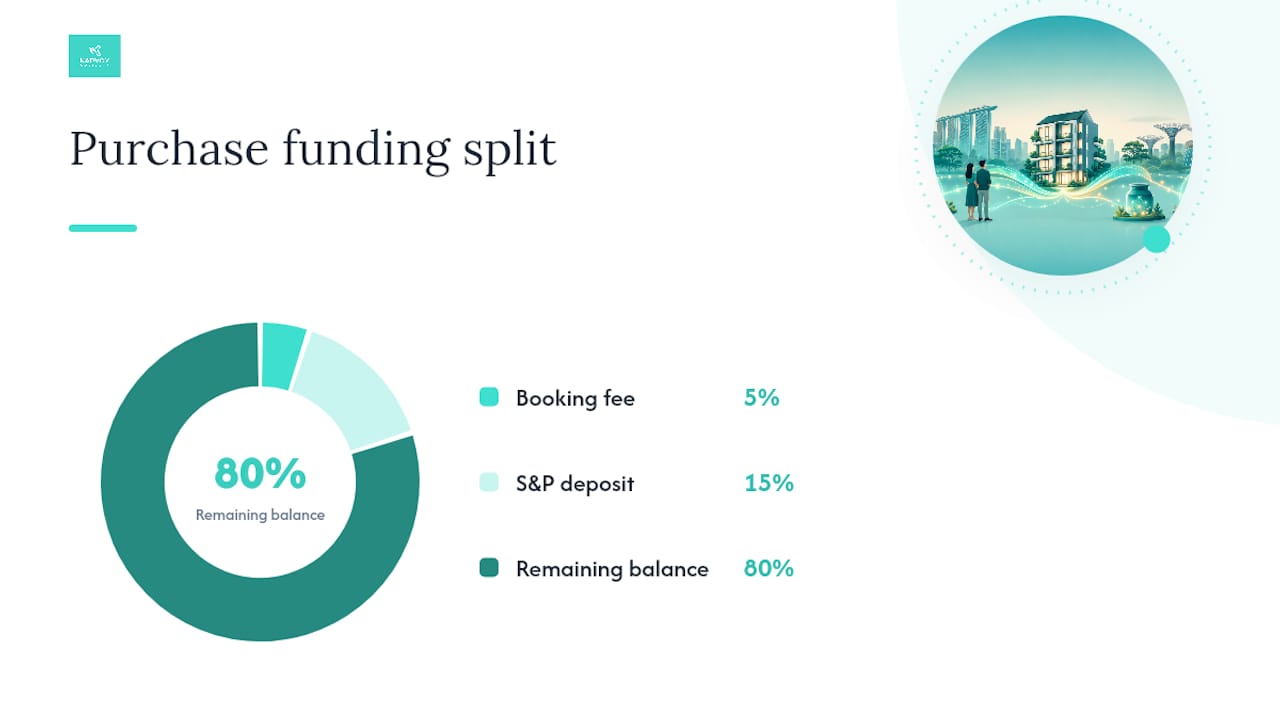
The first 20% of a BUC purchase is where most of the friction actually happens, because it involves three different funding sources interacting on tight deadlines.
- The 5% booking fee at Option to Purchase must be paid in cash. CPF cannot be used at this stage.
- The 15% due on signing the S&P (usually within about eight weeks of the OTP) can be paid using cash, CPF Ordinary Account funds, or a mix of both, provided you stay within your CPF Valuation Limit.
- From the foundation milestone onward, your bank loan takes over the bulk of each payment, topped up by any remaining CPF OA balance you choose to apply.
Before any of this happens, you'll need an in-principle approval (IPA) from a bank, based on your income, credit obligations, and the property's estimated value. Full approval typically firms up once the S&P is signed and the actual purchase price is locked in. From that point, the bank doesn't hand you a lump sum. It disburses funds directly to the developer, milestone by milestone, matching each payment notice as it arrives.
One timing trap worth flagging early: CPF reimbursement for costs like stamp duty often lags behind the cash outlay, so you may need to pay in cash first and claim CPF back afterward.
When Do Loan Repayments Start, and How Do They Change?
Your mortgage doesn't sit dormant while your unit is being built. The moment the bank makes its first drawdown, typically at the foundation milestone, your monthly repayment clock starts running.
Here's how that typically plays out over the life of a BUC loan:
- Foundation stage: the bank releases its first tranche (usually matching the 10% foundation payment), and your first monthly instalment kicks in, calculated only on the amount disbursed so far.
- Each subsequent milestone: the loan balance grows with every drawdown, and your instalment rises in step, since most banks charge interest only on what's actually been released during construction.
- After TOP and CSC: once the full loan is disbursed, repayments convert to standard principal-and-interest instalments, calculated on the entire loan amount over your remaining tenure.
That structure feels manageable early on, since you're often only servicing interest on a fraction of the loan. The mistake is budgeting for that reduced instalment as if it's permanent. It isn't.
Pro Tip: Model your finances against the fully drawn instalment amount from day one, not the interest-only figure you'll actually pay in year one. Add a 1 to 2 percentage point rate buffer to that calculation, since most BUC projects take three to four years to reach CSC, and rates can move meaningfully in that window.
What Costs Fall Outside the Progressive Payment Schedule?
Stamp duties don't follow PPS timing at all, and this catches more buyers off guard than any construction milestone. Buyer's Stamp Duty (BSD) and, where applicable, Additional Buyer's Stamp Duty (ABSD) are due as a lump sum, typically within 14 days of signing the S&P, per IRAS rules, regardless of how the rest of your purchase price is staggered.
For a S$2,000,000 unit, BSD alone runs into the tens of thousands, and ABSD, if it applies to your buyer profile, can add substantially more on top. Most buyers pay this in cash upfront and claim CPF reimbursement afterward, since CPF processing rarely completes within the same 14-day window.
Before signing, prepare:
- A CPF OA statement showing your current balance and Valuation Limit
- Your latest IPA or bank approval letter
- Funds set aside separately for BSD/ABSD, distinct from your 20% booking and S&P money
- Legal fees for the conveyancing lawyer handling your S&P
Stamp duty due date: within 14 days of S&P signing, paid as a single lump sum, not staggered like the construction milestones.
How Do You Model a Progressive Payment Cashflow Plan?
A reliable model needs five inputs: purchase price, your CPF OA balance, the bank's interest rate, your loan tenure, and the expected construction timeline for that specific project. Calculators built for this purpose typically output three things at each stage: cash required now, CPF applied, and the resulting monthly instalment once that tranche is disbursed.
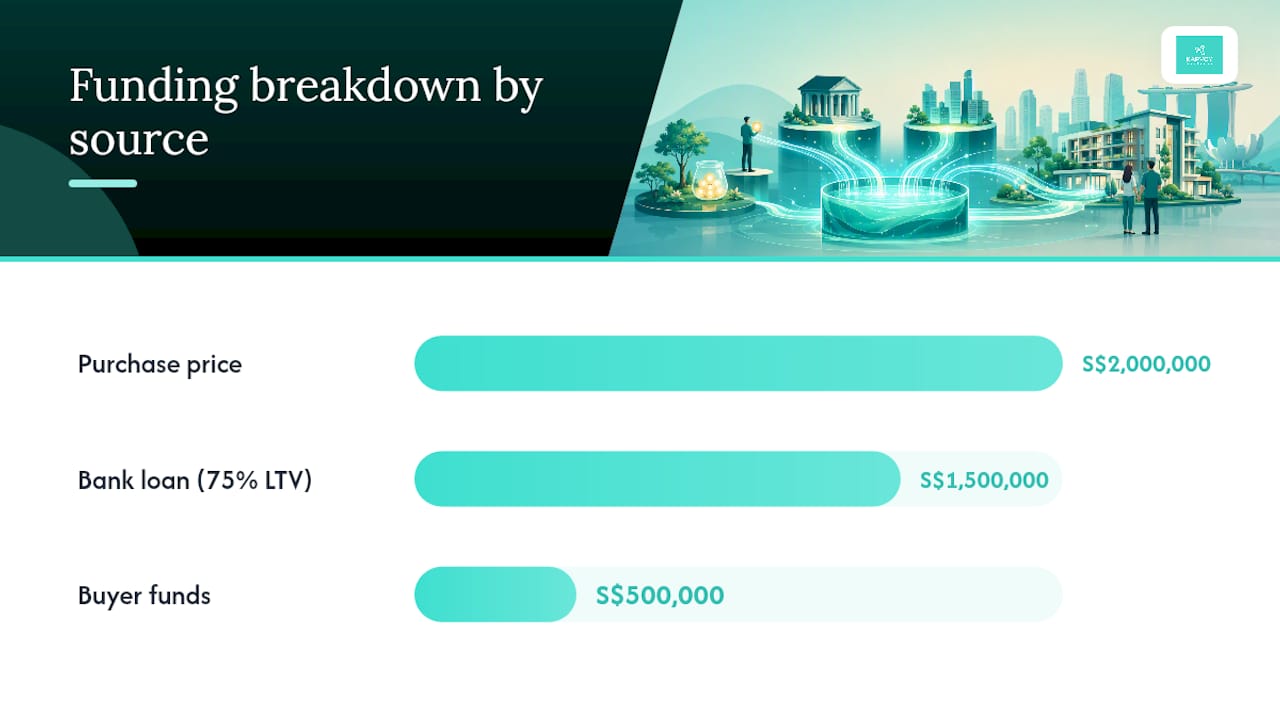
Here's a simplified worked example for a S$2,000,000 new launch condo, assuming a 75% LTV loan:
To build your own version of this table:
- Confirm the exact purchase price and your approved LTV from your bank's full approval letter.
- Apply each milestone percentage from the schedule above to get the dollar figure due at that stage.
- Track which amounts are covered by your loan versus your own CPF/cash, since only the loan portion generates a monthly instalment.
- Re-run the model at a higher interest rate (add 1.5 to 2 points) to see how your post-CSC instalment holds up under a stress scenario.
Watch for developer notices that arrive close together, particularly near TOP, since overlapping deadlines can strain cash reserves even when each individual payment looks manageable on paper.
Why Do Lenders Weigh BUC Applications Differently?
Banks don't evaluate a BUC loan the same way they'd assess a resale purchase. They're underwriting a commitment that stretches over years, against a project that doesn't exist yet, which is partly why the developer's own track record carries real weight in a lender's decision, sometimes as much as your personal financial profile.
That's the gap Kapvoy Advisory was built to close. Rather than applying to one bank and hoping for the best, Kapvoy compares more than 30 lenders and submits your profile to several at once, matching you to banks that are already comfortable financing that specific developer or project.
Before applying, strengthen your position with this checklist:
- Pay down short-term debts and credit card balances to improve your TDSR ratio.
- Confirm your CPF OA balance and Valuation Limit before you need the figures.
- Gather income documents, CPF statements, and existing loan records in one file.
- Ask upfront what LTV the bank will actually extend, not just the maximum ceiling under MAS rules.
- Check the developer's completion history on past projects, since lenders factor this in too.
Pro Tip: Apply for in-principle approval before you commit to an OTP, not after. It tells you your real borrowing ceiling while you still have room to negotiate or reconsider the unit.
Kapvoy's own process typically returns a decision within 1 to 3 days, a meaningful difference when a developer's 14-day payment clock is already running.
What Contract Traps Should You Watch For in S&P Notices?
Read the late-payment interest clause in your S&P before signing. Some contracts compound penalty interest daily, which adds up fast if a notice arrives while you're mid-refinancing or waiting on CPF processing.
- Confirm whether the developer combines milestones into single notices, since this can double the amount due with the same 14-day window.
- Flag developers with a history of repeated TOP delays. It affects both your loan conversion timing and your CPF/cash planning.
- Ask your lawyer to clarify escrow handling if the project's payment structure looks unusual compared to the standard schedule.
Where to Verify These Rules and Numbers
Cross-check figures against IRAS's stamp duty guidance, the Housing Developers Rules, and CPF Board's property usage pages before finalizing your budget. For financing specifics, Kapvoy's Property Financing Guide and eligibility check tool cover the loan side directly.
Why the Standard Advice on Progressive Payment Undersells the Real Risk
Most guides to Singapore's Progressive Payment Scheme stop at the milestone table. They'll tell you the percentages, maybe the 14-day rule, and call it done. The part that actually sinks buyers is the collision between two independent timelines: the construction schedule, which developers control, and your loan qualification, which banks control under MAS's TDSR and LTV limits that don't bend for anyone.
The conventional advice treats loan approval as a one-time event at OTP. It isn't. Your financial profile needs to hold up for years, through job changes, rate hikes, and whatever else happens between foundation and CSC. Buyers who model only the interest-only instalment during construction, and never stress-test the fully drawn figure, are the ones who get uncomfortable surprises at TOP.
If there's one thing to prioritize, it's this: get your borrowing capacity assessed against the full loan amount, at a higher rate than today's, before you sign anything. Everything else in this process, the milestone timing, the CPF sequencing, the stamp duty deadlines, is manageable once that number is solid.
— Viknesh
Get Your BUC Loan Structured Before the Next Payment Notice Lands
Kapvoy is the alternative to walking into a single bank branch and hoping your TDSR clears. For a BUC purchase, where your loan has to stay approved across years of milestone drawdowns, that difference matters: Kapvoy compares your profile against more than 30 lenders at once, including banks with track records financing your specific developer, instead of betting everything on one institution's appetite that day.
This suits buyers who've already found their unit and need financing locked in before the next developer notice arrives, as well as investors juggling more than one BUC commitment who want to know their real borrowing ceiling before signing an S&P. Kapvoy charges nothing upfront and only earns its fee once your financing is actually approved and disbursed, with decisions typically landing within 1 to 3 days.
Start with a free eligibility check or browse all financing options to see which lenders fit your project before your next payment deadline hits.