Get Funding in 1–3 Days: SAFE Note in Singapore for SMEs

When Singapore SME owners search for a "SAFE note," most of what they find online describes a startup equity instrument used in Silicon Valley fundraising. That is not what this guide covers. Here, "SAFE note" refers to the brokered financing routes available to Singapore businesses and property owners: the Enterprise Financing Scheme (EFS), commercial bank loans, and alternative lenders. If you need working capital or a property refinance, your fastest move is a quick eligibility check or a call to a broker who can compare offers across lenders at once.
TL;DR:
- A broker comparing multiple lenders can significantly speed up approval times to as little as one to three days by submitting files in parallel.
- Eligibility for the Enterprise Financing Scheme requires business registration with ACRA, at least 30% local shareholding, and compliance with revenue and headcount limits.
- The most common financing options are risk-shared EFS loans for growth-stage SMEs, creditworthy bank loans for stable businesses, and faster but more expensive alternative lenders for urgent cash needs.
- When assessing proposals, focus on the effective interest rate, loan tenor, fees, prepayment terms, and collateral requirements instead of conversion terms used in startup investments.
- The main advantage of brokered SAFE-style financing is access to multiple lenders with a success fee only paid upon approval, reducing the risk of multiple credit inquiries damaging future borrowing.
Table of Contents
- SAFE Note Singapore: The Three Real Financing Routes
- What Documents and ESIMS Steps Does an EFS Application Need?
- How Does a Broker Improve Your Odds of Approval?
- How Do You Prepare a Financing Application Step by Step?
- EFS vs Bank Loan vs Alternative Lender: How Do You Decide?
- What Is a SAFE Note in Singapore SME and Property Financing?
- SAFE Note Financing: Risks and Benefits Compared to EFS or Bank Loans
- Regulatory and Compliance Considerations for Brokered Financing in Singapore
- How Do You Apply for Brokered Financing Through Kapvoy?
- Comparing Terms: What Do Discount Rates, Caps, and Maturity Actually Mean Here?
- Does Brokered Financing Affect Your Ownership or Future Fundraising?
- An Editorial Take on Singapore's Broker-Forward Financing Model
- Ready to Compare Lenders? Here's How to Start
- Sources
SAFE Note Singapore: The Three Real Financing Routes
Three lanes carry almost all SME and property financing in Singapore, and each fits a different situation.
The Enterprise Financing Scheme (EFS), run through Enterprise Singapore, shares default risk with participating banks so lenders can extend credit they might otherwise decline. The EFS Working Capital Loan caps out at S$500,000 per borrower, with the government absorbing 50% to 70% of default risk depending on company age. The bank sets your rate; EnterpriseSG just makes the bank more willing to say yes.
Commercial bank loans work outside EFS too, usually for established SMEs with clean financials, collateral, or a strong banking relationship. Pricing and terms come entirely from the bank's own credit assessment, so two SMEs with similar revenue can land very different rates.
Alternative and digital lenders, including invoice financing platforms, move faster because they lean on transaction data rather than lengthy manual reviews. That speed comes at a cost: higher effective interest rates than a bank term loan.
- EFS: best for growth-stage SMEs needing risk-shared bank credit
- Bank loans: best for stable, asset-backed businesses with time to spare
- Alternative lenders: best when cash flow is urgent and cost is secondary
What Documents and ESIMS Steps Does an EFS Application Need?
EFS eligibility isn't automatic. Enterprise Singapore requires your business to be registered with ACRA, hold at least 30% local shareholding, and stay under the scheme's group revenue and headcount caps for SME classification. Fully foreign-owned entities generally don't qualify, regardless of revenue size.
Before applying, gather:
- Your ACRA BizFile business profile extract
- Director and shareholder NRIC copies
- The last six to twelve months of bank statements
- Recent financial statements or management accounts
- Supporting contracts or invoices for revenue verification
Submissions to participating financial institutions run through the Enterprise Financing Scheme Integrated Management System, known as ESIMS, which sits behind Singapore's CorpPass login. Your CorpPass administrator must assign someone the Loan Applicant role before that person can create and submit an application to chosen banks. Miss this step, and the application never leaves the queue.
Pro Tip: Reconcile any unusual deposits in your bank statements before submitting. Lenders routinely pause files to ask about one-off receipts, and a short explanatory note attached upfront can save you a week of back-and-forth.
How Does a Broker Improve Your Odds of Approval?
Submitting to one bank at a time means one shot, one set of criteria, and one waiting period before you find out if you need to try again. That is the core inefficiency a broker solves.
A broker compares multiple banks and non-bank lenders, then submits your file to several that genuinely fit your profile at once. Instead of guessing which bank's credit box you fit into, multiple lenders evaluate you in parallel, which shortens the path to a yes.
A few things worth knowing about how this works in practice:
- The broker charges nothing upfront. The fee is a success fee, paid only when financing is approved and disbursed.
- Average approval turnaround for clients runs 1 to 3 days once a complete file is submitted.
- Borderline files, unusual collateral, or tight deadlines are where a broker adds the most value. A straightforward application from an existing bank customer might not need one.
Pro Tip: If you've been rejected by one bank, don't immediately reapply elsewhere on your own. Rejections can sometimes surface on credit reports, and a broker's soft-screening process avoids stacking up hard applications that make your file look shakier than it is.
Existing bank customers with strong transaction history sometimes get near-instant decisions, but that speed rarely extends to new-to-bank applicants, who face manual credit review regardless of which lender they choose.
How Do You Prepare a Financing Application Step by Step?
Getting funded fast has less to do with luck and more to do with what's in your file before you hit submit.
- Clean up your financial documentation first. Pull six to twelve months of bank statements, build a simple cashflow forecast, and make sure your ACRA corporate documents are current.
- Estimate a realistic loan amount and stress-test it. Don't anchor on the headline interest rate. Calculate your effective interest rate (EIR), which includes fees and how interest compounds, then check whether your monthly cashflow can absorb repayments even in a slower month.
- Choose your submission channel. Going direct to one bank is simple but limits you to that bank's appetite. Submitting through ESIMS via a participating financial institution works for EFS-specific products. Going through a broker means simultaneous submissions across a wider panel, at the cost of a success fee.
- Expect a credit review after submission, followed by an offer letter outlining rate, tenor, and conditions, then acceptance and disbursement. Clean files with existing banking relationships move fastest; new-to-bank or complex files take longer regardless of channel.
Pro Tip: Ask for the EIR in writing before comparing any two offers. A lower headline rate with higher processing fees can cost more than a higher rate with none.
EFS vs Bank Loan vs Alternative Lender: How Do You Decide?
Start with three questions: how urgent is the cash, how much collateral can you offer, and does your ownership structure even qualify you for EFS.
If you need funds within days and can tolerate a higher cost of capital, an alternative lender or invoice financing platform fits. If you have time, clean financials, and want the lowest possible rate, a commercial bank loan or EFS facility (if you're eligible) usually wins on cost. If your business is younger or thinner on collateral, EFS's government risk-share can unlock financing a bank might otherwise decline outright.
Before signing with any lender or broker, ask:
- What is the effective interest rate, not just the headline rate?
- Are there processing fees, and are they refundable if the loan doesn't proceed?
- What happens if you want to prepay? Some facilities charge a penalty.
- What security or personal guarantees does the lender require?
- Are there covenants that restrict how you run the business, like maintaining a minimum cash balance?
Property owners considering refinancing should also verify lender licensing. Licensed moneylenders in Singapore don't offer mortgage refinancing; that product comes from banks and licensed mortgage lenders only, so confirm you're talking to the right category of lender before going further.
What Is a SAFE Note in Singapore SME and Property Financing?
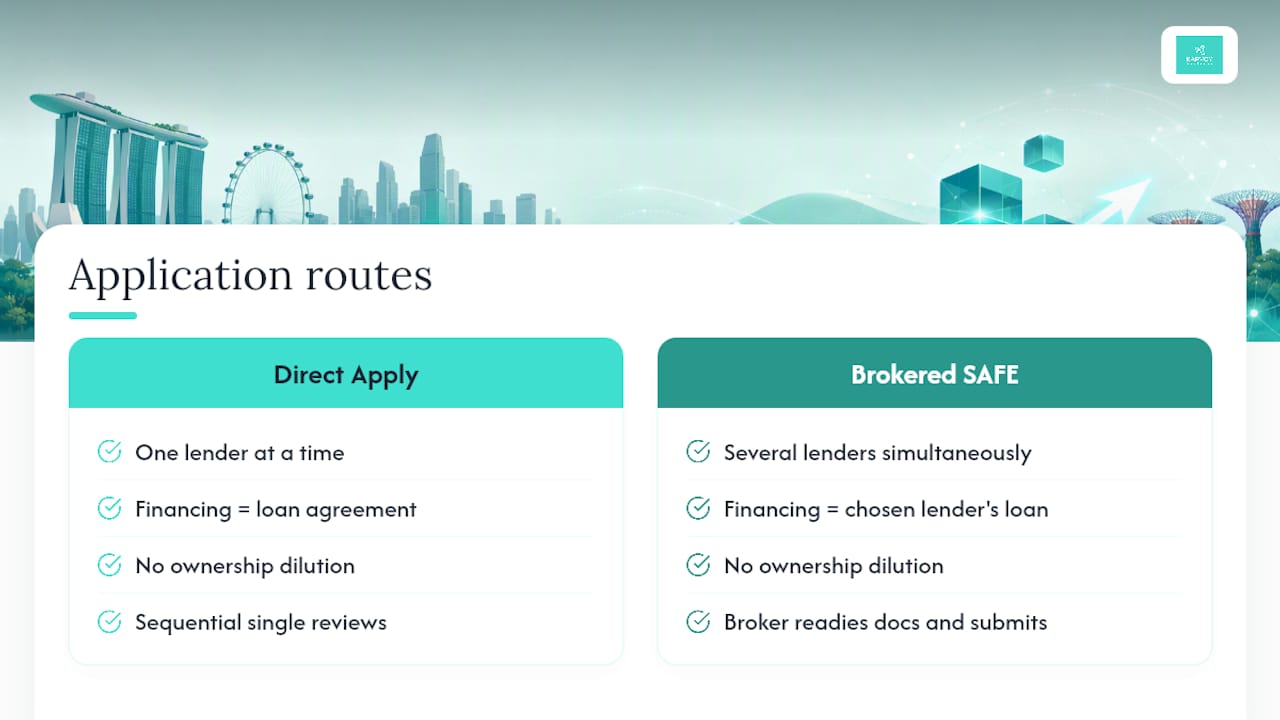
In the context this article uses, a "SAFE note" isn't a startup equity contract. It describes a structured, brokered financing arrangement, where a broker packages your business or property profile and presents it to multiple lenders under terms each lender has pre-agreed to consider.
Legally, this isn't a loan itself and isn't equity either. It's a facilitation arrangement. The actual financing, whether it's an EFS-backed working capital loan, a bank term loan, or an alternative lending facility, still takes the legal form of a conventional loan agreement or credit facility between you and the financial institution. The broker's role sits between you and the lender panel: matching your file to lender criteria, preparing documentation, and managing simultaneous submissions.
This distinguishes it clearly from equity financing, where an investor takes ownership in exchange for capital and has no fixed repayment schedule. A brokered SAFE arrangement keeps you as the sole owner of your business; you repay principal and interest under standard loan terms, and no ownership dilutes.
It also differs from a standard EFS or bank loan application. When you apply on your own, you're limited to whichever lender you approach. When your application runs through a broker's multi-lender submission, several institutions assess your file at once under their own separate legal agreements. You're not negotiating one contract. You're triggering several parallel reviews, and you accept the offer that fits best.
SAFE Note Financing: Risks and Benefits Compared to EFS or Bank Loans
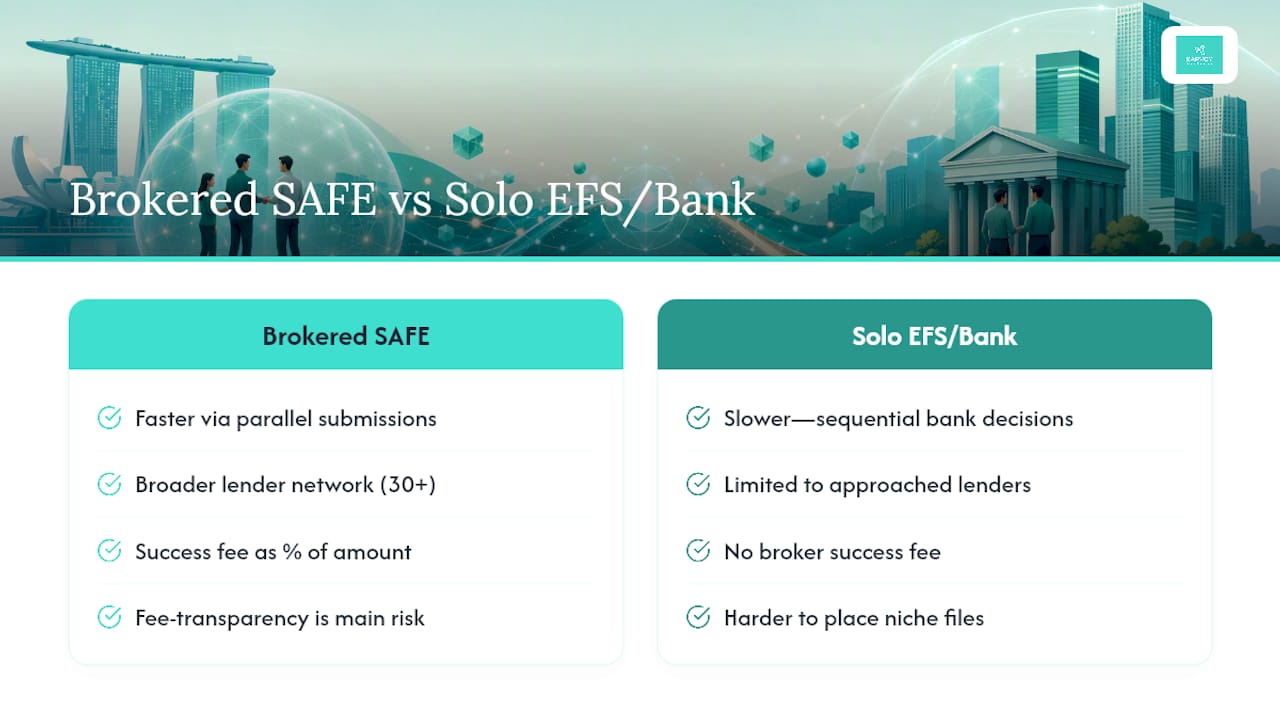
The main benefit of a brokered SAFE-style arrangement is speed through parallel submission. Rather than waiting weeks for one bank's decision before trying another, your file goes to several lenders that fit your profile simultaneously, which is why brokered applications often resolve faster than solo submissions.
The second benefit is access. A broker who tracks the credit appetite of 30-plus lenders can place a file with an institution you'd never have approached on your own, particularly useful for SMEs with unconventional collateral, thin trading history, or industry-specific risk that makes generic bank credit models nervous.
The primary risk isn't financial exposure from the broker itself. It's cost transparency. Because success fees are charged as a percentage of the approved amount, you need to weigh that fee against the value of faster access and a better negotiated rate. A success-fee model, where nothing is charged unless funding completes, removes much of the downside a poorly structured brokerage fee could otherwise create.
There's also a structural risk worth flagging: submitting to too many lenders without discipline can generate multiple credit inquiries that affect how future lenders view your file. This is why soft-screening before formal submission matters. A broker who filters candidates before submitting protects your credit profile rather than shotgunning applications everywhere.
Compared to a standalone EFS application, the brokered route trades a modest fee for materially higher odds of finding a lender whose credit box actually fits you.
Regulatory and Compliance Considerations for Brokered Financing in Singapore
Financing brokers in Singapore operate in a space where the underlying loan products, not the brokerage activity itself, carry most of the regulatory weight. EFS facilities are governed by Enterprise Singapore's own program rules, and every EFS loan is still originated and underwritten by a participating financial institution regulated under Singapore's banking framework. The broker doesn't lend money and doesn't hold client funds; it packages and submits applications on the borrower's behalf.
This matters for compliance because the actual credit decision, interest rate, and loan documentation always come from a licensed bank or MAS-regulated financial institution, never from the broker. When you work with a broker, you're still ultimately signing a facility agreement with a bank or licensed lender, subject to the same regulatory protections that apply to any direct application.
For property refinancing specifically, only banks and licensed mortgage lenders can legally offer that product. This is worth checking directly if you're approached by any party offering property refinancing outside those categories.
If you're evaluating a broker, ask plainly whether they charge upfront fees before funding is disbursed. A success-fee-only model, charged solely on completed financing, is a structural safeguard: it means the broker's incentive aligns with actually getting your application approved, not with generating fees regardless of outcome.
How Do You Apply for Brokered Financing Through Kapvoy?
The application sequence is straightforward, but the prep work in step one is where most delays happen.
Step one: gather your documents. You'll need your ACRA BizFile extract, six to twelve months of bank statements, recent financial statements, and any contracts or invoices that support your revenue claims. Having these ready before you contact a broker cuts days off the process.
Step two: complete an eligibility check. This tells you which routes, EFS, bank, or alternative lending, actually fit your profile before you commit to a full application.
Step three: let the broker match you to a lender panel. Based on your business size, industry, collateral, and urgency, the broker selects which of its 30-plus lenders are most likely to approve your specific file, then submits accordingly.
Step four: compare offers and ask the right questions. When offers come back, ask about the EIR, any processing or prepayment fees, and what security or guarantees the lender wants. Don't accept the first offer purely because it arrived first.
Step five: accept and proceed to disbursement. Once you accept an offer, the bank finalizes documentation and disburses funds, typically within days for straightforward files.
Throughout, the key questions to ask any broker are simple: is there an upfront fee, how many lenders will actually see your file, and what is the realistic timeline given your specific documentation.
Comparing Terms: What Do Discount Rates, Caps, and Maturity Actually Mean Here?
Borrowers researching this topic often encounter language borrowed from startup investment agreements, terms like discount rates, valuation caps, maturity dates, and conversion triggers. Those terms describe how a startup SAFE converts investor cash into equity at a future funding round. They don't apply to the brokered SME and property financing this article covers, and no reputable Singapore SME broker or bank will structure a business loan or property refinance using them.
What you should compare instead, across every offer you receive, are the terms that actually govern loan financing:
| Term to Compare | Why It Matters | |---|---| | Effective interest rate (EIR) | Reflects true borrowing cost including fees and compounding, not just the headline rate | | Loan tenor | Longer tenors lower monthly repayments but raise total interest paid | | Processing and legal fees | Some lenders bundle these into disbursement; others bill separately | | Prepayment penalty | Determines whether you can refinance or repay early without a charge | | Collateral or personal guarantee required | Affects your personal exposure if the business can't repay |
For fixed asset purchases like equipment or commercial property, EFS fixed asset loans can run tenors of 10 to 15 years and sometimes undercut a standard commercial mortgage on price, since the government's risk-share lowers the bank's exposure. That's the real equivalent of comparing "terms" in this market: tenor, rate structure, and fees, not conversion mechanics from an entirely different financial instrument.
Does Brokered Financing Affect Your Ownership or Future Fundraising?
Every route covered here, EFS, bank loans, and alternative lending, is debt. None of it touches your equity or ownership structure. Once the loan is repaid, your cap table looks exactly as it did before you borrowed. This is the single biggest structural difference from a startup SAFE investment, which converts into equity and permanently changes who owns what percentage of the company.
That said, taking on debt still shapes your future financing options, just through a different mechanism than dilution. A loan sits on your balance sheet as a liability, and future lenders or investors will factor your existing debt load into how much additional risk they're willing to take on. Heavy borrowing today can mean tighter terms, or lower approved amounts, on your next financing round.
There's a practical upside too. SMEs that successfully repay an EFS-backed loan or bank facility build a credit track record that participating financial institutions can see. That history often improves your negotiating position the next time you need capital, whether that's a larger term loan, a commercial property purchase, or a working capital facility to fund growth.
For SMEs weighing debt against giving up equity to outside investors, the calculation is straightforward: debt keeps you in full control of your business but requires steady repayment regardless of how revenue performs; equity removes that repayment pressure but permanently reduces your ownership stake. Most established SMEs with predictable cash flow choose debt for exactly this reason.
An Editorial Take on Singapore's Broker-Forward Financing Model
The conventional advice on SME financing in Singapore still treats banks as the default first call and brokers as an afterthought for people who got rejected. That ordering is backwards. Given how much EFS pricing and risk appetite vary bank to bank, applying to just one institution first means you're accepting whatever credit box that single bank happens to use, with no visibility into whether a competing lender would have said yes faster or cheaper.
What gets underestimated is how much the ESIMS and CorpPass mechanics themselves slow down solo applicants. Assigning the Loan Applicant role, navigating which participating financial institutions to select, and packaging documentation correctly on the first attempt is where most delays actually originate, not in the underlying credit decision itself.
If there's one thing SME owners should prioritize, it's financial housekeeping before financing shopping. A clean set of bank statements and a realistic cashflow forecast do more to shorten approval time than switching lenders ever will. Speed comes from preparation meeting parallel access, not from any single lender's internal process.
— Viknesh
Ready to Compare Lenders? Here's How to Start
You've seen the three routes: EFS, bank loans, and alternative lenders, each with different speed, cost, and eligibility trade-offs. Instead of applying to one bank and waiting to see what happens, a broker submits your file to a panel of multiple banks and non-bank lenders at once, so multiple institutions review your profile in parallel rather than one at a time.
There is typically no upfront cost to work with a broker. The fee is a success fee, charged only when your financing is approved and disbursed, and clients often experience average approval times of 1 to 3 days once a complete file goes in. Whether you need SME working capital, an EFS-backed loan, or a property refinance, the process starts the same way.
Have your ACRA extract, recent bank statements, and financial statements ready, then run a free eligibility check to see which routes actually fit your business before you commit to a full application.
Sources
For the official rules on EFS eligibility and mechanics, Enterprise Singapore's ESIMS applicant guide walks through CorpPass onboarding and application submission in detail. DBS's SME Working Capital Loan page shows what a representative bank product looks like in practice. For a broader breakdown of SME loan types available in Singapore, Kapvoy's SME loans comparison guide and document checklist cover preparation in more depth.
- Singapore Business Loans 2026: SME Financing Guide | Sleek