SORA Near 1.0% in 2026: Singapore Homeowners' Quick All In Checklist

SORA is likely to settle near 1.0% through most of 2026, with a plausible range of roughly 0.7% to 1.5% depending on how fast the US Federal Reserve cuts rates. If you hold a floating-rate mortgage, the immediate move is simple: check your current all-in rate, gather your refinancing documents now, and watch the Q2 2026 window that bank strategists flag as a likely low point.
TL;DR:
- Mortgage holders should prepare now by reviewing their current all-in rates, gathering documents, and comparing offers before the Q2 2026 rate bottom.
- The central SORA forecast for 2026 is around 1.0%, with a plausible range of 0.7% to 1.5%, depending on US Fed rate cuts and global conditions.
- SORA rates affect monthly payments by resetting with reference periods, so knowing your spread and all-in rate is crucial for decision-making.
- Borrowers should consider whether SORA or FHR packages suit their risk tolerance, with SORA offering quicker adjustment benefits and FHR favoring payment stability.
- The optimal time to refinance is before rate forecasts peak in early 2026, with comparison across multiple lenders recommended to lock in better deals quickly.
Table of Contents
- SORA Forecast 2026 At a Glance
- What Is the SORA Forecast for 2026, and Where Does It Come From?
- How Does SORA Actually Change Your Monthly Mortgage Payment?
- SORA vs FHR: Which One Fits Your Mortgage in 2026?
- When Should You Refinance or Reprice in 2026?
- How Do Global Financial Trends Affect Singapore's SORA?
- How Volatile Has SORA Been, Historically?
- What Could Push SORA Outside the Expected 2026 Range?
- Kapvoy's Take: Turning a Forecast Into a Refinancing Plan
- Sources
- FAQ
SORA Forecast 2026 At a Glance
Here's the fast version, for anyone who needs the numbers before the reasoning.
- Central 2026 estimate: around 1.0%, with a working band of 0.7% to 1.5%
- Timing to watch: Q2 2026, when UOB expects Singapore rates to bottom out
- Top action 1: calculate your all-in rate (peg plus spread), not just the headline SORA number
- Top action 2: compare your current SORA package against a FHR package using real bank quotes
- Top action 3: pull together your income documents, latest CPF statement, and existing loan letter now, so you can move fast when a bank makes an offer
None of this requires guessing correctly about the Fed. It requires being ready before your bank is.
What Is the SORA Forecast for 2026, and Where Does It Come From?
The SORA forecast for 2026 sits at roughly 1.0% as a central case, built from a mix of official Singapore data and independent bank research rather than a single crystal ball. The Monetary Authority of Singapore publishes the daily SORA series and the methodology behind it, and that remains the reference point every other forecast gets checked against.
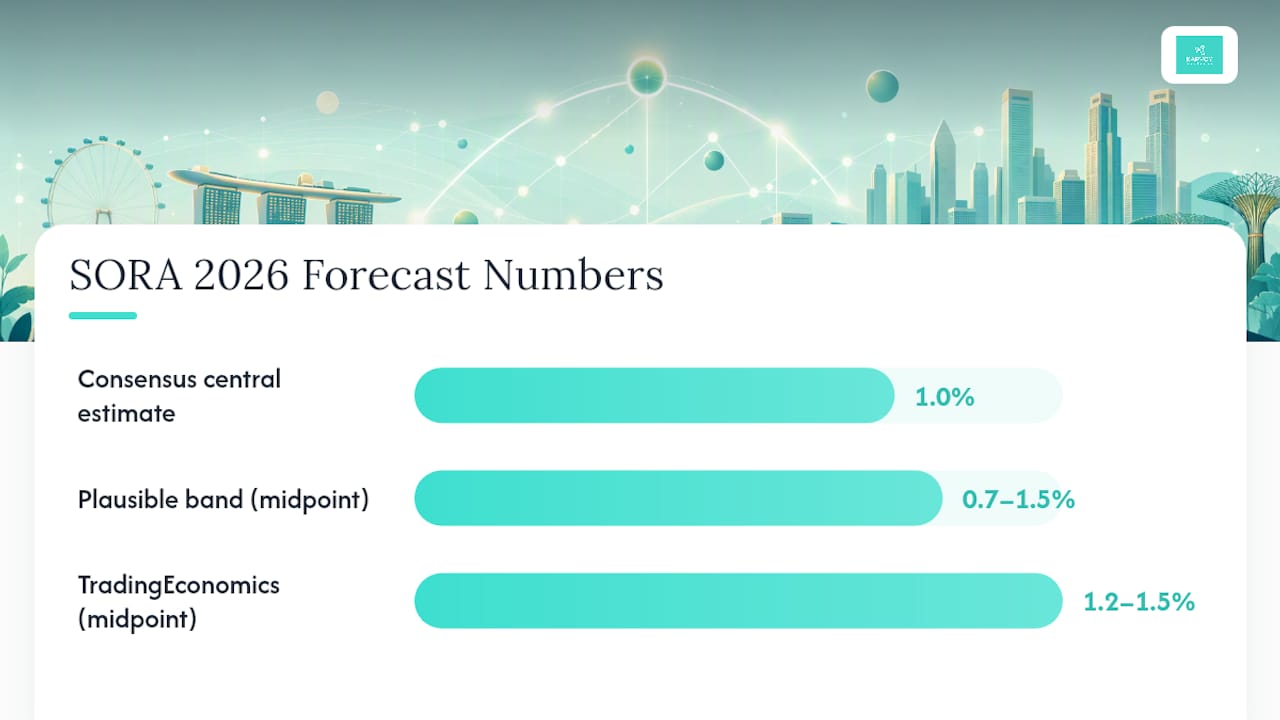
Bank research adds the forward-looking layer. UOB's public commentary, reported by The Straits Times, points to Singapore rates bottoming out around the second quarter of 2026 before drifting back up later in the year. Local mortgage analysis from Homejourney projects SORA stabilizing near 1% across 2026, broadly matching the bank view.
Econometric model output offers a third angle. TradingEconomics projects SORA in a near-term range around 1.2% to 1.5%, slightly above the bank-research consensus, which is a useful reminder that no single model owns the "right" answer.
Consensus snapshot: central estimate near 1.0%, plausible band 0.7% to 1.5%, with the tightest agreement around a mid 2026 low point.
Three forces move that band:
- The pace of US Fed rate cuts, since SORA tracks US dollar funding costs closely through Singapore's open, small economy
- MAS's own monetary policy stance on the Singapore dollar nominal effective exchange rate
- Domestic liquidity conditions in the interbank market, which can push SORA away from its modeled path for weeks at a time
A faster Fed than expected pulls SORA toward the low end. A stickier US inflation print does the opposite.
How Does SORA Actually Change Your Monthly Mortgage Payment?
Most Singapore home loans reference either 1 month compounded SORA or 3 month compounded SORA, then add a fixed spread the bank sets for your loan tenure. Your all-in rate is simply SORA plus that spread, and it resets every time the compounded reference period rolls over, not the day the headline rate moves.
Here's what that looks like on a $600,000 loan over 25 years.
Pro Tip: *Ask your bank for the exact spread in basis points, not just the headline "SORA plus X" pitch.
Follow this sequence when deciding between repricing with your current bank and refinancing with a new one:
- Pull your current all-in rate from your latest statement, not the promotional rate you signed up for.
- Get a repricing quote from your existing bank first, since it usually skips the legal and valuation fees a full refinance requires.
- Get at least two refinancing quotes from other lenders, comparing all-in rate, lock-in period, and any subsidy for legal and valuation costs.
- Total up the switching costs, including early redemption or breakage penalties, legal fees (commonly $2,500 to $3,000), and valuation fees, against the interest saved over the remaining lock-in.
- Check your loan-to-value and TDSR position, since income or property value changes since your last loan can affect what a new lender will offer.
Before any of that, have your latest three payslips, CPF statement, existing loan letter, and IRAS tax assessment ready. Banks that quote fast tend to close fast, and a missing document is the most common reason a good rate offer stalls.
SORA vs FHR: Which One Fits Your Mortgage in 2026?
FHR, or fixed deposit home rate, is pegged to the bank's own fixed deposit rates rather than the open market SORA benchmark. It resets less often and moves more slowly, which is exactly why some borrowers prefer it when they expect volatility.
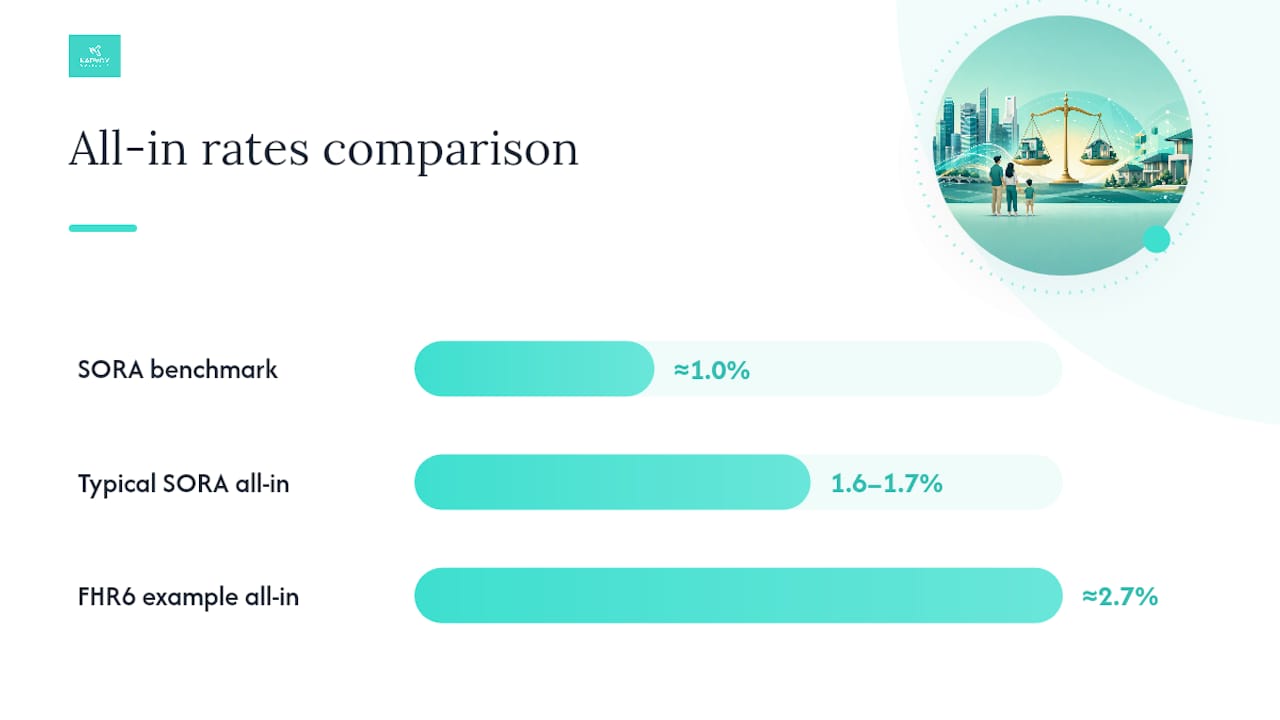
The practical difference shows up in the all-in number, not the label on the loan package. MoneySmart's guidance on current packages puts typical SORA package spreads around 0.60% to 0.70% over the benchmark. On bank-published FHR examples, Homejourney's FHR guide shows FHR6 packages around 1.4% plus a 1.25% spread, landing near a 2.7% all-in rate, broadly similar territory to a SORA package once you add its own spread on top of a roughly 1.0% benchmark.
What actually separates the two:
- SORA packages move with the market in near real time, so you benefit fastest if rates keep falling, but you also feel any spike immediately.
- FHR packages move slower and smoother, which suits borrowers who value predictable monthly payments over chasing the lowest possible rate.
- HDB owners on tighter budgets often lean FHR for payment stability; private property owners with more buffer sometimes prefer SORA to capture savings as rates ease.
- Rate optimists betting on further softening through 2026 skew toward SORA; risk-averse borrowers skew toward FHR or a fixed-rate package.
The simple decision rule for 2026: if the gap between your best SORA quote and your best FHR quote is under 0.2 percentage points, take the FHR package for the predictability. If SORA is meaningfully cheaper on an all-in basis, the savings usually justify the extra rate movement.
When Should You Refinance or Reprice in 2026?
Q2 2026 gets flagged because research ties a Singapore rate bottom to an expected acceleration in Fed cuts around that period. That view breaks if US inflation surprises to the upside and the Fed pauses, in which case the low point could shift later in the year or turn out shallower than expected.
The smarter move isn't predicting the exact week rates bottom. It's being ready before the window opens.
- If you're on a floating SORA loan with no lock-in, start collecting quotes now so you can switch the moment a materially better rate appears.
- If you're on FHR nearing the end of your lock-in, request your repricing letter about three months ahead and compare it against fresh SORA quotes before signing anything.
- If your lock-in ends in the second half of 2026, put a reminder in now. Rates offered late in the year may already reflect a rebound off the Q2 low.
Run a same-day all-in comparison whenever a new quote lands: benchmark plus spread, minus any legal or valuation subsidy, against your current statement. If the math is close or the paperwork feels complicated, that's the point to bring in a broker who can pull multiple lender quotes at once rather than calling banks one at a time.
Pro Tip: Set a calendar reminder for the start of Q1 2026 to request a same-day rate comparison from your bank and at least one competitor. Waiting until your lock-in expires removes your negotiating leverage.
How Do Global Financial Trends Affect Singapore's SORA?
SORA doesn't move on its own. Singapore runs an open capital account and a small, trade-exposed economy, so its overnight funding rate tracks global US dollar liquidity conditions closely, especially the Fed's own rate path.
When the Fed cuts, US dollar funding gets cheaper worldwide, and that pressure typically flows into SORA within weeks rather than months, since Singapore banks fund a large share of their books in US dollars alongside Singapore dollars. That's the main reason 2026 forecasts hinge so heavily on Fed policy rather than purely domestic Singapore data.
Currency matters too. MAS manages the Singapore dollar against a trade-weighted basket rather than targeting an interest rate directly, which means a stronger Singapore dollar against regional currencies can ease imported inflation pressure and give MAS more room to let domestic rates drift lower alongside the global trend.
Global risk events add a second, less predictable layer. A shock in global credit markets, a spike in oil prices, or a sudden flight to safety can tighten interbank liquidity in Singapore even when local fundamentals haven't changed, pushing SORA temporarily off its modeled path. These moves tend to be short-lived, but they're exactly the kind of swing that catches a borrower off guard if they've locked in a decision based only on the central forecast.
For homeowners, the takeaway is that SORA forecasts for Singapore are really a bet on US monetary policy filtered through Singapore's currency management. Watching Fed meeting dates matters as much as watching local news.
How Volatile Has SORA Been, Historically?
SORA is a relatively young benchmark by global standards, having replaced the Singapore Interbank Offered Rate as the market's preferred reference in the early 2020s. Its short history already contains a useful lesson: it can move fast in both directions.
Through 2022 and into 2023, SORA climbed sharply as the Fed ran one of its fastest hiking cycles in decades, dragging Singapore mortgage rates up alongside it and catching many borrowers who'd never budgeted for a 3%-plus benchmark. That period is why so many owners now ask about FHR alternatives, since fixed deposit rates rose more slowly and gave some payment shelter during the spike.
From 2024 into 2025, the trend reversed as the Fed began cutting, and SORA eased back down toward the 2% range and below, feeding directly into the current 2026 outlook where analysts expect it to keep drifting toward 1.0%.
The pattern worth remembering: SORA rarely moves in a straight line for long. It tends to trend for a year or two, then chop sideways in a range while the market waits for the next clear policy signal. That's exactly what current commentary describes for 2026, a stabilization phase rather than a sharp move in either direction, which is also why an uncertainty band matters more than a single point estimate when you're planning a multi-year mortgage decision.
What Could Push SORA Outside the Expected 2026 Range?
Every SORA forecast for 2026 carries real uncertainty, and the honest way to plan around it is a band rather than a single number.
On the downside, a sharper than expected US slowdown could push the Fed to cut faster and deeper than current bank forecasts assume, pulling SORA toward the bottom of that range or below it. A regional growth scare or a sudden drop in global trade volumes, given Singapore's export exposure, could do the same.
On the upside, a resurgence in US inflation, a delayed Fed cutting cycle, or a geopolitical shock that spikes energy prices could keep funding costs elevated longer than banks currently expect, pushing SORA back toward 1.5% or higher for stretches of the year.
There's also a structural risk worth flagging: banks periodically shift which FHR tranche they favor, moving between longer pegs like FHR18 and shorter ones like FHR6 as their own funding strategies change. That doesn't affect SORA directly, but it changes what your realistic alternative package looks like if you're deciding between SORA and FHR mid-year.
The practical response to all of this uncertainty isn't trying to time the bottom precisely. It's keeping your loan documents current, checking your all-in rate quarterly rather than annually, and treating any single forecast, including this one, as a working estimate rather than a guarantee.
Kapvoy's Take: Turning a Forecast Into a Refinancing Plan
A forecast is only useful if it changes what you do next, and that's the gap we see most often at Kapvoy. Homeowners read that SORA might bottom in Q2 2026, then do nothing until their lock-in actually expires, by which point the best offers on the panel may already be gone.
Quotes can be compared across many banks and lenders at once, which matters here specifically because SORA spreads and FHR pricing shift lender by lender, sometimes week by week. Running one all-in comparison against multiple lenders saves the effort of contacting banks individually, and approval turnaround times can be as fast as 1 to 3 days once an application goes in.
There is typically no upfront fee for comparison work in this space. Fees are often charged only when a loan is successfully funded, aligning incentives to find a competitive all-in rate rather than just the best introductory promotion.
If your lock-in ends anywhere in 2026, now is the point to start comparing, not the week your rate resets.
Get Your 2026 Refinancing Quote Compared Across 30+ Lenders
Waiting for the perfect week to refinance usually costs more than moving early with a solid comparison in hand. Kapvoy pulls quotes from its panel of 30+ banks and lenders simultaneously. So you see genuine all-in SORA and FHR offers side by side instead of negotiating with one bank at a time.

Here's how to move this week:
- Check your eligibility and current all-in rate through the free eligibility check
- Run your numbers through the loan calculator to see what a lower spread actually saves monthly
- Explore refinancing and new loan options on the property financing page, covering HDB, private mortgages, and equity release
There's no consultation fee and nothing charged upfront. Start with the eligibility check and a broker will walk you through real quotes before your lock-in window closes.
Where to Check Live SORA Figures and Bank Updates
For readers who want to track this forecast themselves rather than wait for the next update, these are the sources this article draws on:
- MAS for the official daily SORA series and methodology
- The Straits Times for bank research coverage, including UOB's Q2 2026 commentary
- Homejourney for local FHR versus SORA comparisons
- MoneySmart for current package spreads and home loan comparisons
- TradingEconomics for model-based rate projections
— Viknesh
This article is general information, not a substitute for advice from a qualified financial advisor. Consult a qualified financial professional about your own circumstances before acting on anything here.
Sources
- MoneySmart: SORA trend and home-loan comparisons
- Straits Times: S’pore interest rates could bottom out in second quarter of 2026: UOB
- Monetary Authority of Singapore (MAS)
- Homejourney: Singapore SORA rate outlook 2026
- TradingEconomics: Singapore Overnight Rate Average (SORA) projections
FAQ
What Is the Current SORA Rate in Singapore?
Check the MAS website for the exact daily figure, since it updates continuously and any number printed today will be out of date within weeks.
Is SORA Expected to Drop Further in 2026?
Most bank research expects SORA to keep easing gradually through the first half of 2026, with UOB pointing to a possible bottom around Q2 2026. A rebound later in the year is possible if US inflation runs hotter than expected, so the trajectory is a gradual decline rather than a straight line down.
What Will Interest Rates Be in Singapore in 2026?
That range reflects a SORA benchmark near 1.0% plus a typical spread of 0.60% to 0.70%, or a comparable FHR-plus-spread total.
Will the Singapore Dollar Get Stronger in 2026?
MAS manages the Singapore dollar against a basket of trading partner currencies rather than targeting a specific exchange rate level, so any strengthening depends on how regional currencies and the US dollar move through the year. A firmer Singapore dollar tends to ease imported inflation, which can give MAS more room to support lower domestic rates, reinforcing rather than working against the SORA forecast described above.
Should I Refinance Now or Wait for the Q2 2026 Low?
Waiting for a precise bottom usually costs more in lost time than it saves in rate, since the best offers can disappear once a bank's promotional window closes. A more reliable approach is comparing your current all-in rate against fresh quotes now, through a tool like Kapvoy's eligibility check, so you can act the moment a genuinely better offer appears rather than chasing a forecast.