Plan for 1%–1.5% Shock in 2026: SORA vs Fixed Rate for Singapore

If you plan to sell or refinance within three years, or you simply want to know your payment won't move, a short fixed-rate package fits best. If you can hold the loan for five years or more and have a cash buffer for rate swings, a SORA-pegged package usually costs less in 2026. Either way, budget for a payment shock of 1% to 1.5% before you sign anything.
TL;DR:
- SORA pegged loans are usually cheaper if held for five or more years and you have a financial buffer for rate increases, but predictability favors fixed-rate packages.
- A 1% rise in SORA can increase monthly repayments on a S$1 million loan by about S$490, with a 1.5% rise pushing that increase to roughly S$730.
- Fixed-rate mortgages in Singapore typically last two or three years and trigger a penalty around 1.5% of the outstanding loan if exited early, making them suitable for short-term plans.
- Comparing package spreads and running your own shock scenarios helps determine whether fixed or floating suits your budget and holding period better.
- Using a broker to compare multiple lenders improves approval chances and saves time, especially for analyzing the impact of rate swings and finding the best package options.
Table of Contents
- Sora vs Fixed Rate: A Side-by-Side Look at the Trade-Offs
- How Do SORA-Pegged Home Loans Actually Work?
- How Fixed-Rate Mortgages Work in Singapore
- Which Loan Structure Fits Your Situation?
- What Do the Numbers Look Like on a S$1 Million Loan?
- When Should You Start Shopping for a Refinance?
- How a Broker Can Simplify the SORA vs Fixed Decision
- An Editorial Take on Where Borrowers Go Wrong
- Get Your Property Financing Sorted Without the Bank-by-Bank Runaround
- Where to Verify These Numbers Yourself
- Sources
- FAQ
Sora vs Fixed Rate: A Side-by-Side Look at the Trade-Offs
A SORA-pegged loan prices off compounded SORA plus a bank spread, so your rate moves with the market every quarter. A fixed-rate loan locks a single quoted rate for a set period, no matter what happens to interest rates around it. That's the entire distinction, but it plays out differently across four practical dimensions: predictability, starting cost, flexibility, and what happens if you want out early.
Here's how the two stack up:
- Predictability: Fixed wins outright. Your instalment stays the same for the whole lock-in. SORA moves every quarter as 3-month compounded SORA resets, which is smoother than daily SORA but still variable.
- Starting cost: Historically SORA has been cheaper, but by mid-2026 the gap has narrowed. Competitive spreads have pushed some SORA all-in rates close to short fixed offers.
- Flexibility: SORA packages typically carry lighter penalties for early repayment or refinancing. Fixed packages lock you in.
- Lock-in penalties: Breaking a fixed package early commonly triggers a clawback penalty, often calculated as a small percentage of your outstanding loan.
- Reset cadence: SORA reprices quarterly under the common 3-month compounding convention. Fixed doesn't reset until the fixed term ends.
In mid-2026, indicative pricing across the market shows SORA and short fixed packages sitting close enough that the decision usually comes down to how much rate movement you can tolerate, not which one is "cheaper" on paper. That parity is unusual. In past cycles the gap between floating and fixed was often wide enough to make the choice obvious. Not this year.
How Do SORA-Pegged Home Loans Actually Work?
SORA stands for the Singapore Overnight Rate Average, published daily by MAS. Banks don't use the raw daily figure for mortgages. Instead, they compound it over a rolling window, most commonly three months, which smooths out day-to-day noise while still exposing you to periodic repricing.
Your all-in rate is compounded SORA plus a spread the bank sets based on your loan size, tenure, and risk profile. That spread has ranged roughly 0.5% to 1.2% in recent bank packages. Add the spread to the SORA component, and you get the number on your repayment schedule.
Statistic to remember: a 1% rise in SORA adds roughly S$490 a month to repayments on a S$1 million loan. That's the number to run before you commit to floating.
Because most banks use 3-month compounded SORA, your rate reprices quarterly, not daily. That means:
- You get four scheduled opportunities a year to feel a rate change, not constant fluctuation.
- Each reset is based on the average SORA over the prior quarter, so sudden one-day spikes don't hit you directly.
- Budgeting works best if you check the published SORA series roughly a month before each reset.
How Fixed-Rate Mortgages Work in Singapore
Fixed packages in Singapore commonly run two or three years. During that window, your rate is locked regardless of what SORA or the broader market does. Once the fixed period ends, the loan typically converts to a floating package (often SORA-based) unless you actively refinance elsewhere.
The catch is what happens if you want to exit early. Selling the property, refinancing to a cheaper package, or paying down the loan faster than planned during the lock-in usually triggers a clawback penalty, often around 1.5% of the outstanding loan amount. On top of that, refinancing brings its own legal and administrative costs, typically a few thousand dollars in valuation, legal, and processing fees.
- Typical fixed tenures: two or three years, occasionally longer for select packages.
- After expiry: automatic conversion to floating, or refinance if you shop ahead of time.
- Early exit: clawback penalty plus legal and administrative costs.
- Best fit: buyers with a tight monthly budget or a known short holding period.
Pro Tip: If you know you'll sell within the fixed period, ask your bank about a "waiver on sale" clause before signing. Some fixed packages waive the penalty specifically for a sale, even while keeping it for refinancing.
Which Loan Structure Fits Your Situation?
Matching the loan to your plan matters more than chasing the lowest number on a rate sheet. Here's a simple way to sort yourself:
- Selling or refinancing within three years: Take fixed. Certainty and no exposure to quarterly resets outweigh a marginally lower floating rate.
- Holding three to five years: This is the gray zone. If your income has room to absorb a rate increase, SORA is reasonable. If your budget is already tight, fixed is safer.
- Holding five years or more: SORA usually wins over a full cycle, since rates move in both directions and you have time to refinance if conditions turn against you.
Before locking in a floating package, work out what a 1% to 1.5% rate increase would do to your monthly instalment in real dollars, not just percentage terms. On a S$800,000 loan, a 1% rise adds roughly S$390 to S$400 a month using the same rule-of-thumb ratio applied to a S$1 million loan. Run that number against your monthly cashflow, not your approved loan amount.
Regulation gives you a built-in reference point here. TDSR requires banks to stress-test your loan at 4%, well above where most SORA packages sit today. Details on how that stress test actually gets calculated are worth reviewing before you assume you have more room than you do.
- If you barely cleared your TDSR stress test at approval, treat that as a signal to lean fixed.
- If your stress-tested capacity leaves meaningful headroom, SORA's periodic resets are less risky for your budget.
- Recheck your buffer every time your income or other debt obligations change, not just at loan signing.
What Do the Numbers Look Like on a S$1 Million Loan?
Picture a S$1 million loan over a typical tenure. A representative 2-year fixed package in mid-2026 and a SORA package with a competitive spread can land within a fraction of a percentage point of each other, which is unusual by historical standards.
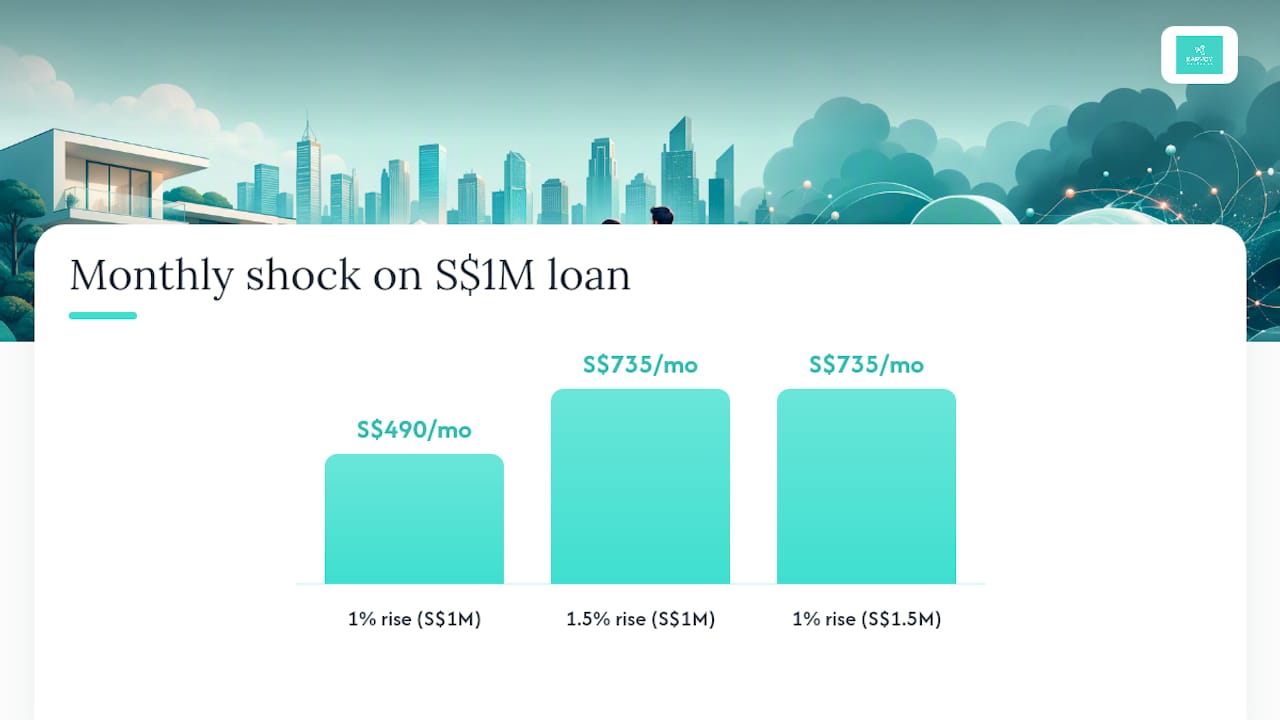
Illustrative figures: a 1% rise in SORA adds roughly S$490 a month to that S$1 million loan's instalment. A 1.5% rise pushes that closer to S$730 to S$740 a month, using the same proportional relationship. That's the number to stress-test against your household budget, not the headline rate on a bank's marketing page.
A few things shift this math meaningfully:
- Spread size: A bank offering a 0.5% spread over compounded SORA behaves very differently in a rate spike than one offering 1.2%. Ask for the spread explicitly, not just the current all-in figure.
- Loan size: The dollar shock scales roughly with loan amount, so a S$1.5 million loan feels close to 50% more shock per percentage point than a S$1 million loan.
- Tenure: A longer tenure lowers your monthly instalment but stretches your exposure to more repricing cycles over the life of the loan.
Run your own numbers with a loan calculator before comparing bank quotes side by side. Headline rates without the shock math attached can make a marginal difference look bigger, or smaller, than it actually is.
When Should You Start Shopping for a Refinance?
Start comparing packages about three to six months before your fixed period expires. Banks typically need that runway to process a new loan, and waiting until the last month often means defaulting into whatever floating rate your current bank sets automatically.
If you're planning to sell rather than refinance, check your loan contract for a waiver-on-sale clause. Many banks distinguish between selling the property and simply switching lenders, and the penalty structure often differs.
A short operational checklist before you commit to a new rate:
- Pull your current loan's outstanding balance and remaining lock-in period.
- Compare at least three to five packages across banks, not just your existing lender's renewal offer.
- Check the spread, not just the quoted all-in rate, since spreads vary by loan size and borrower profile.
- Confirm any clawback or legal fee costs before switching.
Pro Tip: Ask each bank for their historical spread stability, not just today's number. A lender that's held a consistent 0.6% spread over several years is a safer long-term bet than one that quoted an unusually thin spread just to win your application.
Reviewing timelines and paperwork ahead of expiry through a refinancing guide helps you avoid a rushed, last-minute switch.
How a Broker Can Simplify the SORA vs Fixed Decision
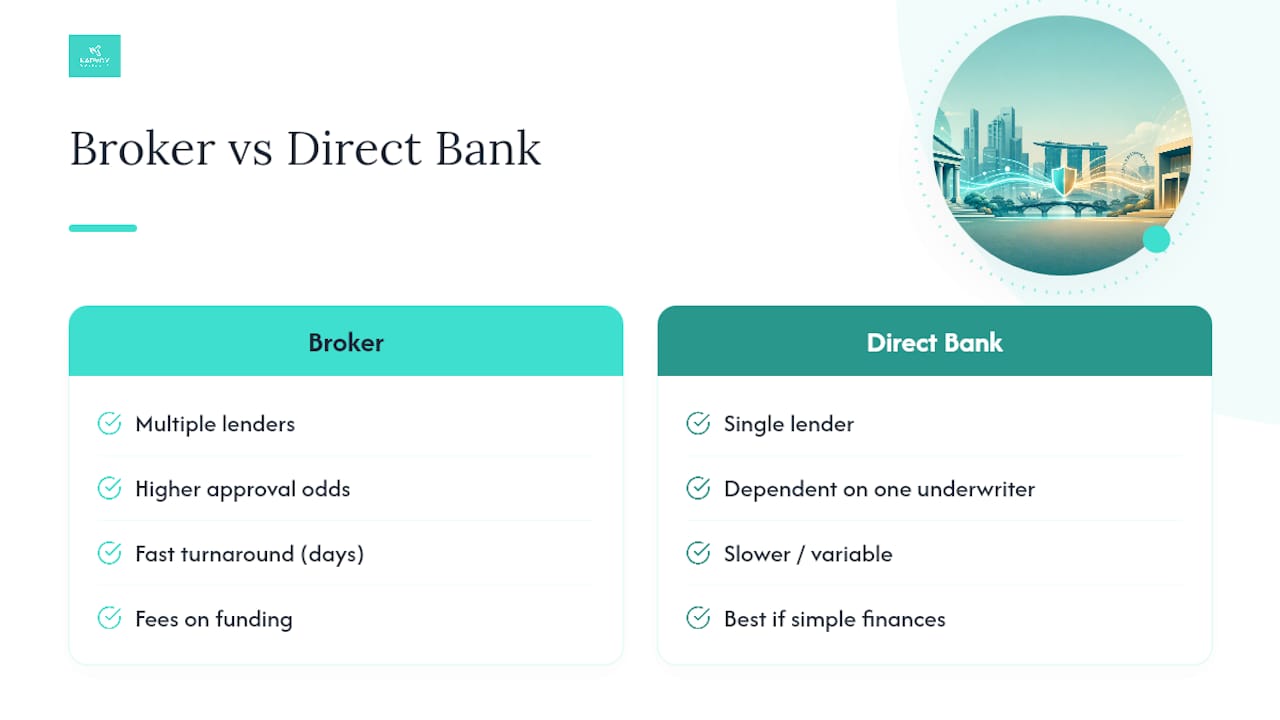
Comparing loan structures across banks by yourself means calling multiple lenders, decoding spread structures, and hoping your application fits each bank's criteria. A broker compares many banks and lenders simultaneously, matching your profile against packages you'd likely never see on your own.
That matters for two reasons. First, submitting to multiple lenders at once meaningfully increases your odds of approval instead of betting everything on one bank's underwriting rules. Second, some brokers offer average approval turnaround within a few days, with no upfront fees or consultation charges. Fees apply only once funding is approved.
Going direct to a single bank can work if your finances are straightforward and you already have a strong relationship with that lender. If you want your SORA versus fixed decision checked against the widest set of live packages, a broker earns its fee by doing that comparison for you.
An Editorial Take on Where Borrowers Go Wrong
The biggest mistake isn't picking SORA or fixed. It's chasing the lowest headline rate without checking whether your budget survives a 1.5% swing, or ignoring the clawback penalty buried in a fixed contract you never planned to break. Both errors come from optimizing for today's number instead of your actual holding plan.
Match the loan to how long you'll keep it and how much shock your budget can absorb. Everything else, including this year's narrow rate gap, is secondary.
— Viknesh
Get Your Property Financing Sorted Without the Bank-by-Bank Runaround
Choosing between SORA and fixed is only half the job. The other half is finding a lender whose spread, tenure options, and approval criteria actually match your profile, and that's where most borrowers lose time calling banks one by one. A broker can compare your situation against many lenders at once, with no upfront fees and approval decisions often returned quickly.
If you're weighing a purchase, refinance, or equity cash-out against today's SORA and fixed pricing, start with a free eligibility check to see which packages you actually qualify for before you commit to either structure. Review the full property financing guide for a deeper walk-through, or head straight to check your eligibility in a few minutes to compare live offers against your numbers.
Where to Verify These Numbers Yourself
Cross-check any figure in this article against the primary sources before you sign a loan contract.
- MAS and MoneySense publish the official compounded SORA series daily, including the methodology banks use for mortgages.
- A TDSR explainer breaks down how the 4% stress test affects your borrowing capacity.
- Run your own instalment scenarios with a loan calculator before comparing bank quotes.
This article is general information, not a substitute for advice from a qualified financial advisor. Consult a qualified financial professional about your own circumstances before acting on anything here.
Sources
- Switching to SORA: What you need to know | MoneySense
- SORA vs Fixed Rate Mortgage - Which is Better in 2026? | Winfred Quek
- SORA vs Fixed Home Loan in Singapore: Rate Structure Guide | Homejourney
FAQ
What Is the Current SORA Rate in Singapore?
SORA changes daily, so check the official published series directly rather than relying on a fixed number in any article, since mortgage quotes commonly use the compounded 3-month average rather than the daily print.
Is a Floating Rate Better Than a Fixed Rate?
Neither is universally better. Floating (SORA) tends to suit borrowers with a longer holding horizon and a budget that can absorb quarterly resets, while fixed suits borrowers who want payment certainty or plan to sell within a few years.
Why Is SORA Dropping or Rising in Singapore?
SORA tracks actual overnight interbank lending activity in Singapore's money market, so it moves with broader monetary policy and liquidity conditions rather than any single bank's decision.
What Is the 3-Month Compounded SORA Rate?
It's the average of daily SORA compounded over a rolling three-month window, which smooths short-term volatility while still resetting your mortgage rate every quarter.
Should I Use a Broker to Compare SORA and Fixed Packages?
A broker like Kapvoy is worth using if you want your profile matched against many lenders at once instead of calling banks individually, particularly since submissions to multiple lenders simultaneously improve approval odds with no upfront cost.