HDB & EC Buyers in Singapore: Why MSR, Not TDSR, Often Caps Your Loan

MSR caps mortgage repayments to a portion of gross monthly income and only applies to HDB flats and executive condos. TDSR caps all monthly debt repayments, including the mortgage, to a larger portion of gross monthly income and applies to every property loan in Singapore. For HDB and EC purchases, MSR is usually the tighter constraint; for private property, TDSR alone decides how much you can borrow.
TL;DR:
- TDSR usually caps total debt repayment at a higher portion of income than MSR, especially for private property loans.
- MSR is the primary constraint for HDB and executive condo purchases before the property enters resale or private market status.
- A stress-test rate around 4.0% reduces the maximum loan amount compared to current promotional rates, affecting borrowing capacity.
- Loan-to-Value limits further restrict borrowing as property ownership increases, with downpayment requirements rising accordingly.
- Applying to multiple lenders simultaneously helps find the best approval chances, as each lender interprets income and debt differently.
Table of Contents
- TDSR vs MSR: What Each Rule Covers
- How TDSR and MSR Are Actually Calculated
- Worked Examples: HDB vs Private Condo
- Where LTV Limits and Loan Tenure Come In
- Practical Steps to Increase Your Borrowing Capacity
- Quick Reference: Which Rule Applies to Your Purchase
- What This Means for Buyers Planning Ahead
- How Kapvoy Helps You Work Within These Limits
- Where to Verify the Latest Rules
- Sources
TDSR vs MSR: What Each Rule Covers
TDSR, or Total Debt Servicing Ratio, and MSR, or Mortgage Servicing Ratio, are two separate affordability checks set by the Monetary Authority of Singapore. They exist so a mortgage doesn't get approved on paper only to collapse under real repayment pressure the moment interest rates move or a borrower takes on other debt.
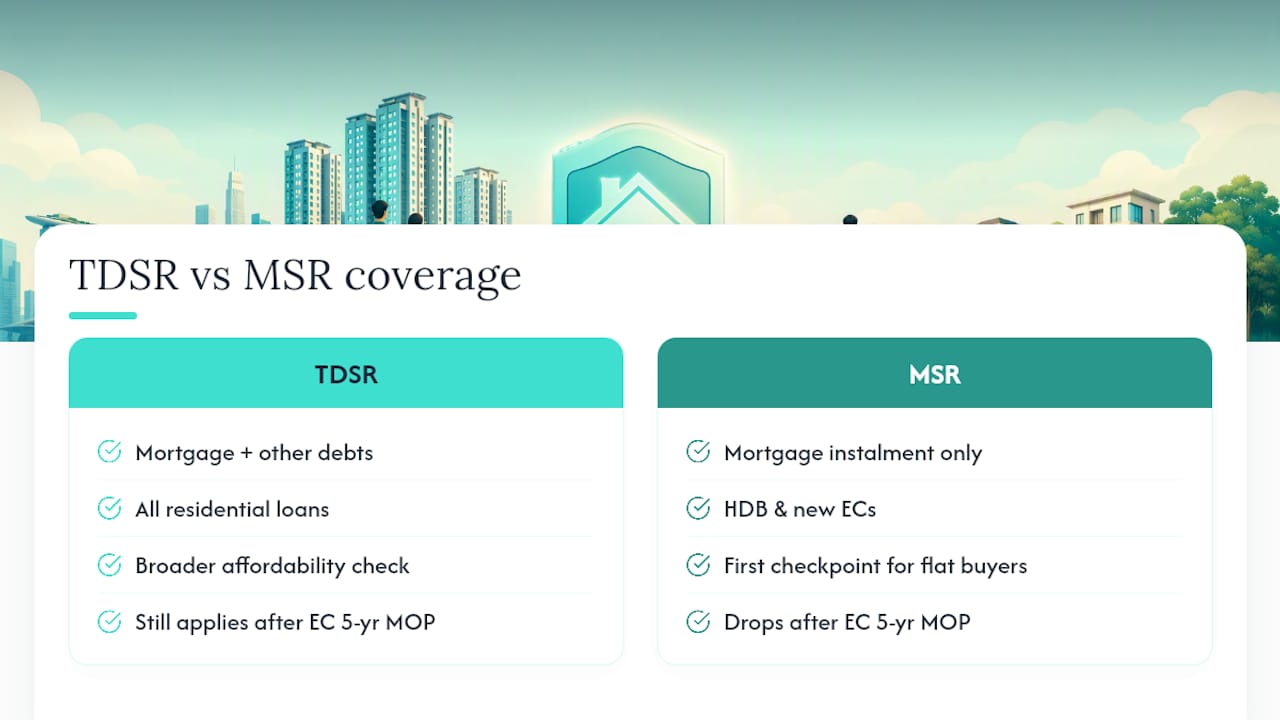
TDSR applies to every residential property loan in Singapore, whether it's an HDB resale flat, an executive condo, or a private condo. It looks at your total monthly debt, not just the mortgage, against your gross monthly income.
MSR is narrower. It applies only when you're financing an HDB flat or a new EC bought directly from a developer, and it looks solely at the mortgage instalment, ignoring your car loan or credit card balance. The HDB's own budgeting guidance frames MSR as the first checkpoint for flat buyers, with TDSR sitting behind it as the broader test.
Once an EC clears its five-year Minimum Occupation Period and enters the resale market, MSR drops away entirely. From that point, an EC is treated like private property for financing purposes, and only TDSR applies. That single detail trips up a lot of buyers who assume EC rules stay fixed for the life of the unit.
How TDSR and MSR Are Actually Calculated
The math behind both ratios is simple once you see it laid out, though the assumptions baked into it catch most first-time buyers off guard.
TDSR formula: (Total monthly debt repayments ÷ gross monthly income) × 100, capped at a specified limit.
MSR formula: (Monthly mortgage instalment ÷ gross monthly income) × 100, capped at a specified limit.
The 4% floor: Banks and HDB don't stress-test your loan at the rate you're actually quoted. For floating-rate and most fixed-rate packages, MoneySense confirms lenders apply a standardized stress-test rate, commonly around a 4.0% floor, to calculate your hypothetical monthly instalment. That protects you against future rate hikes, but it also means your maximum loan is usually smaller than a quick calculation at today's promotional rate would suggest.
What counts toward TDSR is broader than most buyers expect:
- Existing mortgage instalments on any property you still owe on
- Car loans and renovation loans
- The minimum monthly payment on every credit card, even ones you rarely use
- A percentage of your unused credit limit on cards and credit lines
- Any loan you've personally guaranteed for someone else, even if you're not the one repaying it
MSR only looks at the new mortgage instalment itself, which is exactly why it produces a smaller, cleaner number than TDSR for the same property.
Worked Examples: HDB vs Private Condo
Numbers make this concrete faster than any explanation. Take two buyers earning the same $8,000 gross monthly income.
- HDB buyer, no other debt. MSR typically binds first, capping the mortgage instalment at a lower amount than TDSR.
- Private condo buyer, no other debt. MSR doesn't apply; TDSR alone governs, usually allowing a larger instalment.
- Same HDB buyer, now with a car loan. TDSR capacity reduces due to the car loan, but MSR often remains the binding constraint.
- Same private buyer, now with a car loan. TDSR capacity reduces correspondingly, shrinking the maximum mortgage instalment as it is the only test applied.
The stress-test rate drives all four outcomes. Run the same instalments at your bank's actual quoted rate instead of the assessment rate, and the affordable loan quantum looks noticeably larger than what the bank will actually approve.
Where LTV Limits and Loan Tenure Come In
Passing TDSR and MSR doesn't guarantee you get the loan amount you want. Loan-to-Value limits and tenure caps sit on top of both ratios, and one of them often ends up the real ceiling.
- First property: LTV up to 75% from a bank, or up to 80% on an HDB concessionary loan, per MAS's official LTV tables.
- Second property: LTV drops to 45%, pushing up your required cash and CPF outlay significantly.
- Third and subsequent properties: LTV falls further to 35%, with a larger minimum cash component.
- Tenure caps: loans are capped at 25 years for HDB flats and 30 years for private property, or up to age 65 or 75 respectively, whichever comes first, and a shorter tenure raises the stress-tested instalment used in both ratios.
If you already own another property, LTV and the higher minimum cash downpayment usually bind before TDSR does. If this is your first purchase with clean finances, TDSR or MSR is more likely the actual constraint, since LTV is comparatively generous at 75 to 80%.
Practical Steps to Increase Your Borrowing Capacity
Small moves before you apply can shift your approved loan amount more than most buyers expect.
- Close or reduce unused credit lines. Lenders factor in a percentage of your total credit limit under TDSR, even on cards you never touch, so canceling three dormant cards can free up real borrowing room.
- Pay down or consolidate high-interest debt first, since a $500 car loan payment can be the difference between MSR and TDSR binding.
- Use CPF and cash strategically to lower the loan quantum you need, which eases both the MSR and TDSR math simultaneously.
- Stretch or shorten tenure deliberately. A longer tenure lowers the stress-tested monthly instalment, buying more headroom under both caps, though it costs more in total interest.
- Document variable income properly. Commissions, bonuses, and freelance earnings usually need a 12-month average, and incomplete paperwork here is one of the most common reasons approved amounts come in lower than expected.
Pro Tip: Submitting to one bank at a time means you only find out that bank's underwriting quirks after they've already rejected you. Applying across multiple lenders simultaneously, the approach Kapvoy uses with its panel of over 30 banks and non-bank lenders, surfaces the lender most likely to approve your specific income profile before you burn weeks on a single application.
Quick Reference: Which Rule Applies to Your Purchase
- First-timer HDB flat: MSR and TDSR both apply; MSR usually binds.
- New EC bought from a developer: MSR and TDSR both apply while the unit is within its Minimum Occupation Period.
- Resale EC after MOP, or any private condo: only TDSR applies; MSR is irrelevant.
- Guarantors: a guarantor's income can sometimes be added to boost TDSR capacity, but HDB concessionary loans have stricter co-borrower and occupier rules than bank loans, worth checking against HDB loan versus bank loan differences before assuming either path is faster.
What This Means for Buyers Planning Ahead
The stress-test floor exists to keep buyers from stretching into a mortgage that only works at today's rates. That's sound policy, but it also means the number a mortgage calculator shows you at your actual quoted rate is not the number MAS uses to decide your ceiling.
Budget for a gap between what you think you can borrow and what the stress-tested math allows, and keep cash or CPF in reserve for the shortfall at completion. Buyers who plan around the stress-tested figure from day one rarely get blindsided at valuation.
— Viknesh
How Kapvoy Helps You Work Within These Limits
Passing MSR or TDSR on paper doesn't guarantee any single bank offers you its best terms. Every lender weighs variable income, guarantees, and existing credit lines a little differently, and a rejection from one bank often has nothing to do with your actual affordability.
Kapvoy Advisory compares more than 30 banks and non-bank lenders at once, submitting your profile to multiple underwriters simultaneously instead of one at a time, which is exactly the tactic that tends to surface the best fit fastest. There's no upfront consultation fee. Kapvoy only earns a fee once your financing is successfully funded, and approvals typically come back within 1 to 3 days. If you want the fuller picture on how TDSR, MSR, and LTV interact before you commit to a purchase, the Property Financing Guide 2026 walks through it in more depth, or if you're weighing options on a resale EC or condo specifically, the private property mortgage page covers what TDSR-only financing looks like in practice. Ready to see where you stand? Check your eligibility in three minutes and get a clearer read on your actual borrowing capacity before you make an offer.
Where to Verify the Latest Rules
For official figures, check MAS's housing loan rules, HDB's flat budgeting guidance, MoneySense's affordability explainer, and your bank's own TDSR breakdown, or run your numbers through a budgeting tool like Haio before applying.
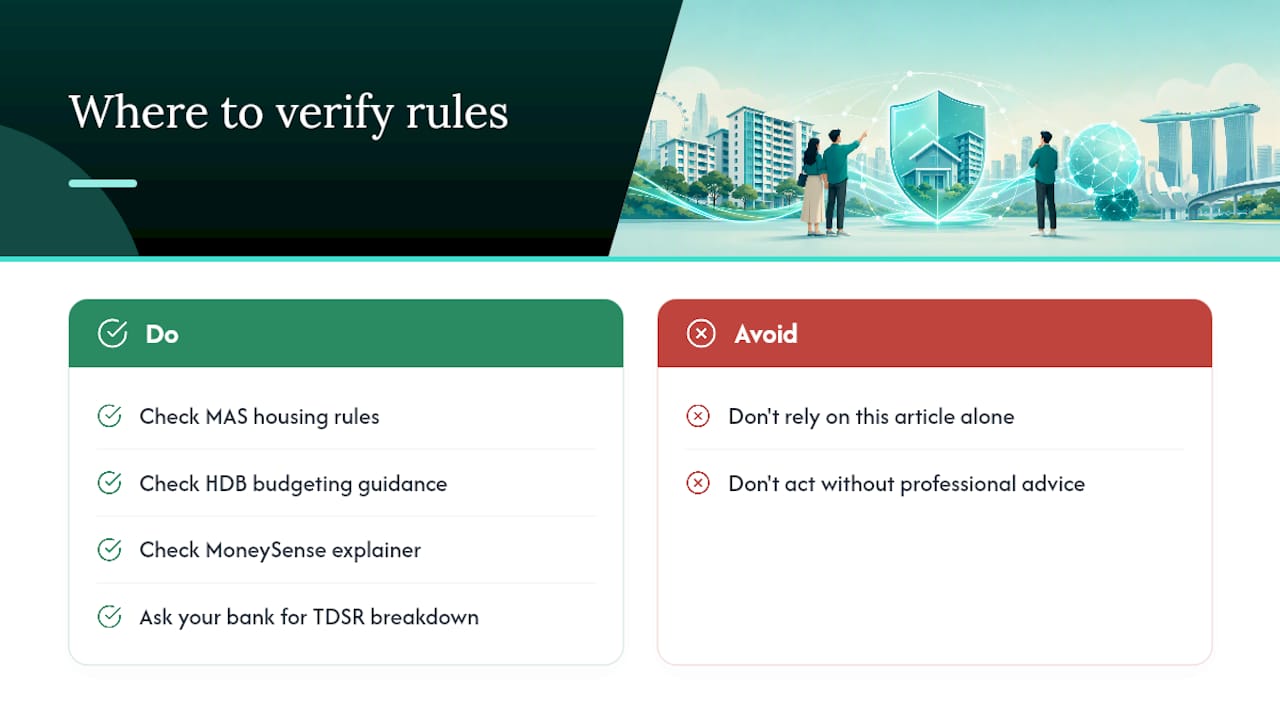
This article is general information, not a substitute for advice from a qualified financial advisor. Consult a qualified financial professional about your own circumstances before acting on anything here.