Get Matched Fast: Trade vs Invoice Finance for SME Cash Gaps

Trade finance funds the purchase and shipping of goods before you get paid; invoice financing turns invoices you've already issued into cash. The choice comes down to timing: if your cash gap sits before the sale, look at trade finance; if it sits after the sale, look at invoice finance. Many SMEs eventually use both, though eligibility and cost differ sharply between them.
TL;DR:
- Trade finance is ideal for funding overseas transactions before goods are shipped, especially in cross-border deals with large, reliable buyers.
- Invoice financing provides quick cash (within 24 hours) against already issued invoices, mainly based on the creditworthiness of your customers.
- Using both financing types simultaneously is common for businesses that import raw materials and ship finished goods, but requires careful coordination of documentation.
- Trade finance costs vary widely, from 0.25% to 4%, depending on country risk and deal size, while invoice finance fees typically range from 1% to 6%.
- Properly mapping your cash-flow cycle before applying ensures the selected product aligns with your timing needs, avoiding unnecessary delays.
Table of Contents
- What Is Trade Finance and How Does It Work?
- How Does Invoice Financing Actually Work?
- Trade Finance vs Invoice Finance: What Actually Separates Them
- What Do Trade Finance and Invoice Finance Actually Cost?
- Choosing Between Trade Finance and Invoice Finance: A Quick Checklist
- Can You Combine Trade Finance and Invoice Finance?
- How a Broker Helps You Match the Right Facility
- The Timing Question SMEs Get Wrong
- Get Matched to the Right Financing Faster
- Sources
What Is Trade Finance and How Does It Work?
Trade finance covers a family of tools built around one thing: an actual trade transaction between a buyer, a seller, and one or more banks. According to ICC guidance, there's no single global regulatory definition of the term. It's better understood as financing and risk mitigation tied to the movement of goods, with the specific instruments varying by region and deal size.
The most common tools include letters of credit (a bank guarantee that payment will happen once shipping terms are met), bank guarantees, pre-export and import loans, forfaiting (selling receivables from an export deal at a discount), and payables finance arrangements between a large buyer and its suppliers. The ICC Academy's trade finance overview groups these into settlement/risk-mitigation instruments like letters of credit and finance-driven instruments like pre-export loans.
A wholesaler importing electronics from overseas might use a letter of credit so the overseas supplier ships with confidence, then draw a short-term import loan to cover the gap until the goods sell. That's trade finance doing its job: funding the deal before revenue exists.
How Does Invoice Financing Actually Work?
Invoice financing unlocks cash you've already earned but haven't collected yet. You've delivered the goods, sent the invoice, and now you're waiting 30, 60, or 90 days for payment. Instead of waiting, you sell or borrow against that invoice.
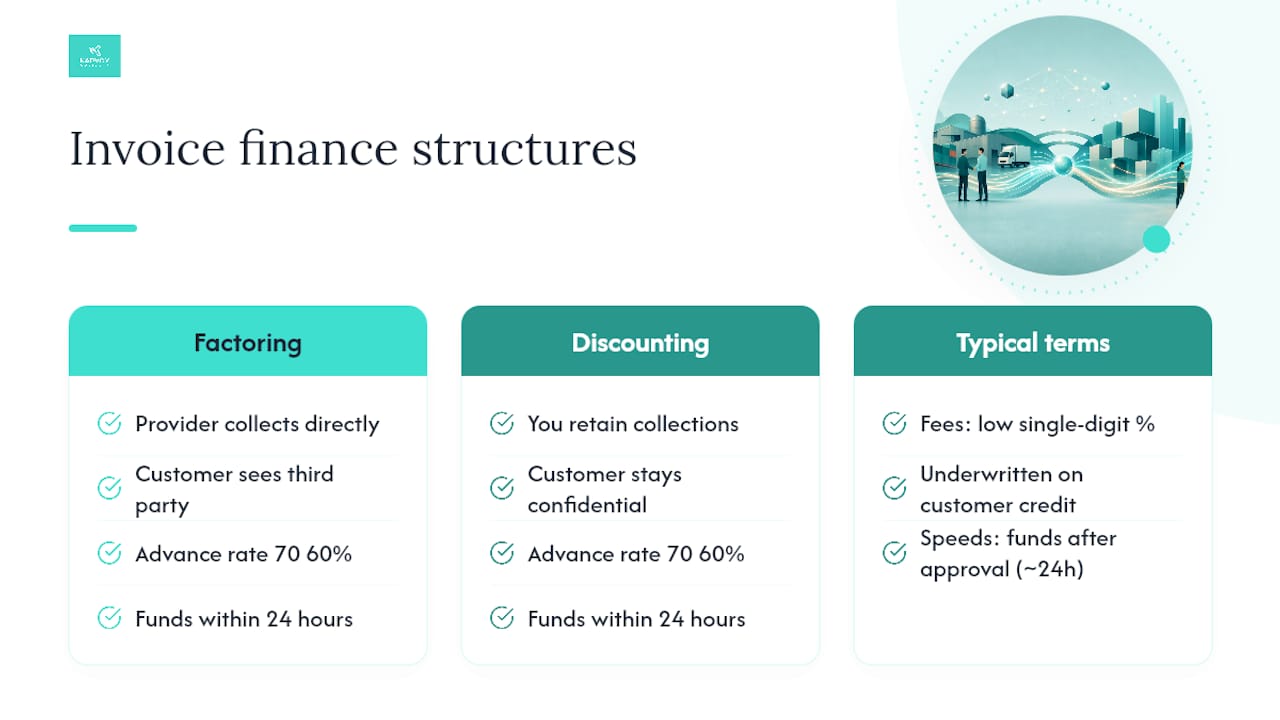
Two main structures dominate: factoring and invoice discounting. With factoring, the provider typically takes over collections directly from your customer, which can be efficient but means your customer knows a third party is involved. With discounting, you keep control of collections and your customer relationship stays confidential, which matters a lot to SMEs protecting how they look to buyers.
Advance rates and speed are where invoice finance shines. Providers typically advance 70% to 90% of an invoice's value, with fees running low single-digit percentages and funds often landing within 24 hours of approval. Eligibility hinges less on your business and more on your customer: practitioner guidance from ITFA notes that a lender is really underwriting your customer's creditworthiness, not yours. A shaky customer payment history will hurt your rate even if your own books are clean. Kapvoy's invoice financing options walk through which structure suits which customer profile.
Trade Finance vs Invoice Finance: What Actually Separates Them
The two products solve opposite ends of the same cash-flow problem. Here's where they split:
- Timing: Trade finance funds purchases before a sale happens; invoice finance releases cash after the sale and invoice are already issued.
- Security basis: Trade finance is secured against the underlying transaction, shipment, or goods; invoice finance is secured against the receivable itself and your customer's payment behavior.
- Who collects payment: Trade finance repayment usually comes from sale proceeds or an agreed loan schedule; with factoring, the funder often chases your customer directly, while discounting leaves that job with you.
- Speed and cost profile: Invoice finance tends to move faster (often within a day) with fees in the low single digits; trade finance costs swing much more depending on country risk and deal size.
- Best fit: Trade finance suits importers, distributors, and manufacturers buying stock; invoice finance suits B2B service firms and suppliers sitting on long payment terms.
Map your gap to the right column before you apply. Applying for the wrong product wastes weeks you don't have.
What Do Trade Finance and Invoice Finance Actually Cost?
Invoice finance pricing is fairly transparent: expect advances of 70% to 90%, with the remaining 10% to 20% held back as a reserve until your customer pays. Fees are typically 1% to 6% of invoice value, driven mainly by how creditworthy your customer is and how long the invoice term runs.
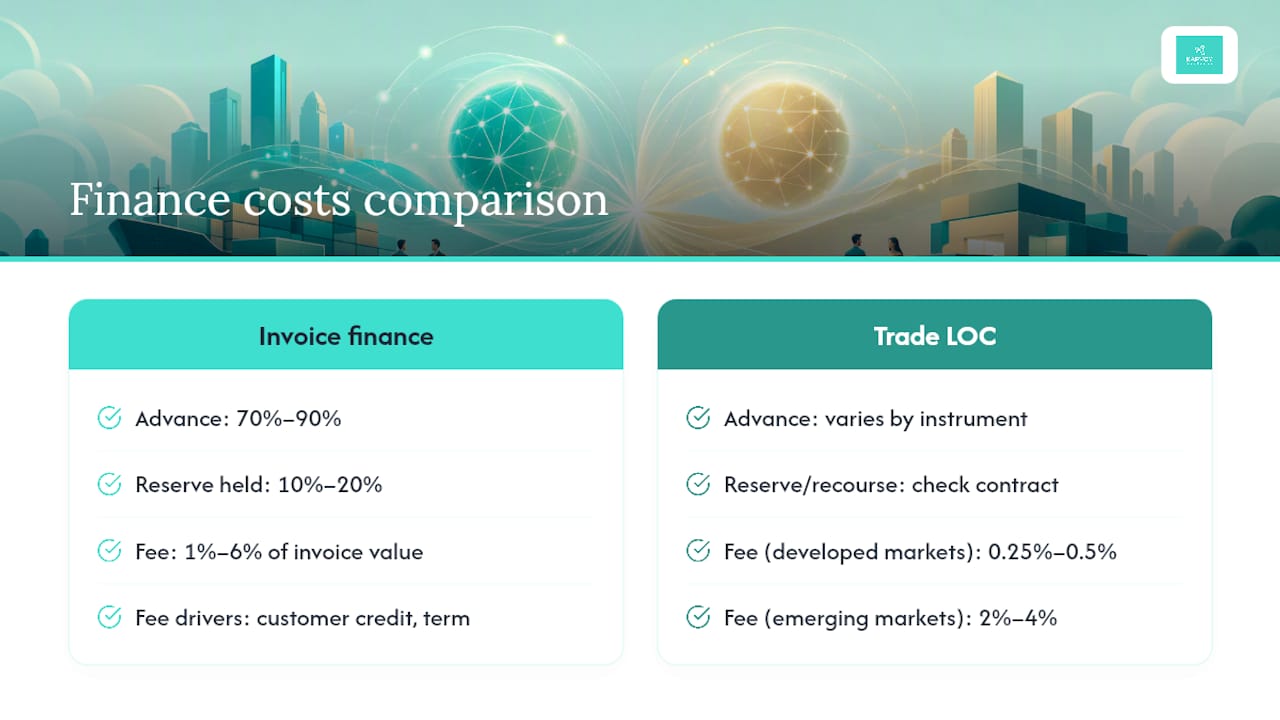
Trade finance costs move around far more. A letter of credit might run 0.25% to 0.5% of transaction value in a developed market, but 2% to 4% in higher-risk emerging markets, and SMEs generally pay a premium over large corporates for the same instrument. Watch for recourse terms, reserve percentages, and hidden fees buried in the contract before signing either product.
Choosing Between Trade Finance and Invoice Finance: A Quick Checklist
Run your situation through these questions before picking a product:
- Is your cash gap before or after the sale? Before means trade finance; after means invoice finance.
- Is the transaction cross-border or domestic? Cross-border deals with unfamiliar counterparties lean toward trade finance instruments like letters of credit.
- How concentrated is your customer base? A handful of large, reliable customers makes invoice finance cheaper and easier to qualify for.
- What's your margin profile? Thin margins make trade finance's variable costs riskier; factor that into your pricing before committing.
An importer buying seasonal inventory typically needs trade finance. A staffing agency waiting 60 days on client invoices typically needs invoice finance. A manufacturer doing both, importing raw materials and shipping finished goods on credit terms, often needs both products running in parallel.
Pro Tip: If keeping your financing arrangement private from customers matters to your brand, confirm upfront whether the facility is disclosed. Discounting arrangements usually stay confidential; factoring usually does not.
Can You Combine Trade Finance and Invoice Finance?
Yes, and many manufacturers and importers do exactly this. A typical sequence: trade finance covers the supplier payment and shipping, you fulfill the order and issue an invoice, then invoice finance unlocks cash from that invoice before the customer's payment term ends.
Running both means coordinating documentation carefully. The ICC Academy notes lenders often require clear ring-fencing between facilities and may attach cross-default covenants, so track disbursement and remittance timing closely to avoid double-charging the same income stream.
How a Broker Helps You Match the Right Facility
Comparing trade finance and invoice finance products across individual banks eats time SMEs don't have. A broker can compare multiple banks and non-bank lenders simultaneously, matching your specific cash-flow timing, whether pre-sale or post-sale, to the lenders most likely to approve it, including options that preserve confidential invoice discounting where that matters to you. Before engaging a broker or lender, gather your invoices, purchase orders, and trade documents. Having them ready is what turns a multi-week process into a matter of days.
The Timing Question SMEs Get Wrong
The mistake I see most often isn't picking the wrong product outright. It's applying for financing before mapping the actual cash conversion cycle: how long money is tied up between paying suppliers and collecting from customers. Get that timeline right first, then match the facility to it. Protecting the customer relationship matters just as much as the rate you're quoted.
— Viknesh
Get Matched to the Right Financing Faster
Comparing trade finance and invoice finance offers on your own usually means calling several banks, filling out overlapping paperwork, and waiting on each one separately to say yes or no. A broker can run that comparison for you across multiple banks and non-bank lenders at once, so you see real options instead of guessing which lender fits your cash-flow timing.
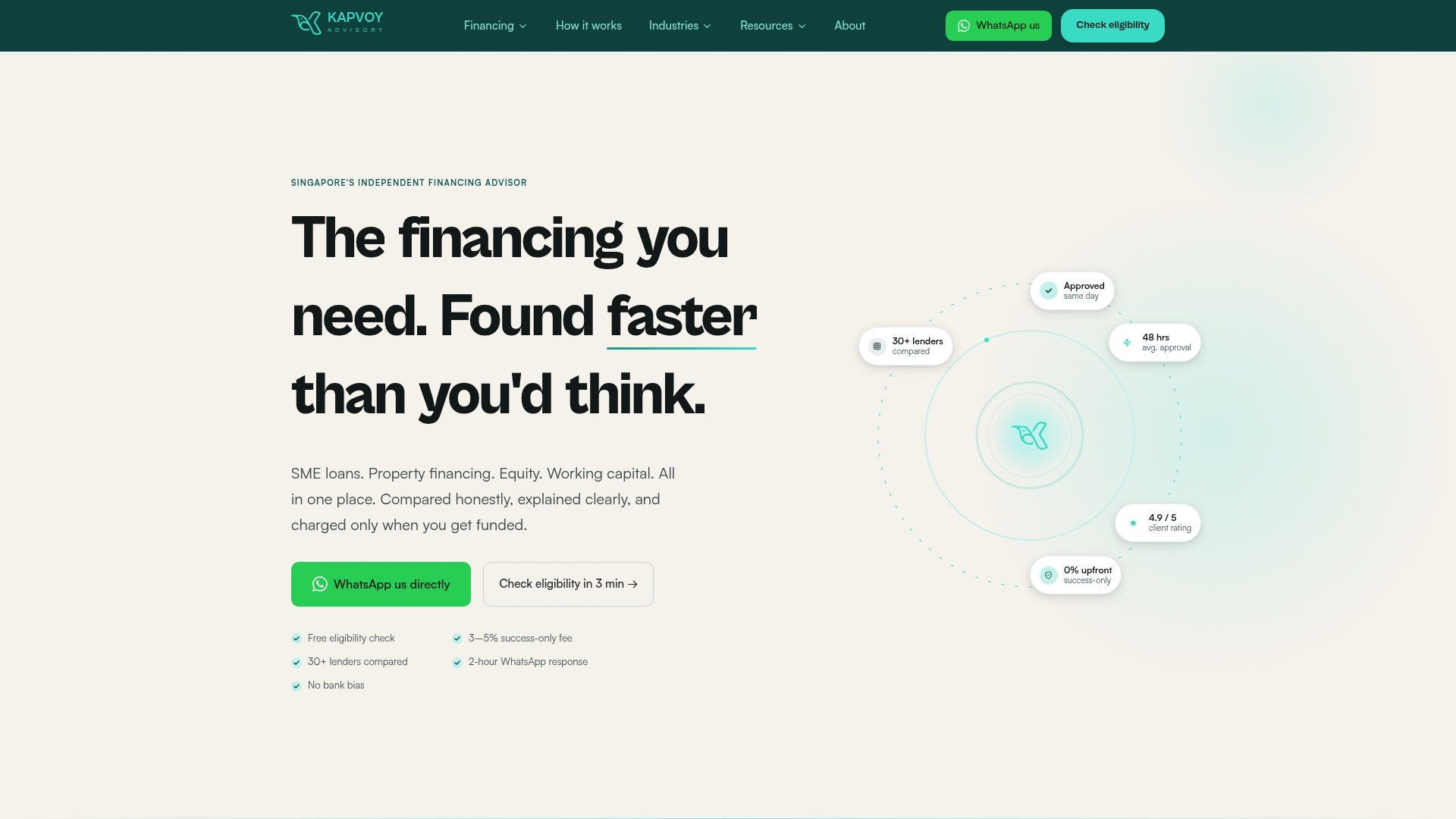
There's no upfront cost to check what's available. The advisory charges a fee only when your financing is successfully funded, and most applications get an answer within a few days rather than the weeks a single bank application can take. That speed matters most when a supplier payment or a stack of unpaid invoices is the actual problem, not paperwork. If you're weighing invoice financing against a broader working capital option, Kapvoy's SME loan comparison lays out the full panel of products side by side. Start by checking what you qualify for at Kapvoy's eligibility check and get matched to lenders suited to your specific cash-flow gap.
Sources
- Invoice finance | British Business Bank
- ICC briefing: Definition of Trade Finance
- What is trade finance? — ICC Academy
- Invoice financing — Shopify blog
These are background references for further reading, not endorsements of any specific provider.