Get Vessel Financing Decisions in 1–3 Days for Owners with a Broker

Most commercial vessel needs are met by one of four routes: a bank mortgage, a finance lease or sale and leaseback, export credit for newbuilds, or private credit when timelines are tight. The right choice depends on vessel age, how much leverage you need, how fast you need funds, and how much covenant restriction you can tolerate. Whichever route fits, prepare your financials and vessel documentation early, and consider a broker if you want multiple lenders reviewing your file at once.
TL;DR:
- Bank mortgages typically offer lower loan-to-value and longer tenors but require clean financials and steady vessel employment.
- Export credit agency support provides longer tenors and better loan conditions for newbuilds linked to specific yards or countries.
- Proper documentation, including vessel appraisals and legal clearances, is crucial to avoid delays, with early appraisals saving critical time.
- Structuring options like sale and leaseback or SPV arrangements influence control, residual risk, and the deal’s impact on your balance sheet.
- Using a broker to submit to multiple lenders simultaneously can increase approval chances and reduce overall approval time.
Table of Contents
- Vessel Financing Options at a Glance
- What Loan Terms Should You Expect on Cost and Tenor?
- What Documents Do You Need to Apply for Vessel Financing?
- How Should You Structure a Vessel Financing Deal?
- What Covenant and Legal Risks Should You Watch For?
- How Does a Broker Improve Your Vessel Financing Odds?
- What Should Owners Prioritize First?
- Ready to Explore Your Vessel Financing Options?
- Sources
Vessel Financing Options at a Glance
Each financing route trades cost against speed and flexibility, and knowing that trade-off before you approach a lender saves weeks of back-and-forth.
- Bank mortgage: the traditional route. Lower loan-to-value, longer tenor, and the strictest covenants. Best for owners with clean financials and steady vessel employment.
- Finance lease or sale and leaseback: higher leverage with less equity upfront, and often a faster execution timeline. The trade-off is a higher all-in cost over the life of the deal.
- Export credit agency (ECA) support: the strongest option for newbuilds tied to a specific yard and build country, often extending tenor and improving loan-to-value where the ECA has coverage.
- Private credit and mezzanine financing: flexible underwriting for owners who don't fit a bank's box, but the pricing reflects that flexibility.
A Ship Universe industry summary groups these routes the same way: secured bank loans, export credit, leasing, private credit, and capital markets, each with predictable trade-offs on cost, flexibility, and speed. If your vessel is older or your charter book is thin, a bank mortgage may simply not be available to you, which pushes the conversation toward leasing or private credit whether you'd prefer it or not.
What Loan Terms Should You Expect on Cost and Tenor?
Tenor typically runs for several years for bank mortgages, is shorter for private credit, and can be longer for ECA-backed newbuilds where the agency's coverage extends the horizon. Loan-to-value ranges vary by route and vessel age: bank mortgages often have moderate loan-to-value ratios for younger tonnage, while finance leases can push leverage higher in exchange for cost.
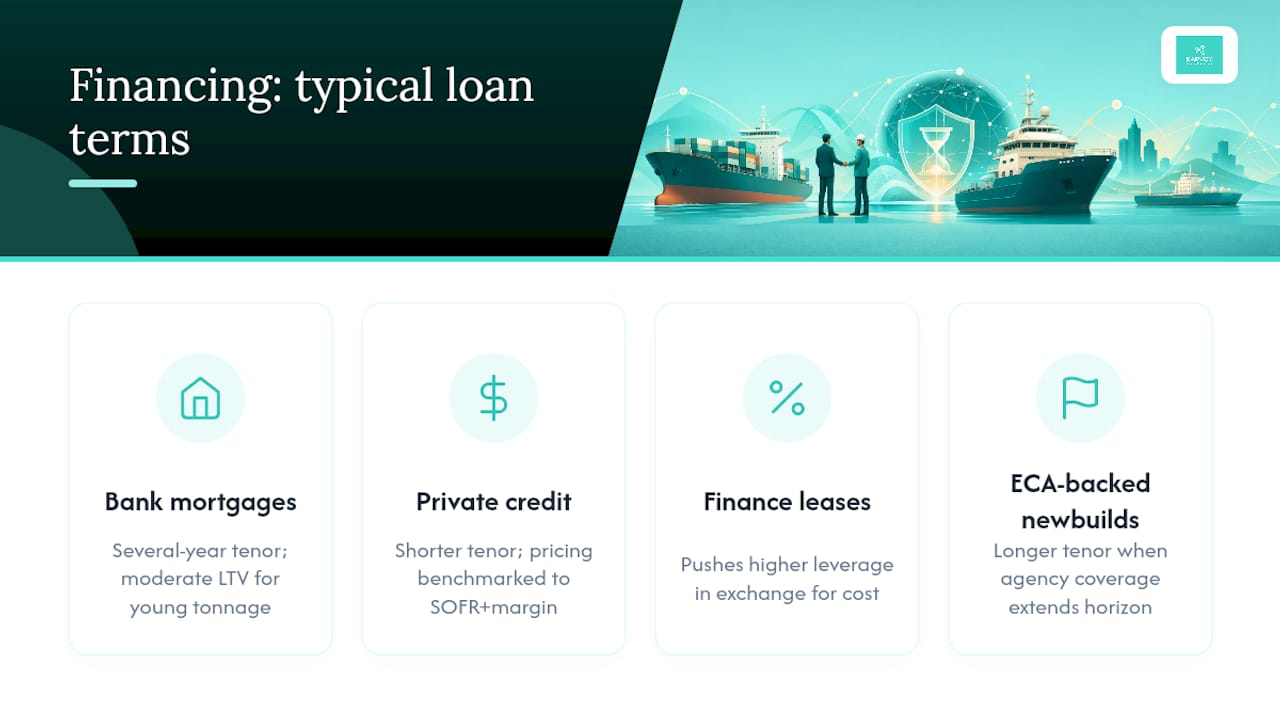
Reference rates for shipping loans are typically benchmarked to SOFR (having replaced LIBOR), with margins layered on top based on borrower risk, vessel type, and charter coverage. A vessel on a long-term charter with a creditworthy counterparty will price meaningfully tighter than one trading spot.
Pro Tip: Ask every lender for the effective all-in cost, not just the headline margin. Covenant-driven fees, mandatory hedging, and refinancing triggers can add real cost that never shows up in the rate you're quoted.
One factor increasingly shaping pricing: environmental performance. The Poseidon Principles framework now influences how signatory banks assess climate alignment, and fuel-efficient tonnage can see better terms as a result. Covenants that restrict re-chartering or force early amortization can also quietly raise your effective cost, even when the stated rate looks competitive.
What Documents Do You Need to Apply for Vessel Financing?
Lenders commonly ask for two to three years of financial statements plus a business plan demonstrating vessel employment, according to Dentons. Funding timelines can run from several weeks to several months depending on deal complexity and cross-border legal work. Build your package in this order:
- Financial statements covering two to three years, plus current cash flow projections.
- Business plan and employment evidence, including any signed or pending charter contracts.
- Vessel appraisal and survey, ideally ordered before you approach lenders.
- Title and registry abstracts, confirming clean ownership history.
- Insurance evidence, hull and machinery plus protection and indemnity cover.
- Charter and management contracts for lender review.
Diligence holdups almost always cluster around legal work: title searches, cross-border consents, and confirming who actually holds registered interest in the vessel. Thompson Coburn's review of vessel finance transactions notes that a robust documentation package typically includes appraisal, title and lien searches, and a full review of charter and management agreements before security can be perfected.
Pro Tip: Order your vessel appraisal before you submit anything. Lenders often stall applications waiting on a valuation that could have been in hand from day one, and a stale appraisal can restart the clock entirely.

Our own SME loan documents checklist follows a similar structure, and the same discipline applies whether you're financing a vessel or a piece of industrial equipment: complete packages move faster than partial ones, every time.
How Should You Structure a Vessel Financing Deal?
Structure determines more than your monthly payment. It shapes who bears residual value risk, how much of your balance sheet the deal touches, and how much control you keep over the asset.
- A secured term loan keeps the vessel on your books and gives you full control, but ties up capital as equity.
- A finance lease shifts more of the balance-sheet weight off the borrower, at the cost of higher financing charges.
- A sale and leaseback frees up capital immediately by selling the vessel and leasing it back, useful when cash flow matters more than ownership.
- An SPV structure isolates the vessel and its liabilities from the sponsor's other assets, which Clarksons notes helps lenders manage enforcement and recovery risk in larger deals.
- Syndication or project finance fits when the deal size exceeds what a single lender wants to hold, spreading exposure across several institutions.
Clarksons also points to bespoke techniques like non-recourse financing and co-investment as ways to align leverage with a vessel's actual cash flow lifecycle rather than forcing a standard loan shape onto an asset that doesn't fit it. The right structure is the one that matches your appetite for control against your need for leverage, not the one that looks cheapest on a term sheet.
What Covenant and Legal Risks Should You Watch For?
Value-maintenance covenants and operational restrictions can quietly box you in long after signing. A clause that requires minimum vessel value relative to loan balance sounds reasonable until a soft charter market forces a mark-down and triggers a technical default. Watch closely for restrictions on re-chartering, sale, or redeployment, since these often matter more day to day than the interest rate itself.
Cross-border deals carry a separate risk: governing law and flag state mechanics have to line up. Dentons' review of international ship financing warns that misaligned governing law and flag state rules can leave a lender's security effectively unenforceable in certain jurisdictions.
Pro Tip: Have local counsel confirm that your preferred ship mortgage will actually be recognized and enforceable in the vessel's flag state before you sign. This single check has saved deals from unraveling at the worst possible moment.
How Does a Broker Improve Your Vessel Financing Odds?
Submitting one application to one bank means one shot at approval. A broker submits your file to multiple lenders at once, which widens your odds without multiplying your workload.
- Multi-lender submission puts your file in front of several underwriters simultaneously instead of one at a time.
- Fee-on-success pricing means you pay nothing unless funding actually closes, so there's no upfront cost to test the market.
- Pre-checked documentation catches gaps before a lender sees them, which is often what separates a fast approval from a stalled one.
- For prequalified cases, initial lender decisions can come back in as little as one to three days once the package is complete.
Preserve this section for author credentials and relevant case studies as they become available.
What Should Owners Prioritize First?
Employment visibility beats almost everything else lenders look at. Lock in charter coverage before you shop rates. Match your loan tenor to the vessel's useful life, not the other way around, and negotiate hard against covenant creep before you sign, not after. If you're starting from scratch, get your financials, appraisal, and charter documentation in order first. That alone puts you ahead of most applicants.
— Viknesh
Ready to Explore Your Vessel Financing Options?
Financing comparisons are made across a panel of more than 30 banks and non-bank lenders, so instead of waiting on one institution's answer, your file gets reviewed by several at once. That matters most for vessel deals, where a single bank's risk appetite can sink an otherwise solid application for reasons that have nothing to do with your business.
Before reaching out, gather your last two to three years of financials, any charter agreements or employment evidence, and a recent vessel appraisal if you have one. There are typically no charges until a facility is successfully funded, with no upfront consultation fees. Start with a free eligibility check or browse the full range of financing options to see which lenders on our panel are likely to fit your vessel and your timeline.
Sources
For deeper detail beyond this guide: Dentons covers cross-border legal mechanics, Clarksons details bespoke structured finance, Thompson Coburn outlines documentation requirements, and the Maritime and Port Authority of Singapore provides local regulatory context.
- International ship financing: navigating complexities and leveraging global expertise — Dentons
- Strategies for documenting vessel acquisition and financing transactions — Thompson Coburn LLP