SMEs: Pair Term Loans and Working Capital, Don’t Pick One

Pick a term loan when you're funding a defined, long-term investment with a known cost, like new equipment or a property purchase. Pick working capital financing when you're covering a short-term cash gap, like slow-paying customers or a seasonal inventory buy. Term loans give you predictability and usually a lower cost of capital. Working capital gives you speed and flexibility, at a higher price for that convenience. Most SMEs eventually need both.
TL;DR:
- A term loan is suitable for financing assets with a multi-year useful life and involves fixed monthly payments over several years, often requiring collateral.
- Working capital financing provides quick, flexible access to short-term cash needs, usually at higher costs, through tools like lines of credit or invoice financing.
- The choice depends on purpose, duration, repayment style, collateral willingness, speed needs, and ongoing reporting requirements, with an emphasis on real total costs and repayment timing.
- Pairing a term loan for long-term assets with a revolving line for seasonal or short-term needs is often the best strategy to optimize funding flexibility.
- Using a broker like Kapvoy can streamline access to multiple lenders and reduce approval times, especially when speed and approval odds are critical.
Table of Contents
- What Is a Term Loan?
- What Is Working Capital Financing?
- Term Loan vs Working Capital: The Differences That Actually Matter
- When to Use Each: 5 SME Scenarios
- How to Choose the Right Financing: Checklist and Lender Questions
- How KAPVOY Advisory Helps SMEs Access the Right Financing
- The Practical Take on Layering Financing
- Ready to Match Your Financing to the Right Lender?
- Sources
What Is a Term Loan?
A term loan is a lump sum you borrow once and repay on a fixed schedule, typically monthly, over a set period. Term loans are designed for long-term investments with scheduled repayments, which is why lenders structure them around the useful life of whatever you're financing. A loan for a delivery van looks different from one for a factory unit, but the mechanics stay the same: borrow, then pay down in predictable installments.
Terms usually run several years, and lenders lean harder on collateral and documentation than they do for shorter facilities. Expect requests for financial statements, tax filings, and sometimes a personal guarantee, especially if your company is under three years old. Funding timelines vary by lender and loan size, but expect the underwriting process to take longer than a working capital application because the bank is assessing years of repayment risk, not weeks.
Common uses for a term loan include:
- Buying equipment, machinery, or vehicles with a multi-year useful life
- Purchasing or renovating commercial property
- Funding a business acquisition or buyout
- Consolidating multiple higher-cost debts into one fixed payment
If the expense is one-time, large, and tied to something that will keep generating value for years, a term loan is usually the right shape.
What Is Working Capital Financing?
Working capital financing is money designed to plug short-term gaps in cash flow rather than fund a specific asset. It covers the space between when your bills are due and when your customers actually pay. Working capital facilities like lines of credit and invoice financing are structured for short-term liquidity and tend to fund faster, though usually at a higher effective cost than a term loan.
The category covers several distinct tools, each shaped differently:
- Business line of credit: A revolving limit you draw against and repay as needed, paying interest only on what you use
- Invoice financing: An advance against unpaid invoices, useful when customers routinely pay on 30 to 90 day terms
- Overdraft facilities: A buffer attached to your operating account for short, unplanned dips
- Short-term working capital loans: A smaller lump sum repaid quickly, often within a year
Repayment shapes here differ sharply from term loans. A revolving line lets you draw, repay, and draw again without reapplying. Invoice financing and some short-term products collect daily or weekly, which keeps individual payments small but demands tighter cash flow monitoring. That faster access and flexibility is the whole point, and it comes at a cost. Because these products carry more risk for the lender and shorter windows to earn a return, the effective rate tends to run higher than a comparable term loan. You're paying for speed, not just capital.
Term Loan vs Working Capital: The Differences That Actually Matter
The decision usually comes down to five factors: what the money is for, how long you need it, how it gets repaid, what drives the cost, and how fast you need it in hand.
| Factor | Term Loan | Working Capital Financing | |---|---|---| | Purpose | Long-term asset or project | Short-term liquidity gap | | Term length | several years | Weeks to several months | | Repayment | Fixed monthly installments | Revolving draws, or daily/weekly collections | | Cost driver | Fixed rate over full term | Rate plus fees, often on outstanding balance | | Funding speed | Days depending on lender and documentation | Often faster once approved, especially for revolving lines | | Collateral | Often required for larger amounts | Sometimes unsecured, or secured against invoices/assets |
Headline rate isn't the whole story. Getting an all-in cost example for your actual usage pattern matters more than comparing advertised rates, because repayment frequency changes the real cash impact. A line of credit with daily repayment pulls cash out of your account constantly, even at a modest rate, while a term loan's fixed monthly payment is easier to plan around even if the total interest looks larger on paper.
When to Use Each: 5 SME Scenarios
- Building inventory ahead of a peak season. A retailer stocking up for the holidays needs cash now and repayment once goods sell, making a working capital line or invoice financing a better fit than a multi-year loan.
- Bridging payroll while waiting on a slow-paying client. This is a timing problem, not an investment, so a short-term working capital facility solves it without locking you into years of debt.
- Renovating or opening a second location. A defined project with a known budget points toward a term loan, though some owners pair it with a small line for unexpected costs.
- Covering a supplier's early-payment discount. Businesses commonly use a term loan for big purchases and a line of credit for everyday cash flow management, and this is exactly that split in miniature.
How to Choose the Right Financing: Checklist and Lender Questions
Match the loan to the job before you match it to the lender. Run through this checklist first:
- Amount and purpose: Is this a one-time investment or a recurring cash need?
- Repayment rhythm: Can your cash flow handle fixed monthly payments, or do you need flexibility to draw and repay irregularly?
- Collateral tolerance: Are you willing to pledge assets, or do you need an unsecured option?
- Speed: Do you need funds this week, or can underwriting take longer?
- Covenant comfort: Larger revolving credit facilities often come with reporting requirements, so check what ongoing paperwork a facility demands.
Once you're comparing offers, ask every lender the same set of questions: What's an all-in cost example for my expected usage, not just the headline rate? How often does repayment get collected? What are the prepayment terms? Are there covenants tied to the facility? Is collateral or a personal guarantee required?
Watch for red flags that separate a reasonable offer from a costly one: a lender who won't walk through a concrete cost example for your situation, daily withdrawal structures with no clear amortization schedule, or fees that only surface after you've signed. Our loan calculator can help you sanity check any figures a lender quotes before you commit.
Pro Tip: *Ask for the cost example in dollars, not percentages.
How KAPVOY Advisory Helps SMEs Access the Right Financing
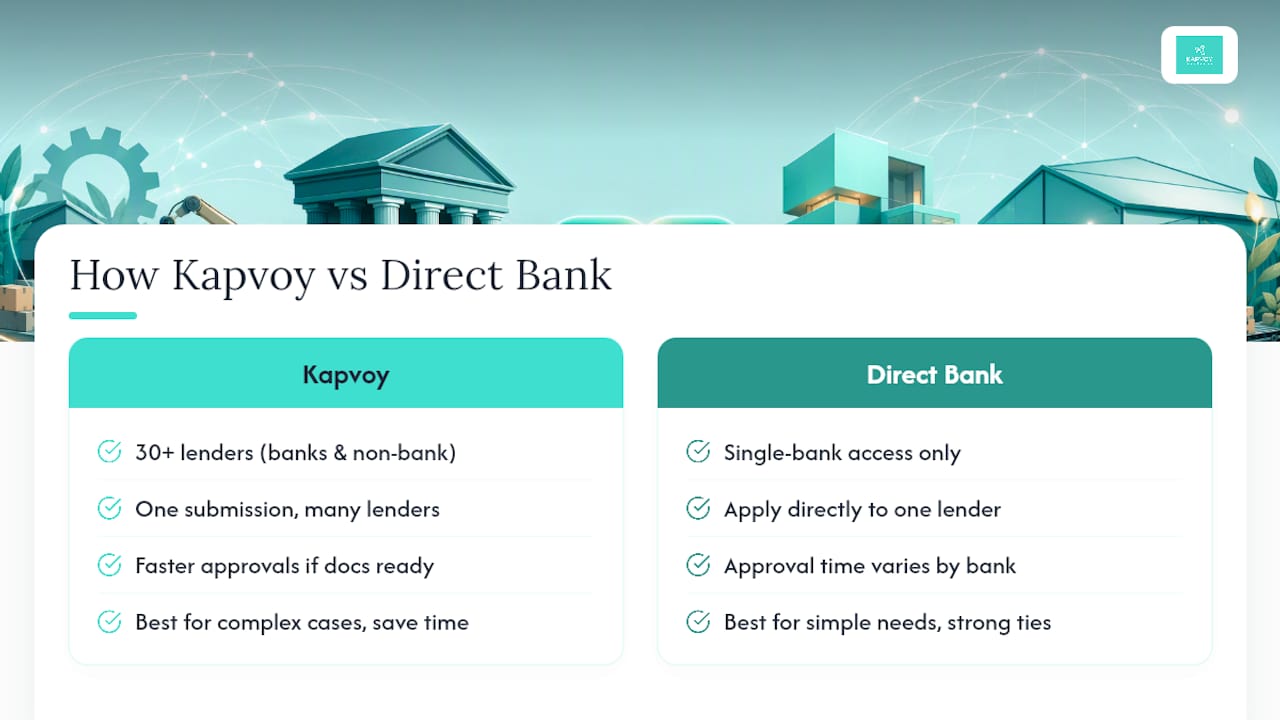
Kapvoy works with a panel of over 30 banks and non-bank lenders across Singapore, covering term loans, working capital facilities, and EFS fixed asset financing. Instead of applying to one bank and waiting on a single answer, Kapvoy submits your profile to multiple lenders at once, which is a meaningful advantage when speed or approval odds matter more than shopping around yourself.
Approval times may vary but can be relatively quick once your documents are in order. A broker earns its place when your situation doesn't fit neatly into one bank's checklist, or when you'd rather spend your week running the business than chasing paperwork across five lenders. If your needs are simple and your bank relationship is strong, going direct can still work fine.
The Practical Take on Layering Financing
Don't treat this as an either/or decision. Pair a term loan for equipment or property with a revolving line for seasonal swings, then review both facilities twice a year as your business changes.
— Viknesh
Ready to Match Your Financing to the Right Lender?
A financing broker provides an alternative to walking into a single bank branch by submitting one application to multiple lenders at once, each evaluating your profile against their own criteria, so you're not relying on one underwriter's decision alone.
There's no upfront cost to find out what you qualify for. Kapvoy's fee is charged only when funding actually closes, whether that's a term loan, a working capital facility, or a mix of both. Approval typically takes 1 to 3 days once your documents are submitted. If you're weighing your options right now, the fastest way forward is to check your eligibility or browse the full range of SME loan solutions Kapvoy arranges before you commit to a single lender's terms.
Sources
- Business loan vs. line of credit: Top differences | Chase for Business
- Revolving credit facility | CIMB Singapore