Shophouse Financing in Singapore: A Practical Guide
A shophouse loan is a commercial property loan, not a home loan, and that changes who can borrow, how much, and how the lender decides. The loan route depends on whether you buy personally or through a company, how strong the business is, and what the property earns. Because each bank weighs these differently, comparing many lenders at once usually beats approaching one bank. At KAPVOY Advisory we compare over 30 lenders for each application and charge a fee only when you are funded.
TL;DR
- Shophouses are non-residential, so the residential loan rules do not apply in the same way. Banks set their own loan-to-value (LTV) limits.
- The Total Debt Servicing Ratio (TDSR) of 55% applies if you borrow as an individual. It does not apply to company borrowers.
- Budget for Buyer's Stamp Duty (up to 5% for non-residential property) and possibly GST, on top of the down payment.
- Owners can refinance or release equity. Under MAS rules, TDSR does not apply to an equity withdrawal loan at 50% LTV or below.
- We submit your application to many lenders at once. Our fee is 3% to 5% of the approved loan amount, paid only on successful funding.
Table of Contents
- Why a shophouse loan is not a home loan
- Individual or company: the TDSR question
- What the loan can look like
- Loan-to-value and down payment
- Stamp duty and GST on a shophouse
- How lenders assess a shophouse application
- Refinancing a shophouse or releasing equity
- The application steps, and where we fit in
- What our fee looks like
- Talk to us about your shophouse
- FAQ
- Sources
Why a shophouse loan is not a home loan
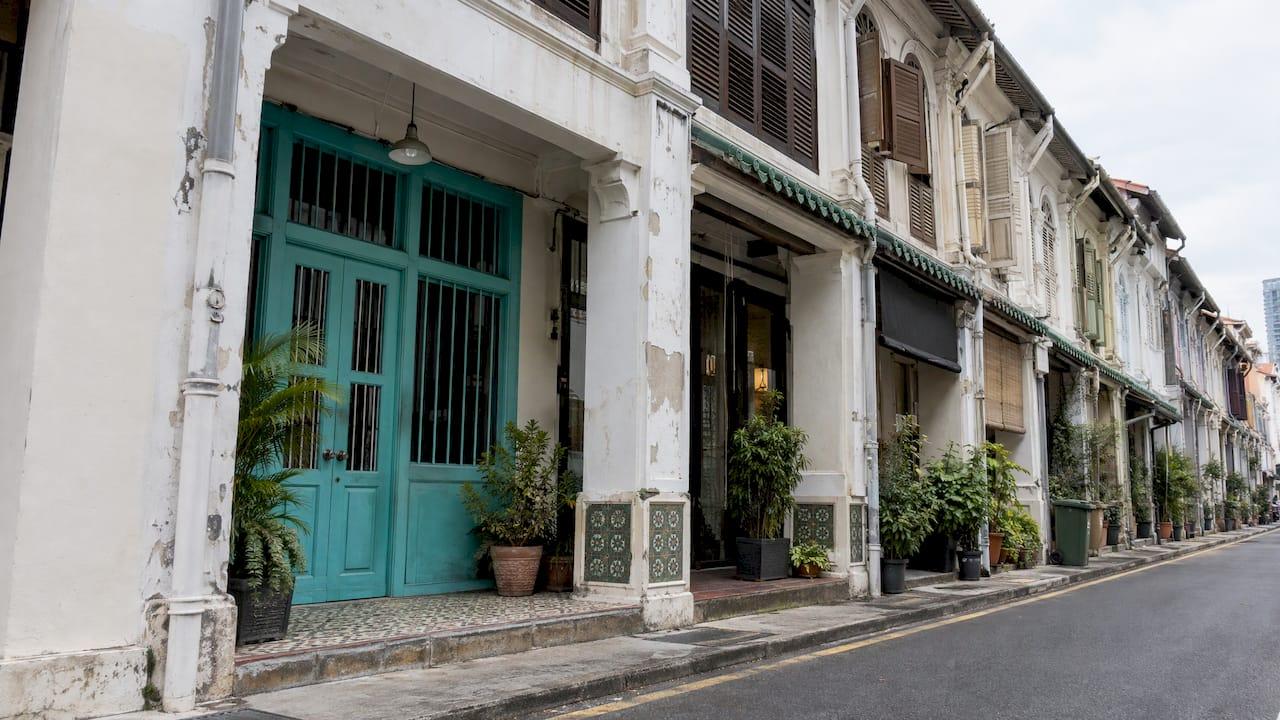
A shophouse is a row-house building, usually with a shop or office on the ground floor. Singapore's rules treat it as a commercial or non-residential property. That affects the loan in four ways.
The lender looks at the business, not only the buyer. Banks lending against commercial property mainly assess the financial strength of the borrowing business and the income the property can generate, such as tenancy agreements. A salary slip alone rarely settles it.
The residential LTV limits do not set the ceiling. MAS publishes LTV limits for housing loans: 75% for a first loan, 45% for a second and 35% for a third. Commercial lending is left to each bank's own policy, so the limit you get depends on who you ask and how the application is presented.
CPF savings are not the usual funding source. Commercial property loans from banks are generally structured around cash and the business's cash flow rather than CPF. Plan your down payment in cash.
Tax costs differ. Stamp duty rates, and GST, work differently for non-residential property. We cover both below.

Individual or company: the TDSR question
The TDSR caps all your monthly debt repayments at 55% of your gross monthly income. MAS states that the cap is 55%, tightened from 60% in December 2021.
The key point for shophouse buyers is who the borrower is. According to MAS, TDSR applies to any loan to buy a property or secured by a property, residential or non-residential, and to refinancing of those loans. It does not apply to company borrowers. It does apply to sole proprietors, and to individuals who set up a company only to buy a property.
So a buyer holding the shophouse in a genuine operating company is assessed differently from an individual buying in their own name. If you want to see how the ceiling shrinks a loan, read how the 55% TDSR ceiling works. We also explain how documents and a broker help in our guide to Singapore's 55% TDSR cap.
Which structure suits you depends on your income, existing debts and how the property will be used. Ask us before you sign an Option to Purchase (OTP), the contract that gives you the right to buy at an agreed price. Once the OTP is signed, the options for structuring the loan get narrower.
What the loan can look like
There is no single shophouse product. These are the routes owners use, and we can arrange each of them.
| Need | Route | What to know | |---|---|---| | Buy a shophouse | Commercial property loan | Secured by a mortgage on the property. Limit, tenure and rate vary by lender. | | Lower repayments or change lender | Property refinancing | Replaces your existing loan with a new one. Check the TDSR position and any lock-in. | | Raise cash for the business | Equity release | Borrow against the value you already own. See the 50% LTV point below. | | Fund operations, not the property | Working capital loan or term loan | Useful when the property is already financed and you need cash for stock, renovation or hiring. |
Loan terms are agreed with the lender, so tenure, rate type and lock-in periods differ from one offer to the next. Compare the full package, not only the headline rate: interest rate, lock-in, legal and valuation fees, and any early repayment charge.
Loan-to-value and down payment
LTV is the loan as a percentage of the property's price or valuation. A higher LTV means a smaller down payment but bigger repayments and less cushion if values or rental income fall.
There are three practical points.
- Banks set the limit. With no fixed MAS ceiling for commercial property, one lender may offer a notably higher LTV than another to the same borrower. That gap is the main reason to compare.
- Valuation matters. Lenders usually lend against the lower of the price and their own valuation. If the valuation comes in low, you cover the difference in cash.
- Higher LTV raises risk. Lower leverage leaves more equity as a buffer. Higher leverage gives more borrowing power but makes your repayments more sensitive to rate moves and vacancies.
The cash you need at the start is the down payment plus stamp duty, legal fees and any GST you cannot immediately claim. Work out all of it before you commit to an OTP.
Stamp duty and GST on a shophouse
These two costs surprise many first-time commercial buyers.
Buyer's Stamp Duty
IRAS states that from 15 February 2023 the top marginal Buyer's Stamp Duty (BSD) rate for non-residential property is 5%. The tiers are 1% on the first S$180,000, 2% on the next S$180,000, 3% on the next S$640,000, 4% on the next S$500,000 and 5% on the next S$1,500,000. Duty is calculated on the price or market value, whichever is higher.
Worked example for a S$1,200,000 shophouse:
- 1% of S$180,000 = S$1,800
- 2% of S$180,000 = S$3,600
- 3% of S$640,000 = S$19,200
- 4% of the remaining S$200,000 = S$8,000
- Total BSD: S$32,600
IRAS also states that stamp duty must be paid within 14 days of the date of the contract, usually arranged through your lawyer. Have the cash ready before the OTP is exercised.
GST
GST is payable on non-residential property if the seller is GST-registered. IRAS's guide explains that GST on a non-residential purchase can be claimed back if the property is used for business activities that make taxable supplies. For a mixed-use building, GST applies to the non-residential portion. The claim comes later, so you may need to fund the GST first. Ask your accountant how it applies to your case, and tell us early so the financing covers the timing.
How lenders assess a shophouse application
Expect questions on three things.
The borrower. For a company: how long it has been operating, who owns it, its profit and cash flow, and the directors' credit records. For an individual: income, existing debts and the TDSR calculation.
The property. Its valuation, its title, its current use and any tenancy agreements. A shophouse with tenants on clear leases is easier to assess than one with uncertain income.
The purpose and structure. Is it for your own business use, for rental income, or for equity release? Lenders price and structure these differently.
Typical documents include an ACRA business profile, two years of accounts, recent bank statements, tax returns for the company and directors, the OTP, a valuation report, title documents, tenancy agreements and ID for directors and guarantors. Our SME loan documents checklist lists what to prepare. An incomplete file is one of the most common reasons an application stalls, so assemble it before you submit anywhere.
Why applications get rejected
Rejections usually come from one of these:
- Debt repayments already take up too much of the income the lender counts.
- Cash flow looks weak or irregular in the statements.
- The company is too new, or its shareholding or credit record falls outside the lender's policy.
- The valuation is lower than the price.
- Documents are missing or do not match each other.
Each lender has different policies, so a decline from one bank does not mean every lender will decline. That is why we submit to multiple lenders at the same time instead of one after another. Each separate decline can also slow your timeline.
Refinancing a shophouse or releasing equity
If you already own a shophouse, two moves are common.
Refinancing replaces your current loan. Owners do it to cut monthly repayments, move away from a rate they no longer want, or to unlock cash. Note that MAS says TDSR also applies to refinancing of individual loans, and that refinancing of loans granted before 16 December 2021 stays at the older 60% threshold.
Equity release lets you borrow against the value you already hold, for example to fund inventory, a second outlet or debt consolidation. MAS states that TDSR does not apply to a mortgage equity withdrawal loan where its LTV, together with other loans on the same property, does not exceed 50%. That makes the 50% line a useful planning number when you decide how much to draw.
Before you refinance, check:
- Any lock-in period or early repayment charge on your current loan.
- Legal and valuation fees on the new one.
- Whether the new loan's tenure and rate type fit your cash flow.
- What the equity will earn: borrowing against the property to fund something that pays back is different from borrowing to cover a gap.
We arrange property refinancing and equity release through our panel of banks and non-bank lenders. For a broader view, read our property financing guide.
The application steps, and where we fit in
A shophouse loan runs in this order:
- Define the need. Purchase, refinance or cash-out; amount; and who will borrow, you or your company.
- Gather documents. Use the checklist above. For a purchase, you also need the OTP.
- Check eligibility. We start with a free eligibility check that takes about three minutes, so we can match you to lenders suited to your profile.
- Submit to multiple lenders. We prepare the application and send it to several lenders at once. You do not repeat the paperwork for each bank.
- Valuation and credit review. The lender values the property and reviews your file. The valuation is a physical step and it takes longer than the credit review.
- Compare offers. Look at the rate type, lock-in, fees and tenure, not the rate alone.
- Legal completion and disbursement. Lawyers handle the mortgage documents, stamp duty is paid, and funds are released on completion.
Our average approval time is 1 to 3 days. Your own timeline also depends on valuation, legal steps and how complete your file is, so see SME loan processing in Singapore for what to expect.
What our fee looks like
We charge 3% to 5% of the approved loan amount, and only when you are funded. There is no upfront cost, no consultation fee and no retainer. We earn from the borrower on a completed financing, not from lenders, and we have no lender referral arrangements. On a S$1,000,000 approved loan, that fee range works out to S$30,000 to S$50,000. You decide with the offer in front of you.
Our view
A shophouse is one of the least standard assets a bank sees. No two have the same tenancy, title or use, and each lender values that differently. So the same owner can get a decline from one bank and a strong offer from another.
That is why we compare rather than recommend one bank. We look at 30+ lenders, match the file to those most likely to approve, and submit to several at once. For owners who were turned down elsewhere, this often matters more than any single rate.
Our advice before you start: decide whether you or your company will borrow, work out your cash needs including stamp duty and GST, and get your documents in order. A prepared application gets better offers.
Viknesh
Talk to us about your shophouse
Whether you are buying, refinancing or releasing equity, we can compare lenders for your commercial property loan, with no upfront cost and a fee only if you are funded. You also get a personal broker as your contact throughout. Start with our commercial property loan page.
If you need cash for the business rather than the building, see our SME loans or the full list of financing solutions.
FAQ
Can I use CPF to buy a shophouse?
Commercial property loans are generally arranged around cash and business cash flow rather than CPF. Plan your down payment, stamp duty and legal fees in cash. We can confirm the funding structure for your case when we check your eligibility.
Does the 55% TDSR apply to my shophouse loan?
It applies if you borrow as an individual, including sole proprietors. According to MAS it does not apply to company borrowers, except where an individual sets up a company solely to buy property. Which route fits you depends on your finances, so we review this before you submit.
How much cash do I need upfront?
The down payment depends on the LTV the lender offers. On top of that, budget for Buyer's Stamp Duty, legal and valuation fees, and GST if the seller is registered. On a S$1,200,000 purchase, BSD alone is S$32,600.
Can I get a shophouse loan if a bank has rejected me?
Often, yes. Lenders differ in how they treat cash flow, company age, existing debts and property type. We submit your application to multiple lenders at once, so a decline from one does not end the process. Our fee is charged only on successful funding.
Can I borrow against a shophouse I already own?
Yes, through refinancing or equity release. MAS states that TDSR does not apply to an equity withdrawal loan at 50% LTV or below, counting all loans on that property. We can compare lenders for the amount you want to draw.
Sources
- MAS: Macroprudential Policies in Singapore
- MAS: Who TDSR Applies To
- IRAS: Stamp Duty
- IRAS: Information for Buyers of Other Types of Properties
- IRAS: e-Tax Guide on GST and property