Trust Property Mortgage in Singapore: What Lenders Need

Yes, property held in a trust in Singapore can be mortgaged in some cases. The Trustees Act lets trustees raise money by mortgaging trust property, but only where the trust deed or the law allows it, and each lender then decides for itself. Lenders differ in how they treat a trust title, so the practical route is to prepare the trust documents first and put the case to several lenders at once. KAPVOY Advisory compares more than 30 lenders and submits to several at the same time, and we charge a fee only when funding is approved.
TL;DR
- A trustee can mortgage trust property if the trust deed or the Trustees Act authorizes it. The deed's wording decides the question.
- Banks that lend on residential property follow MAS Notice 632, and a trust counts as a borrower that is not an individual under that notice.
- Buying property into a trust triggers ABSD (Trust) of 65% upfront, with a possible remission for qualifying trusts.
- The CPF page on home purchases does not address trust-held property, so do not plan around CPF funds without confirming the position.
- Applying to several lenders at once improves your chances. KAPVOY charges 3-5% of the approved amount only on successful funding.
Table of Contents
- What "property held on trust" means for a loan
- What the law says about mortgaging trust property
- How banks treat a trust as the borrower
- What lenders usually ask to see
- CPF and trust-held property
- ABSD (Trust): the cost to plan around
- Steps to get a trust property mortgage ready
- Why a broker route suits trust cases
- Start with a free eligibility check
- FAQ
- Sources
What "property held on trust" means for a loan
When property is held on trust, a trustee is the legal owner on the title. The trustee manages the property for one or more beneficiaries under a trust deed, the document that sets out what the trustee may and may not do. Families use trusts for estate planning, for children who are minors, or to keep assets separate from a business.
This matters for borrowing because a lender normally lends to the person on the title. With a trust, the borrower is the trustee, and the lender wants to know three things:
- Does the deed let the trustee borrow against the property?
- Who signs, and are all trustees on board?
- Can the trustee repay from the trust's income or from the beneficiaries' support?
The rest of this guide follows those three questions.
What the law says about mortgaging trust property
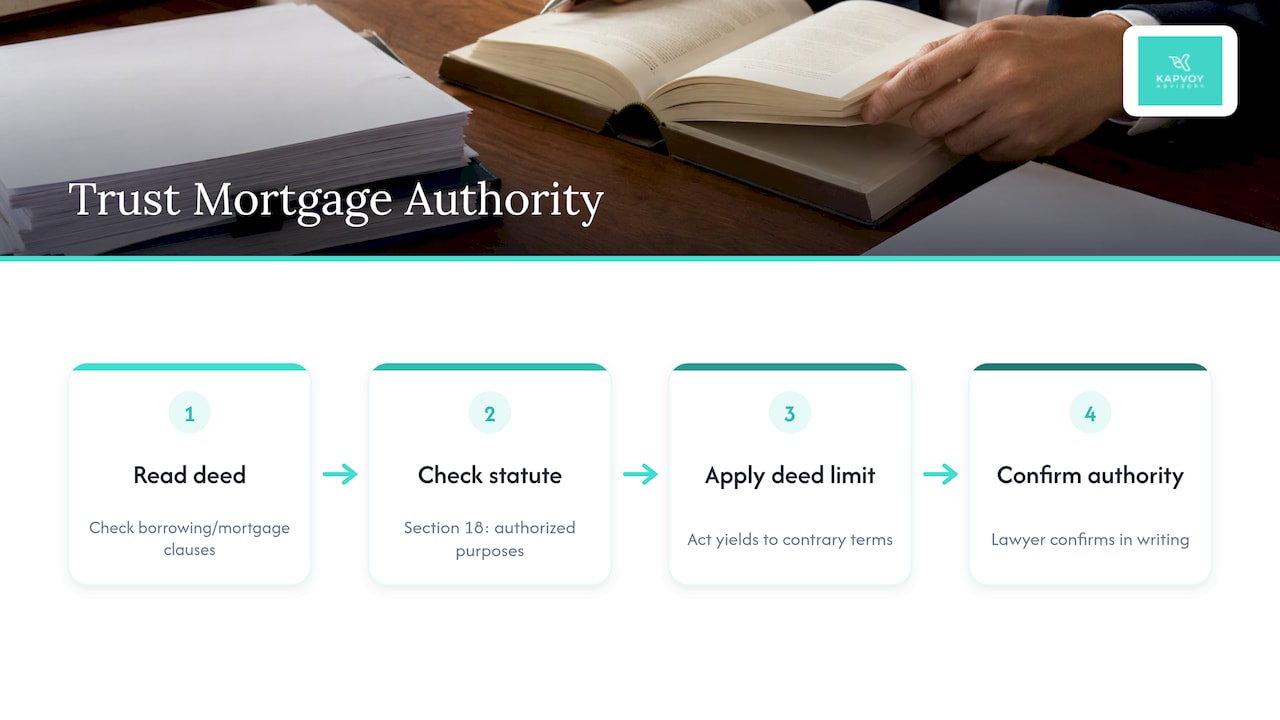
The starting point is the Trustees Act 1967 on Singapore Statutes Online. Section 18 allows trustees to raise money by mortgaging trust property where the trust instrument or the law authorizes them to apply trust capital for a purpose. Property held for charitable purposes is excluded from that section.
Section 19 helps the lender. A mortgagee who advances money under a mortgage that purports to be made under a trust or trustee power does not have to check whether the money is needed or how it is applied. This is one reason a lender can be comfortable with a properly drawn trustee mortgage.
Section 2 sets the limit. The powers in the Act are additional to the powers in the trust instrument, but they operate only so far as the instrument does not express a contrary intention. If the deed forbids borrowing, or requires beneficiary consent first, the Act does not override it.
In plain terms, the deed comes first and the statute fills the gaps. Before you approach any lender, read the deed's borrowing and mortgage clauses, and ask your lawyer to confirm in writing that the trustees have authority to mortgage this property for this purpose. Lenders will ask for that confirmation anyway.
If you are unsure how a trust sits alongside other structures, a general read on what trust banking involves can help you see how trustees and the trust instrument work together.
How banks treat a trust as the borrower
Banks lending on residential property in Singapore follow MAS Notice 632. It applies to all banks in Singapore and sets rules on loan amounts, conditions, tenure and refinancing for residential-property loans. It was last revised on 21 August 2025, and the 2025 amendment took effect on 22 August 2025.
The notice is relevant to trusts because it names them. The notice text lists a trust among the borrowers that are not individuals. It also defines a borrower to include someone assessed as unable to pay part of the monthly instalment who contributes to it, in the circumstances the notice specifies.
The notice also restricts a bank from granting certain purchase or property-secured facilities when their total, together with other relevant secured credit and vendor loans, exceeds the notice's "Relevant Amount". In other words, the bank must count the whole picture of secured borrowing, not only the loan you are asking for today.
What this means for you:
- A bank cannot simply waive the notice's limits because the borrower is a trust.
- Other secured loans linked to the same borrower or property count in the bank's test.
- Each bank applies its own credit policy on top of the notice, so two banks can give different answers on the same trust.
That last point is why a single bank's refusal does not settle your case. For a wider look at how bank assessment works, including TDSR, see our piece on avoiding 55% TDSR surprises.
What lenders usually ask to see
The exact list depends on the lender, but a trust-held property application is easier when the file is complete from day one. Prepare:
- The signed trust deed and any deed of variation or appointment of trustees.
- Identification documents for every trustee, and for beneficiaries where the lender asks.
- The property title details and the latest valuation or purchase price.
- Your lawyer's confirmation that the trustees have power to mortgage.
- Proof of repayment source: trust income, rental income, or the trustees' and beneficiaries' income statements.
- A list of existing loans secured on the property or related to it.
A file that answers the lender's questions before they are asked moves faster. Our Property Financing Guide 2026 sets out the general documents for property loans in Singapore, which you can use as a base list.
CPF and trust-held property
Many owners ask whether CPF savings can help. The CPF Board's page on using your CPF to buy a home says Ordinary Account savings can go toward eligible Singapore home purchases, downpayments, housing loans, and stamp and legal fees, subject to eligibility and usage limits. The page does not address property held on trust.
So do not build your funding plan on CPF until the position for your own trust is confirmed with CPF Board directly. Plan the financing so that it works from cash and a loan, and treat any CPF use as something to confirm in writing before you commit.
ABSD (Trust): the cost to plan around
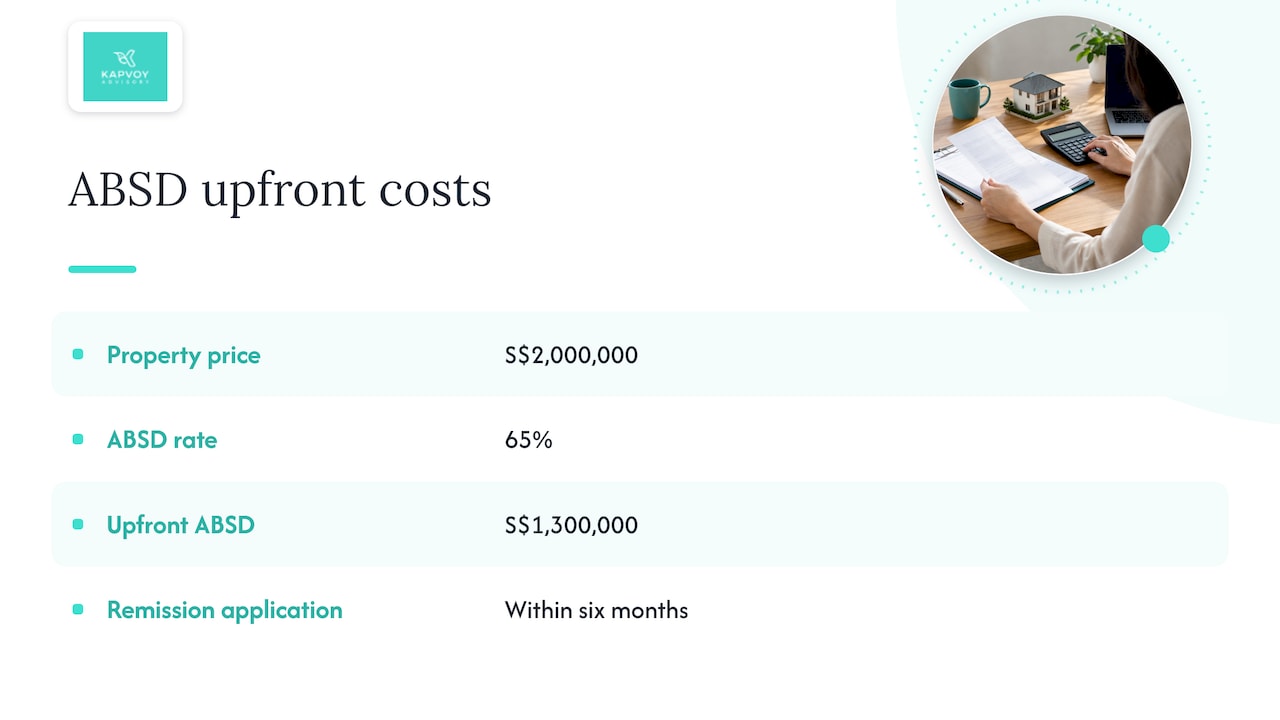
If you are buying residential property into a trust, or transferring it to a trustee, stamp duty is the largest cost to understand. IRAS states that a conveyance, assignment or transfer of residential property to a trustee to hold on trust is subject to ABSD (Trust) of 65%. The rate has applied to trusts since 9 May 2022, and the 65% rate is the one in force for dates on or after 27 April 2023.
IRAS says the 65% must be paid upfront. A remission application can be made within six months of execution if the trust qualifies. The refund is the difference between the amount paid and the rate that matches the highest applicable beneficial-owner profile. The remission is limited to cases where the beneficiaries are identifiable individuals and their beneficial ownership is not revocable, variable or contingent, as IRAS defines it.
A worked example shows why this matters for financing. Take a property priced at S$2,000,000. At 65%, the upfront ABSD (Trust) is S$1,300,000, due before any refund. Even if the trust qualifies for remission later, you need the cash flow to cover the amount in the meantime. The size of this upfront payment affects how much you need to borrow, and how much the lender sees as your own money in the deal.
This section concerns property going into a trust. If the property is already held on trust and you only want to mortgage or refinance it, speak to your lawyer about whether any stamp duty arises on your specific transaction before you proceed.
Steps to get a trust property mortgage ready
1. Confirm the trustees' power in the deed
Read the clauses on borrowing, mortgages and the application of capital. Ask your lawyer for a written opinion that the trustees can mortgage this property. Where it goes wrong: a deed that requires beneficiary consent or is silent on borrowing, discovered after the lender has issued an offer.
2. Define the purpose and the amount
Write down what the money is for: a purchase, a refinance of an existing loan, or an equity cash-out for a trust purpose. Lenders assess each differently. For cash-out limits, see our worked example on mortgage cash-out limits.
3. Show how the loan will be repaid
Banks look at repayment ability. Gather income evidence for whoever services the loan, and the rental or trust income if there is any. Where it goes wrong: income that sits with a beneficiary but is not documented as available to the trustee.
4. Check your total secured debt
List every secured loan linked to the property or the borrowers, because the MAS test counts them together. Missing one causes late-stage declines.
5. Approach lenders as a group, not one by one
Banks and non-bank lenders handle trust titles differently. One lender's no says little about the next lender's answer. Each separate application also takes time and effort, and it is easy to send an incomplete file. This is the step where we do the work for you: KAPVOY matches your profile to lenders from a panel of 30+ banks and non-bank lenders, prepares the application and submits to several lenders at once.
6. Review offers and complete legal steps
Compare rates, tenure, fees and clawback terms. Your lawyer handles the mortgage documents and the trustees sign. Our article on subsidy traps and clawbacks explains the terms to read closely before you sign.
Why a broker route suits trust cases
Trust cases do not fit a standard bank checklist. The borrower is a trustee, the repayment source may sit with someone else, and the deed adds conditions. Each lender reads those facts through its own credit policy.
A broker that compares many lenders gives you more chances for a lender whose policy fits your structure. It also shortens the process: KAPVOY's average approval time is 1-3 days, and applications go to multiple lenders simultaneously instead of one after another. If you have been declined before, the matching step is designed to point your file at lenders more likely to approve.
Our fee is 3-5% of the approved loan amount, paid only on successful funding. There are no upfront costs and no consultation fees. We do not take lender referral arrangements, so the comparison is made for you, not for a lender.
Our view on trust-held property
Most refusals we see described by owners come from a file that does not answer the lender's first questions: who may sign, where the repayment comes from, and what else is secured on the property. These are preparation problems, and preparation is something we can do with you.
We believe the right response to a decline is not to give up on the property or the plan, but to match the structure to a lender whose policy suits it. That is why we compare more than 30 lenders, prepare the application, and submit to several at once. Our fee is earned only when your funding is approved, so our interest is the same as yours: a loan that gets approved.
If your trust is already in place, start with the deed and a short summary of what you need. We will take it from there.
Viknesh
Start with a free eligibility check
If you hold property in a trust, or plan to, and want to know which lenders are likely to consider it, KAPVOY can match your case to our lender panel. We cover private property mortgages, refinancing, equity release and commercial property loans, with no upfront cost.

Tell us about the property, the trust and the amount you need at kapvoy.sg, and a personal broker will contact you. Our fee of 3-5% applies only on successful funding. You can also read more on our property financing options page.
FAQ
Can a trustee refinance an existing mortgage on trust property?
Possibly. The same tests apply as for a new loan: the deed must allow it, the trustees must sign, and the lender must accept the structure. MAS Notice 632 also covers refinancing facilities for residential property, so the bank applies its rules to the new loan. Our guide to private property refinancing covers the general process.
Does the lender have to check why the trustee is borrowing?
Under section 19 of the Trustees Act 1967, a mortgagee who advances money under a mortgage purporting to be made under a trustee power need not check whether the money is needed or how it is applied. Lenders still run their own credit checks on the borrower and the repayment source.
Can I use CPF for a trust property loan?
The CPF Board page on home purchases lists the eligible uses of Ordinary Account savings but does not address trust-held property. Confirm the position for your case with CPF Board before you rely on CPF in your plan.
Is ABSD (Trust) always 65%?
IRAS applies 65% upfront to residential property transferred to a trustee to hold on trust. Trusts that meet the identifiable-individual-beneficiary conditions may apply for remission within six months of execution, and the refund depends on the beneficial owners' profile. Check the IRAS remission page or ask your lawyer about your own trust.
How much does KAPVOY charge?
We charge 3-5% of the approved loan amount, and only when funding is successful. There are no upfront fees, no retainer and no consultation charges.
Sources
- Trustees Act 1967, Singapore Statutes Online
- MAS Notice 632 Residential Property Loans
- MAS Notice 632, Total Credit Facilities Not to Exceed Relevant Amount (revised 21 August 2025)
- CPF Board, Using your CPF to buy a home
- IRAS, Additional Buyer's Stamp Duty (ABSD)
- IRAS, Remission of ABSD (Trust)
- What is trust banking